
Introduction
Judo is a sport that involves high-intensity efforts and requires athletes to wrestle their opponents to the ground [1]. Previous studies have indicated that judo athletes with higher anaerobic power and capacity, muscle power, and judo-specific endurance present a greater chance of success [2–5]. These performance factors can be acutely enhanced through properly planned conditioning activities during warm-ups, a phenomenon termed post-activation performance enhancement (PAPE) [6]. PAPE is a phenomenon where performing a voluntary sub-maximal to maximal muscular contraction results in an acute enhancement of the later exercise [7, 8]. Possible mechanisms for PAPE include phosphorylation of myosin regulatory light chains, increased recruitment of higher-order motor units, and changes in pennation angle [7].
Incorporating conditioning activities that induce PAPE into warm-ups prior to competitive bouts may enhance performance in sports requiring explosive movements (e.g., judo) [8–10]. However, traditional conditioning activities are usually performed with high-intensity (heavy-load) exercise, which potentiates the muscle groups involved, but this effect does not always translate into sport-specific movements [8, 9, 11]. Moreover, high-intensity conditioning activities can produce potentiation or trigger fatigue, depending on the rest interval, which might mask potentiation [11]. Therefore, the rest interval between the conditioning activity and the subsequent activity is vital in producing an optimal PAPE effect. The PAPE-fatigue relationship due to conditioning activities and its effects on subsequent activity are multi-faceted [7]. However, evidence suggests that a longer recovery period may not be necessary for PAPE benefits, and could sometimes lead to unchanged or diminished performance [7, 12]. To date, only a few studies have examined the optimal rest period between conditioning activity and performance, yielding varying and often conflicting findings, particularly among judo athletes [13–15].
Baruah et al. [13] utilised 8 min as a recovery period post three conditions (i.e., judo-specific warm-up, back squats, and ballistic jumps) and reported significant improvement in the special judo fitness test (SJFT) after squat and ballistic jumps as conditioning activities (i.e., improved number of throws in set 2, total number of throws, and SJFT Index) in young male judokas. In contrast, Lum [14] compared the effects of combined upper and lower body versus lower body exercises on high-pull test performance after 5 min of recovery, followed by SJFT 2 min after the high-pull test [14]. Another study by Miarka et al. [15] compared ballistic exercises, squats, and a combination of squats and ballistic exercises and reported improved SJFT performance after 3 min of recovery in adult male judokas. Although previous studies have reported improvements after 3–8 min of recovery after conditioning activities, no studies have directly compared this recovery duration in the same participants.
As previous PAPE studies on judo athletes primarily focused on male participants [13–15], it is imperative to determine whether conditioning activities would induce similar acute effects in young female judokas across different rest intervals. Females exhibit physiological differences compared to males [16], leading to slower heart rate recovery and often greater reliance on oxidative metabolism during high-intensity effort, limiting their continuous force production capacity [17, 18]. Moreover, a previous study has reported sex and age to be moderating factors in inducing PAPE effects, with a significant effect of conditioning activities on squat jump performance among males, but not in females and adolescent participants [19]. Therefore, the primary aim of this study was to determine the optimal recovery period (3 min vs. 8 min) between conditioning activity and subsequent explosive activity (i.e., SJFT) among young female judokas. Based on previous literature, the authors hypothesised that the conditioning activities would induce a PAPE effect on the performance measures during the SJFT compared to a control condition.
Material and methods
Participants
A priori analysis was conducted using the G*Power software (version 3.1.9.7, University of Düsseldorf, Düsseldorf, Germany) to determine the minimum sample size required for the study. The results of the analysis revealed that at least 15 participants would be necessary to achieve statistical significance, considering one group and four measurement points (i.e., 3-min control, 3-min experimental, 8-min control, 8-min experimental), with an alpha error probability of less than 0.05, non-sphericity correction = 1, correlation between repeated measures of 0.7 (an independent analysis of data from the study by Baruah et al. [13] showed a correlation of > 0.7 was found in the SJFT index between the experimental condition), a desired power (1 – error probability) of 0.80, and an effect size (Cohen’s f) of 0.25, indicating a moderate effect based on within-factors repeated measures ANOVA.
A total of 15 female judokas between the 2nd and 6th Kyu who had experience in sub-junior-level and cadet-level national competitions were recruited for the study after their voluntary confirmation. The participants were aged 14.6 ± 1.8 years, had a height of 150.6 ± 5.7 cm, a body mass of 48.7 ± 6.2 kg, a body fat percentage of 23.4 ± 2.8%, and a body mass index of 21.4 ± 1.9 kg/m2. Every participant had a minimum of three years of structured judo training experience. Further, the participants had to be proficient in performing the ippon-seoi-nage technique to be eligible for the study. Additionally, no recent injuries were reported by the participants that could limit their exercise performance. Prior to the commencement of the study, the potential benefits and risks associated with the interventions were explained to the participants, and thereafter each participant provided their written assent. The participants were enrolled in a residential sports academy, and therefore, their legal guardians signed the informed consent forms.
Experimental design
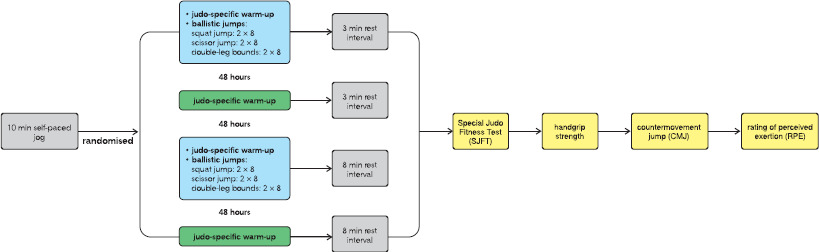
The study employed a randomised crossover design that included four within-group conditions: two experimental conditions involving ballistic jump exercises with rest intervals of 3 min and 8 min, and two control conditions consisting of judo-specific warm-ups with the same rest intervals. This design aimed to compare the effects of different rest intervals following conditioning activities on judo-specific performance outcomes. The randomised crossover design allowed every participant to undergo all conditions, minimising the influence of extraneous factors (such as environmental temperature) and facilitating a thorough comparison of the interventions’ impacts on performance [20]. The testing sessions were carried out at consistent times each day, specifically between 3 p.m. and 5 p.m., to minimise the impact of circadian rhythms and environmental factors. A minimum rest period of 48 h was also allowed between testing sessions to avoid any interference (residual fatigue) from prior interventions [15]. The sequence of the tests (i.e., SJFT, handgrip, countermovement jump [CMJ], and rating of perceived exertion [RPE]), as well as the participants involved in them, was maintained consistently across all conditions (i.e., 3 min experimental, 3 min control, 8 min experimental, 8 min control). Additionally, familiar-isation sessions were conducted over one week prior to the start of final testing sessions, allowing each participant to practice the ballistic jumps that would be performed during the experimental conditions. During this phase, the researchers thoroughly explained each testing procedure and allowed the participants to practice the tests in order to minimise the learning effects. Anthropometric and demographic measurements were also taken at this time. Finally, participants were instructed to maintain their usual dietary habits and to avoid consuming heavy meals at least three hours prior to the testing sessions.
Participants were tested in four conditions: control and experimental, each followed by rest intervals of either 3 or 8 min. After the designated rest period, they performed the SJFT. The peak heart rate recorded during the SJFT protocol was considered the ‘maximum heart rate’. The heart rate was recorded immediately after SJFT and again after 1 min, followed by assessments of handgrip strength, CMJ, and RPE at approximately 3, 5, and 30 min post-SJFT, respectively. The schematic representation of the study design is presented in Figure 1.
Conditioning activity
The participants performed a judo-specific warm-up protocol (control condition) and an experimental protocol incorporating an additional conditioning activity. Both protocols commenced with a 10-min self-paced jog. Thereafter, the judo-specific warm-up was performed that comprised 10 repetitions of ukemi drills (covering front, back, side, and rolling techniques), two sets of 10 repetitions of ‘rapid’ uchikomi drills (throwing practice), two sets of 1-min kumikata (grip fighting), and two sets of 10 repetitions of nagekomi (practice throws) [14]. The experimental protocol included the same judo-specific warm-up with the addition of ballistic jump exercises as a conditioning activity, including squat jumps, scissor jumps, and double-leg bounds, with a 1-min rest between sets. Previous studies have shown these types of ballistic exercises to acutely improve performance in athletes [13, 21].
Special Judo Fitness Test (SJFT)
The SJFT is used to assess judo-specific performance and is considered a reliable test (Cronbach = 0.81 for the SJFT index) [22]. For the current study, the SJFT was conducted in accordance with the stand-ardised protocol established by Sterkowicz [23]. The test required the participation of three athletes with similar body masses. The athlete to be tested was called TORI and was positioned at the centre between two assistants (UKEs), who stood 3 m apart on either side. The test commenced following a 3- or 8-min passive rest period after both the control and experimental protocols. At the assessor’s signal, the TORI alternated between the two UKEs, executing the Ippon-Seoi-Nage throw as rapidly as possible. The test consisted of three phases: an initial 15-second bout, followed by two 30-second bouts, with 10-second rest intervals between the second and third phases. The aim of the test was to maximise (i.e., increase) the number of throws during these intervals that simulated the high-intensity efforts of judo bouts. Data collection involved three researchers, with two recording the number of throws for each UKE, while the third managed the timing. During the test, heart rate was continuously monitored and recorded using a Polar H10 heart rate monitor (Kempele, Finland) that was connected to the Polar Beat application, with measurements taken during the test, immediately post-test, and 1 min after completion. The primary performance measure, the SJFT index, was calculated by summing the immediate post-test and 1-min post-test heart rates and dividing this total by the number of throws executed. A lower SJFT index indicates better performance, reflecting an athlete’s ability to withstand continuous explosive efforts (i.e., throws) while maintaining an efficient cardiovascular response [24].
Handgrip strength
The handgrip strength was measured using a Jamar Handgrip dynamometer (Jamar, Lafayette, CA, USA) [13]. Participants were seated in a predefined position, ensuring the shoulder was abducted, with the elbow flexed at a 90-degree angle, and the forearms and wrists maintained in a neutral position. Each participant performed one maximal effort trial with each hand, with a 1-min rest between trials to minimise fatigue. They were instructed to exert maximum isometric force for approximately five seconds. The highest recorded value for each hand was used for analysis.
Countermovement jump (CMJ)
The CMJ test was administered to measure the lower body power of the participants. They were instructed to maintain an upright posture with their feet shoulder-width apart and hands placed on their hips, maintaining this position throughout the jump without bending their knees. After that, participants were asked to jump as high as possible, ensuring all movements occurred along the sagittal axis and within the frontal plane. A reliable video-based software application (My Jump) was used to measure the jump height, which was installed on an Apple iPhone 14 equipped with a 120 Hz high-speed camera at 720p resolution [25]. To capture the jump accurately, the camera was placed at the lowest possible angle. Each participant performed 1 maximal jump, and the highest jump height was selected for subsequent analysis.
Rating of perceived exertion (RPE)
The RPE of the participants was assessed using the Borg 10-point scale, adapted by Foster et al. [26], which provides a single numerical score in arbitrary units to quantify the internal training load. Participants were instructed on the use of the scale and given time to practice before the commencement of the experiment. Approximately 30 min after completing each warm-up protocol, they rated the overall difficulty of the exercise, and their RPE scores were recorded.
Statistical analysis
The normality of the data was verified using the Shapiro–Wilk test. Data that are normally distributed are shown as mean and standard deviation, whereas non-normally distributed data are presented as median and interquartile range. A 2 (condition: experimental and control) × 2 (recovery duration: 3 min and 8 min) repeated measures analysis of variance (ANOVA) or Friedman test was used to analyse the difference between the different experimental conditions. Upon observing significant differences, a post-hoc analysis was conducted using Bonferroni-corrected multiple t-tests. Partial eta squared ( p2) was used as an effect size (ES) score for repeated measures ANOVA. Further, Hedge’s g (t-test ES) was calculated to assess the magnitude of the difference between conditions. The magnitude of effects for p2 was interpreted as small (< 0.06), moderate (0.06–0.13), and large ( 0.14) [27], while Hedge’s g was interpreted as trivial (< 0.2), small (0.2–0.6), moderate (> 0.6–1.2), or large (> 1.2–2.0) [28]. All statistical analyses were carried out using SPSS version 26.0.0 (IBM, New York, USA), and the significance level was set at 0.05 for all analyses.
Table 1
Statistical analysis results comparing the four conditions
[i] au – arbitrary unit, a significant difference between experimental 3 min and control 8 min, b significant difference between control 3 min and experimental 3 min, c significant difference between experimental 3 min and 8 min, bpm – beats per minute, CMJ – countermovement jump, RPE – rating of perceived exertion, SJFT – special judo fitness test
Results
The means and standard deviations (normally distributed data) or medians and interquartile ranges (non-normally distributed data) for all variables are presented in Table 1. The study found no significant differences in the throw performances, SJFT index, RPE, CMJ height, left handgrip strength, or heart rate post 1 min of SJFT (all p > 0.05). However, the repeated measures ANOVA or Friedman test revealed significant differences for HR (immediate) (F = 5.020; p = 0.005; p2 = 0.264; large ES), HR (maximum) (F = 3.543; p = 0.022; p2 = 0.202; large ES), and right handgrip strength (Q = 10.67; p = 0.014) among four conditions. Post-hoc comparisons showed that the HR (immediate) was significantly higher in the experimental 3-min condition compared to the control 8-min condition (p = 0.018; Hedge’s g = 0.77; moderate ES). Similarly, the HR (maximum) was significantly higher in the experimental 3-min condition compared to the experimental 8-min condition (p = 0.021; Hedge’s g = 0.60; small ES). Furthermore, the right handgrip strength was significantly higher after the experimental 3-min condition compared to the control 3-min condition (p = 0.043; Hedge’s g = 0.45; small ES).
Discussion
The aim of the present study was to examine the effects of different rest intervals (3-min vs. 8-min) on PAPE assessed by the SJFT in young female judokas. The findings revealed no significant differences between conditions for SJFT performance, CMJ height, RPE, or left-hand grip strength. However, maximal HR was significantly higher in the 3-min compared to the 8-min experimental condition, and immediate HR was significantly higher in the 3-min experimental compared to the 8-min control condition. In addition, the right hand’s grip strength was significantly higher after the 3-min experimental condition compared to the 3-min control condition.
The SJFT index for the experimental 3-min (12.7 ± 1.4) and 8-min (12.5 ± 0.7) conditions did not differ meaningfully from their respective control groups (3-min control: 12.9 ± 1.2; 8-min control: 12.4 ± 1.2). The applied conditioning activities with both short and long rest intervals were not sensitive enough to induce PAPE in young female judokas. These findings contrast with studies on male judokas, in which ballistic exercises improved SJFT outcomes. Baruah et al. [13] reported improved throws in set 2 and the SJFT index following an 8-min rest period with the same ballistic exercises applied in our study. Moreover, Miarka et al. [15] and Lum [14] reported significant improvement in set 1 throws after 3-min rest and 7-min rest intervals, respectively, in male judokas. Variation in sex and participant age may account for differences in results between male (i.e., previous studies) and female (i.e., current study) participants [19]. Females have a lower type II muscle fibre composition compared to males,which is responsible for generating the rapid force required during SJFT performance [29]. Of note, the total number of throws performed by the participants of this study (range: 25.9 to 27) closely aligns with the throws performed by the young male judokas in the study by Lum [14] (range: 23.4 to 24.3) and Miarka et al. [15] (range: 23.7 to 24.3). Notably, a meta-analysis by Sterkowicz-Przybycien and Fukuda [30] categorised a total of 26 or more throws during SJFT as excellent for junior female judokas, suggesting that our participants already performed at a high level. This suggests the possibility that the judokas in our cohort may have already reached the ceiling of their performance, and hence, no acute performance enhancement was observed.
Furthermore, the ballistic exercises (scissor jumps, squat jumps, and double-leg bounds [2 × 8 repetitions]) used in our study may have induced cumulative fatigue, offsetting potential PAPE benefits. This aligns with findings in young female handball and basketball players (age: 15.4 ± 0.3), in which repeated drop jumps [double-leg (3 × 10) or one-leg (3 × 5 each leg)] impaired subsequent countermovement jump and sprint performance [31]. The lack of significant improvements in SJFT performance could be due to inter-individual variability and modulating factors (e.g., training status, exercise modality, sex, etc.) [7]. Especially, the SJFT’s design combining anaerobic power, muscular endurance, and cardiovascular recovery may not be sensitive enough to detect minor PAPE-induced improvements in explosive performance. While PAPE is often associated with acute improvements in maximal strength or power output (e.g., vertical jump or sprint performance) [32, 33], the sports-specific repetitive throwing demands of SJFT may place greater emphasis on local muscular endurance rather than explosive power [24, 34]. Furthermore, females often depend more on oxidative metabolism during high-intensity endurance efforts due to physiological differences (e.g., differences in lung size) [16], which limits their ability to generate energy quickly [17, 18]. This might explain the lack of measurable changes in the SJFT index despite the conditioning activity’s potential to prime neuromuscular performance.
Of note, a significantly higher immediate HR was observed in the experimental 3-min condition compared to the control 8-min condition (186 vs. 178 bpm; p = 0.018), while maximum HR was elevated in the experimental 3-min vs. 8-min condition (187 vs. 183 bpm; p = 0.021). These findings suggest that ballistic jumps imposed additional cardiovascular strain, even after 3 min of rest. Ballistic jumps involve rapid stretch-shortening cycle muscle action, which increases sympathetic nervous system activity and catecholamine release, elevating HR [35]. The 3-min rest may have been insufficient for full cardiovascular recovery, leading to residual HR elevation during the SJFT. This aligns with Miarka et al. [15], who reported elevated HR after the 3-min rest of the ballistic exercises (10 × 3 consecutive jumps stepping off from 20 cm to 40 cm and then to 60 cm) compared to a controlled condition in male judokas. Furthermore, females typically exhibit slower HR recovery post-exercise compared to males, attributed to lower stroke volume and higher reliance on parasympathetic reactivation [18]. Thus, the 8-min rest may have allowed better cardiovascular recovery, mitigating HR elevation in the experimental 8-min condition. Additionally, the elevated maximum heart rate may indicate fatigue processes at play following the ballistic exercise conditioning protocol, which could explain the lack of improvement in SJFT performance [6].
An interesting finding of our study was the significantly higher right-hand grip strength following the experimental 3-min condition compared to the control 3-min condition. In contrast, Baruah et al. [13] found that right handgrip strength decreased after squat-based conditioning activity compared to controlled and ballistic conditions. This suggests that the right hand-grip strength does not decrease as a result of the additional ballistic exercises included in the judo-specific warm-up. The ballistic jumps may have led to temporary neural potentiation in the forearm flexors, which enhanced grip strength compared to the control condition. During the control condition, participants likely experienced fatigue due to the repeated use of their forearm muscles during the judo-specific warm-up and the three sets of throws within the SJFT [13]. Additionally, there was no significant difference in left-hand grip strength, likely due to the predominant use of the right arm for throws during the SJFT evaluations. It was observed that most participants chose the right side for the throws, even though they were free to select their preferred throwing side.
This study observed no significant differences in CMJ height across the four conditions. The lack of improvement in CMJ height may indicate that the ballistic exercises implemented did not effectively elicit the specific neuromuscular adaptations necessary for enhancing vertical jump performance. Alternatively, it might suggest that the recovery periods utilised were not optimal for inducing measurable changes in CMJ performance [6, 7]. The analysis of the RPE showed no significant differences between the control and experimental conditions across both rest intervals. This indicates that participants experienced similar levels of perceived exertion, regardless of the intervention. These findings suggest that the inclusion of additional conditioning activities did not impose greater psychophysiological stress. These results are consistent with prior research, which has demonstrated that such conditioning exercises can be effectively utilised to induce PAPE without elevating perceived effort [13].
Lastly, this is the first study that investigated the effects of ballistic exercises as conditioning activities to induce PAPE in young female judokas. Although the current study provides novel findings for the female judoka population, it has some limitations that should be acknowledged and considered in future studies. First, the current study’s participants were young female judokas participating in national-level competitions, and thus, these findings should not be extrapolated to adult females participating at different competitive levels. Additionally, despite the a priori sample size calculation, the small sample size (n = 15) may limit the generalisability of the findings. Second, while the validated My Jump app [25] was used to measure CMJ height, the lack of a gold-standard force platform limited the ability to collect jump kinetics data, which could have provided more comprehensive and reliable insights into neuromuscular performance. Third, PAPE responses may be moderated by factors such as exercise type, loading, and recovery intervals [7]. In this study, only 1 min of rest was provided between sets during the ballistic jump conditioning activity, which may have influenced the outcomes. Future research should explore the effects of varying inter-set recovery periods (e.g., > 1 min). Fourth, no data on menstrual cycle function were recorded. Since female hormonal modulation may influence the response to exercise [36, 37], future studies should analyse whether the PAPE response is affected by hormonal fluctuations. Fifth, the absence of direct neuromuscular measures (e.g., electromyography or force-plate kinetics) weakens the mechanistic claims. Lastly, this study focused solely on acute performance effects instead of the long-term influence of repeated conditioning activities. While the results provide insights into immediate performance changes, the chronic effects of incorporating these exercises into structured training programs remain unclear.
Conclusions
Our findings suggest that different rest intervals (3 min vs. 8 min) did not produce significant improvements in SJFT performance, suggesting a limited PAPE effect in young female judokas. However, the 3-min rest interval led to significantly higher immediate and maximum heart rates, indicating increased cardiovascular strain. Additionally, right-hand grip strength was significantly higher in the 3-min experimental condition, suggesting a potential neuromuscular activation effect. Coaches should recognise that PAPE protocols that are effective for males might not translate to females, and therefore, an individualised strategy may be suitable based on the preference of the coach or athlete (considering the inclusion of ballistic exercises, as a conditioning activity did not negatively affect performance). Future research should explore longer rest intervals, combined upper- and lower-body exercises, and chronic adaptations to better understand PAPE in female athletes. This study underscores the need for individualised warm-up protocols to enhance judo-specific performance in young female judokas.