Introduction
Insufficient physical activity among children and adolescents remains a major public health concern worldwide. Despite clear and consistent recommendations advocating at least 60 min of moderate-to-vigorous physical activity daily, a substantial proportion of young people fail to meet these guidelines [1]. This issue remains highly relevant from both public health and practical perspectives, as high-intensity interval training continues to be widely endorsed as a time-efficient and adaptable exercise format in health and fitness settings worldwide [2]. Low levels of physical activity during adolescence are associated with unfavourable cardiometabolic profiles, including increased adiposity, elevated systolic and diastolic blood pressure, and reduced cardiorespiratory fitness, which may track into adulthood and contribute to long-term health risks [3, 4]. Thus, blood pressure should be considered an important early health indicator in adolescence. Consequently, identifying effective, scalable, and equitable strategies to promote physical activity and improve health outcomes in youth represents a priority for public health systems.
Schools are a key setting for population-level health promotion, given their reach, structured environment,and ability to engage children and adolescents regardless of background [5]. Physical education (PE) lessons, in particular, provide a unique opportunity to deliver structured physical activity interventions within the regular school curriculum. However, traditional PE lessons often fail to elicit sufficient amounts of moderate-to-vigorous physical activity to meaningfully influence health-related outcomes [6, 7]. Recent evidence further indicates that insufficient physical activity, excessive screen time, and inadequate sleep are strongly associated with overweight and obesity risk in school-aged children and adolescents, underlining the health relevance of movement-based interventions in this population [8]. Time constraints, curricular demands, and variability in lesson content have prompted growing interest in alternative pedagogical approaches that maximise physiological stimulus within limited time.
In this context, high-intensity interval training (HIIT) and high-intensity plyometric training (HIPT) have emerged as promising, time-efficient strategies that can be feasibly implemented during PE lessons. These approaches are characterised by short bouts of vigorous activity interspersed with brief recovery periods and have demonstrated favourable effects on body composition, blood pressure, and cardiorespiratory fitness in children and adolescents [9–11]. Importantly, school-based HIIT and HIPT interventions can be delivered with minimal equipment and adapted to large groups, enhancing their potential for real-world implementation. This practical value is supported by recent school-based evidence showing that multi-level physical activity interventions can improve physical activity participation and reduce obesity-related indicators in youth [12]. Nevertheless, evidence regarding their effectiveness remains heterogeneous, with reported effect sizes varying substantially across studies and outcomes [13].
This heterogeneity may partly reflect individual differences in responsiveness to exercise interventions. Socioeconomic status (SES) is a well-established determinant of health behaviours and outcomes, including physical activity participation, fitness, and cardio-metabolic risk in youth [14, 15]. Adolescents from lower socioeconomic backgrounds are, on average, less physically active and exhibit poorer health indicators compared with their more affluent peers, although findings are not entirely consistent across countries and measurement approaches [16, 17].
Beyond socioeconomic factors, baseline levels of physical activity may also influence responsiveness to exercise interventions. More active adolescents may exhibit attenuated gains due to ceiling effects, whereas less active individuals might demonstrate greater relative improvements – or, conversely, may struggle to tolerate high-intensity protocols [18, 19]. Despite the relevance of these considerations, few school-based intervention studies have explicitly examined whether SES and baseline physical activity moderate the effects of HIIT or HIPT delivered during PE lessons.
Importantly, from an equity-oriented public health perspective, there is a growing concern that well-intentioned health promotion interventions may inadvertently reinforce existing inequalities if their benefits are greater among adolescents with higher socioeconomic resources or higher initial activity levels [20].
To date, few studies have examined whether socioeconomic status and baseline leisure-time physical activity moderate the effects of different forms of interval-based training implemented within regular PE lessons. Therefore, the aim of the present study was to investigate whether socioeconomic status and baseline leisure-time physical activity moderate the effects of school-based interval training interventions delivered during physical education lessons. Specifically, using data from two independent school settings, we examined: (1) the effects of HIIT and HIPT interventions on selected health-related outcomes compared with school-specific control groups, and (2) whether these effects differ as a function of socioeconomic status or baseline physical activity.
Material and methods
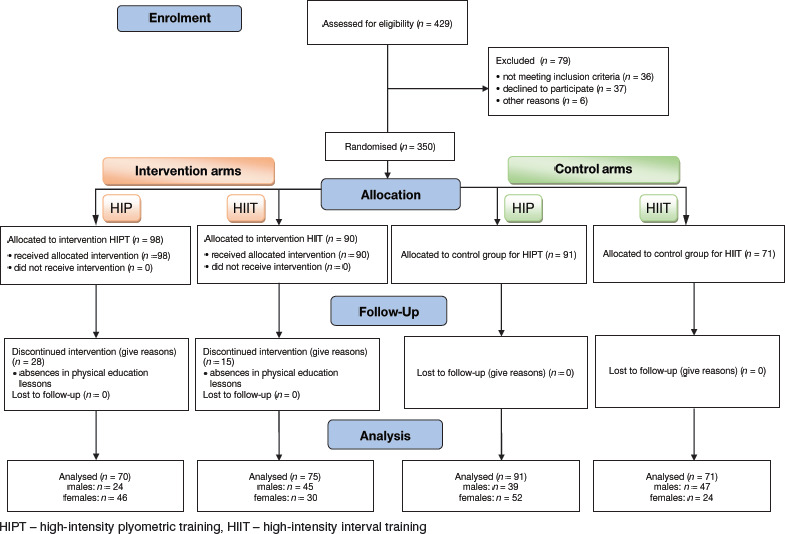
This manuscript presents an independent analysis based on data derived from the PEER-HEART project. To ensure that the present report is self-contained, all methodological procedures relevant to the current research question are described below. A study flow chart illustrating participant recruitment, allocation, follow-up, and final inclusion in the present analyses is provided in Figure 1 [21].
Participants
Sample size estimation was performed using the G*Power software (version 3.1), assuming a multivariate analysis of variance (MANOVA) framework with eight groups (two schools, experimental and control groups, boys and girls analysed separately) and three repeated measurements (baseline, post-intervention, and follow-up). With an assumed effect size of 0.20, a significance level of 0.05, and a desired statistical power of 0.95, the minimum required sample size was calculated to be 310 participants.
Participants were recruited from two secondary schools, each implementing a different form of high- intensity training: a plyometric-based high-intensity plyometric training program (HIPT) and a modified Tabata-based high-intensity interval training protocol (HIIT). Each school also included a control group following the standard physical education curriculum. Initially, 429 students from thirteen classes in each school were allocated to the project. Group allocation was conducted using simple, non-replacement randomisation via an online randomisation tool (www.randomization.com; accessed on 08 January 2024). Classes within each school were numbered from 1 to 13, and all students were enrolled at the same educational level and followed an identical PE syllabus.
Eligibility criteria required participants to be first-year high school students who regularly attended compulsory physical education classes. Additional inclusion criteria included the absence of medical conditions or contraindications (e.g., cardiovascular, respiratory, or musculoskeletal disorders) that could limit participation in high-intensity exercise, no involvement in structured high-intensity training programs outside the school curriculum, and provision of written informed consent by both the participant and a parent or legal guardian in the case of minors.
Prior to group allocation, 79 students were excluded due to refusal to participate, medical contraindications, or engagement in organised sports training during the preceding six months. During the intervention period, an additional 43 participants were excluded because their attendance rate in PE classes fell below 80%. The participant selection and retention process is summarised in Figure 1. No adverse events related to the intervention were reported. Ultimately, data from 307 adolescents were included in the final analyses. Participation was voluntary, and students were informed of their right to withdraw from the study at any time without consequences. Written informed consent was obtained from school principals, parents or guardians, and all participants prior to study commencement.
Anthropometric assessment
Measurement procedures
Anthropometric and morphological assessments were conducted at three time points: before the start of the intervention, immediately after its completion, and following an eight-week follow-up period. All measurements were performed on a single testing day between 8:00 a.m. and 1:00 p.m. in school sports halls under standardised conditions. Participants wore sports clothing (T-shirts, shorts, and athletic shoes), although anthropometric measurements were collected barefoot.
Body height and body composition were assessed first. Blood pressure measurements and the multistage fitness test were conducted on a separate day. All participants, as well as their parents and PE teachers, were informed in advance about the testing procedures and measurement protocols. Identical procedures were applied on each measurement occasion.
Body morphology
Stature was measured to the nearest 0.1 cm using a calibrated anthropometer (GPM Anthropological Instruments, DKSH Ltd., Switzerland), with participants standing barefoot in an upright position according to the guidelines of the International Society for the Advancement of Kinanthropometry (ISAK) [22]. Body mass and body fat percentage were assessed using a bioelectrical impedance analyser (Tanita Inner Scan V, model BC-601; Tanita Co., Tokyo, Japan), a method previously shown to demonstrate acceptable reliability in adolescent populations [23].
Prior to testing, participants were instructed to empty their bladder, refrain from excessive fluid intake, and maintain their usual breakfast habits. Measurements were conducted at least three hours after the last meal. During the assessment, participants stood barefoot on the analyser platform with heels positioned on the rear electrodes, legs extended, arms slightly abducted, elbows straight, and fingers in contact with the hand electrodes. Body mass index (BMI) was calculated as body mass divided by body height squared (kg/m2).
Blood pressure assessment
Resting blood pressure was measured using an automated oscillometric device (Omron BP710, Omron Healthcare Inc., Hoffman Estates, IL, USA), following standardised procedures [24]. Appropriate cuff sizes were selected based on individual arm circumference. Participants remained seated in a quiet position for 10 min prior to the measurement. Three readings were obtained at 10-minute intervals, and the mean of the three measurements was used for statistical analyses. Blood pressure was assessed at baseline, post-intervention, and during the follow-up period.
Multistage fitness test
Cardiorespiratory fitness was evaluated using the multistage fitness test (MSFT), with heart rate continuously monitored using Polar Verity Sense sensors (Polar Electro, Kempele, Finland). The test required participants to run back and forth between two lines set 20 m apart, synchronised with audio signals. The initial running speed was set at 8.5 km/h and increased by 0.5 km/h every minute. The test was terminated when participants were unable to maintain the required pace.
Maximal oxygen uptake (VO2max) was estimated using the equation proposed by Ramsbottom et al. [25]:
VO2max = 3.46 × [L + SN / (L × 0.4325 + 7.0048)] + 12.2,
where L represents the final completed level and SN denotes the number of completed shuttles at that level.
Intervention protocols
The HIIT intervention, based on a modified Tabata protocol, was implemented twice weekly during regular PE lessons over an eight-week period, with progressive increases in training volume. Exercise intensity was monitored using Polar Verity Sense heart rate sensors, and target intensity was prescribed relative to individual maximal heart rate values derived from the MSFT. In all remaining PE lessons, students followed the standard first-year PE curriculum focused on general motor skill development across various sports disciplines. Heart rate monitoring was also used during intervention sessions to ensure that exercise intensity reached approximately 75% of maximal heart rate.
Each intervention session began with a standardised 10-minute warm-up. The HIIT structure initially consisted of four cycles of 20 s of maximal effort followed by 10 s of passive recovery during the first two weeks. This was increased to six cycles during weeks three and four, and to eight cycles during the final four weeks of the intervention.
The exercises included in both intervention variants were selected because they are feasible to implement in standard school-based PE conditions, require little or no specialised equipment, and can be performed safely in large groups within a limited timeframe. Importantly, they involve large muscle groups and whole-body movement patterns, which makes them relevant for influencing key health-related outcomes such as body fat percentage, blood pressure, and cardiorespiratory fitness. In addition, the predominance of multi-joint movement tasks was intended to increase the overall physiological demand during the short intervention bouts. This rationale is supported by evidence showing that multi-joint exercises, particularly those involving the lower body, elicit greater trunk and abdominal wall involvement than more isolated exercise forms, which may contribute to a stronger systemic training stimulus [26].
Both intervention variants were delivered twice weekly within regular PE lessons for 8 weeks and followed the same general session structure: a 10-minute standardised warm-up, the interval-based intervention block, and then the usual PE content. The work interval lasted 20 s and the recovery interval 10 s throughout the intervention, while the number of work-rest cycles progressed from 4 cycles in weeks 1–2, to 6 cycles in weeks 3–4, and to 8 cycles in weeks 5–8. Accordingly, the network duration progressed from 80 s to 120 s and finally to 160 s per session, with the total interval block duration progressing from 2 to 3 and 4 min, respectively.
The HIIT protocol consisted primarily of general whole-body calisthenic exercises, including squats, modified burpees without jumping, lunges, shoulder taps, lateral squats, push-ups, standing abdominal rotations, and sit-ups. In contrast, the HIPT protocol emphasised dynamic and plyometric actions, including ankle hops, burpees, high knees, shoulder tap-clap combinations, butt kicks, mountain climbers, squat jumps, and alternating-leg movement variations.
Because the intervention was designed as a time-based school PE protocol performed in an all-out manner, the exact number of repetitions completed within each 20-s bout was not fixed in advance and varied between participants and sessions. For the same reason, time under tension was not standardised at the individual repetition level. Instead, the external structure of the session was standardised by fixed work and recovery durations, predefined progression of the number of cycles, uniform teacher supervision, and identical timing conditions. Students were instructed to perform as many technically correct repetitions as possible during each work interval while maintaining maximal effort.
All intervention sessions were directly supervised by trained instructors. Participants received continuous verbal encouragement and real-time feedback during both work and recovery intervals, and the timing was clearly visible throughout each session. Exercises were performed with maximal voluntary effort, with students encouraged to complete as many repetitions as possible during each work interval. Following the intervention segment, the PE lessons continued with standard activities aimed at developing a broad range of motor skills, including team sports and individual disciplines. Control group lessons followed an identical structure, excluding the high-intensity intervention component.
Socioeconomic status – Family Affluence Scale (FAS)
Socioeconomic status at the individual level was assessed using the Family Affluence Scale III, administered electronically via Google Forms. The FAS III is a validated proxy measure of family socioeconomic position in adolescent populations, based on an asset-oriented approach rather than traditional indicators such as parental income or residential area [27]. This method captures material living conditions that are more reliably reported by adolescents.
The questionnaire consists of six items reflecting household material resources, including ownership of cars, availability of computers or tablets, presence of a dishwasher, number of bathrooms, having one’s own bedroom, and frequency of family holidays. Responses are summed to create a composite score ranging from 0 to 13, with higher values indicating greater family affluence. The Polish version of the FAS III was used in this study [28]. The reliability of the scale, assessed using Cronbach’s alpha, is 0.643, and the skewness coefficient is –0.412.
Specifically, the FAS III includes the following items: 1. having one’s own bedroom (0–1 point), 2. number of cars in the household (0–2 points), 3. number of computers/laptops/tablets (0–2 points), 4. ownership of a dishwasher (0–1 point), 5. number of bathrooms (0–2 points), and 6. number of family holidays taken in the past year (0–3 points).
In addition to being treated as a continuous indicator of material affluence, the total FAS III score can be categorised into three socioeconomic levels to facilitate interpretation: low affluence (0–7 points), medium affluence (8–11 points), and high affluence (12–13 points).
Physical activity – International Physical Activity Questionnaire (IPAQ)
Physical activity was evaluated using the Polish version of the International Physical Activity Questionnaire – Short Form (IPAQ-SF) [29], which was completed online via Google Forms. The instrument consists of 11 questions assessing physical activity across four domains: work- or study-related activity, transportation, household and gardening activities, and leisure-time physical activity, as well as one item related to sitting time. Participant responses were transformed into metabolic equivalent task minutes per week (METmin/week), from which it was possible to calculate the total physical activity, activity within specific domains, and sedentary time. In this study, physical activity measures were primarily applied to confirm comparable activity levels among participants, thereby supporting sample homogeneity and reducing potential confounding associated with differences in habitual training load.
Missing data handling
Missing data were present in questionnaire-based variables only. For socioeconomic status (FAS), missing values were observed in 16 participants (male experimental = 5, male control = 2, female experimental = 5, female control = 4). For leisure-time physical activity (IPAQ), missing data were identified in 25 participants (male experimental = 1, male control = 9, female experimental = 0, female control = 15).
Missing data were handled using multiple imputation by chained equations (MICE). The missingness mechanism was evaluated using Little’s MCAR test in combination with visual inspection of missing data patterns. These analyses supported the assumption that data were missing at random (MAR). Twenty imputed datasets were generated, with all variables included in the main analyses entered as predictors in the imputation models. Parameter estimates were pooled across imputations according to Rubin’s rules.
To assess the robustness of the findings, the results obtained from the imputed datasets were compared with complete-case analyses, yielding consistent conclusions.
Statistical analysis
All analyses followed a predefined statistical work-flow. Model assumptions were checked using standard diagnostic procedures. Linearity was assessed with residual plots, normality with Q–Q plots and the Shapiro–Wilk test, and homoscedasticity with residual plots and the Breusch–Pagan test. Multicollinearity was evaluated using variance inflation factors (VIF). When heteroscedasticity was detected, robust (HC3) standard errors were applied.
Descriptive statistics are reported as means, standard deviations (SD), and 95% confidence intervals (95% CI).
Assessment of clustering
To determine whether multilevel modelling was required, clustering at the class level was evaluated using intraclass correlation coefficients (ICC). ICCs were calculated from unconditional random-intercept models.
As ICC values were close to zero for all outcomes, indicating negligible between-class variance, single-level models were used in all subsequent analyses.
Relationship between SES and physical activity
The relationship between socioeconomic status (SES; Family Affluence Scale) and physical activity (PA) was examined in two steps. First, violin plots were used to visualise the distribution of PA across SES categories (low, medium, high).
Second, regression models were applied with PA as the dependent variable and SES as the predictor, allowing a formal comparison between groups.
Main analyses: moderation framework
The effects of the interventions and the moderating role of SES and baseline physical activity were tested using ANCOVA within a general linear model framework. An ANCOVA approach was selected instead of a change-score analysis, as it provides better control for baseline differences and reduces bias related to regression to the mean.
Post-intervention values were treated as dependent variables, with baseline values included as covariates. Intervention group (intervention vs. control) was included as a fixed factor, while SES and baseline PA were entered as continuous predictors. Sex was included as a covariate.
Because intervention type was confounded with school, all analyses were conducted separately for each school.
Moderation was tested using interaction terms between intervention and SES, and between intervention and baseline PA. Significant interactions were interpreted as evidence of moderation.
The models were specified as follows:
School 1 (HIIT vs control):
Ypost = β0 + β1 (HIIT vs CON) + β2SES + β3PApre + + β4 (HIIT × SES) + β5 (HIIT × PApre + β6Ypre ++ β7sex +ε
School 2 (HIPT vs control):
Ypost = β0 + β1 (HIFT vs CON) + β2SES + β3PApre + + β4 (HIFT × SES) + β5 (HIFT × PApre + β6Ypre ++ β7sex + ε
Moderation effects were tested by including interaction terms between the intervention condition and SES, as well as between the intervention condition and baseline PA. Significant interaction effects were interpreted as evidence of moderation, indicating differential intervention effects across levels of SES or baseline physical activity. Sex was included as a covariate in all models. All analyses were conducted separately for each school due to the confounding of school and intervention type.
Statistical significance was set at p < 0.05. All analyses were conducted in Statistica 14.0 (TIBCO Software Inc., Palo Alto, CA, USA) and RStudio (2025.09).
Results
Diagnostic evaluation across all regression models (fat percentage, SBP, DBP, and VO2max) indicated no substantial violations of linear model assumptions. Residual plots revealed no systematic patterns, Q–Q plots suggested approximate normality with only minor deviations in the tails, and scale-location plots indicated at most mild heteroscedasticity. No influential observations exceeding Cook’s distance thresholds were identified.
Descriptive characteristics of outcome variables are presented in Table 1. The present study extends these descriptions by including socioeconomic status and leisure-time physical activity. For a concise overview of the data, a table of descriptive statistics for the outcomes of interest is provided, together with a summary of the results of group comparisons.
Table 1
Descriptive statistics of the basic anthropometric measurements in pre-intervention, post-intervention, and follow-up per variant, sex, and group [21]
Previous analyses in this cohort demonstrated that temporal changes in body fat percentage, systolic and diastolic blood pressure, and cardiorespiratory fitness were influenced by the intervention context and group assignment. A significant higher-order interaction involving time, intervention variant, and group confirmed that changes in BF%, SBP, DBP, and VO2max depended on the intervention setting (multivariate test: F = 2.20, p = 0.027, 2p = 0.057). Univariate analyses revealed significant time-related and intervention-related effects for BF%, SBP, and DBP, with the strongest changes observed in the interval-based training groups. Significant effects were found for BF% (time: p = 0.023; intervention: p < 0.001), SBP (time: p < 0.001; intervention: p = 0.003), and DBP (time: p = 0.033; intervention: p = 0.026). In contrast, changes in VO2max were char-acterised by a significant interaction between time, sex, and group (p = 0.001), indicating that improvements in cardiorespiratory fitness were not attributable to the specific training variant.
Despite these statistically significant effects, the effect sizes were small across outcomes (η2p ranging from 0.001 to 0.057), and post-intervention comparisons did not reveal significant differences between the experimental and control groups, nor between the interval training variants, indicating broadly comparable health responses across conditions.
Table 2 presents descriptive statistics for socioeconomic status assessed using the Family Affluence Scale (FAS) and physical activity level measured by the International Physical Activity Questionnaire (IPAQ), stratified by sex and study group. Group differences were further examined using one-way analysis of variance (ANOVA) for continuous variables and chi-square tests for categorical FAS distributions.
Table 2
Socioeconomic status (FAS) and physical activity level (IPAQ) by sex and study group
The experimental group demonstrated a significantly higher socioeconomic status compared with the control group, as indicated by higher FAS scores [ANOVA: F(1,305) = 11.64, p = 0.0007]. In contrast, no significant differences were observed between groups in physical activity level assessed by IPAQ [F(1,305) = 1.38, p = 0.244].
Table 3 presents the distribution of socioeconomic status categories assessed using the Family Affluence Scale (FAS) across sex and study groups. Data are expressed as absolute numbers and percentages within groups. Differences in FAS category distributions between experimental and control groups were evaluated separately for males and females using chi-square tests. Among males, the distribution of FAS categories differed significantly between the experimental and control groups ( 2 = 7.72, p = 0.021), with a higher proportion of participants classified in the high FAS category and a lower proportion in the low FAS category in the experimental group. In contrast, no significant differences in FAS category distribution were observed between groups among females (χ2 = 2.98, p = 0.225).
Table 3
Distribution of Family Affluence Scale (FAS) categories by sex and study group
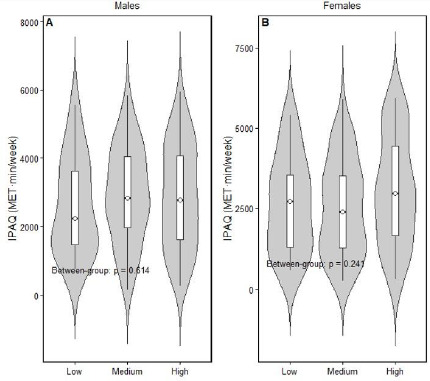
Physical activity levels demonstrated broadly similar distributions across socioeconomic status categories in both males and females. Although the median IPAQ values tended to be slightly higher in the medium and high FAS categories compared with the low FAS category, these differences did not reach statistical significance in either males (p = 0.614) or females (p = 0.241). The violin plots further indicate substantial within-category variability in physical activity levels, suggesting that socioeconomic status alone does not strongly differentiate habitual physical activity in this cohort (Figure 2).
Figure 2
Violin plots illustrating the distribution of physical activity levels assessed by the International Physical Activity Questionnaire (IPAQ) across Family Affluence Scale (FAS) categories (low, medium, high), shown separately for males (A) and females (B).The shaded area represents the kernel density of the data, white boxes indicate the interquartile range, and white dots denote median values. Between-group p-values refer to Kruskal–Wallis tests comparing IPAQ distributions across FAS categories.
Intervention effects and moderation analysis
The intervention and moderation effects are presented in Tables 4 and 5.
Table 4
Moderation analysis of the HIIT intervention effects in School 1
[i] EX – experimental group, CON – control group, SES – socioeconomic status, PA – physical activity Linear regression models were adjusted for baseline outcome values and sex. Socioeconomic status (SES) and baseline physical activity (PA) were included as moderators via interaction terms with the intervention group. SES and PA variables were mean-centred prior to analysis. Bold values indicate statistically significant (p < 0.05).
Table 5
Moderation analysis of the HIPT intervention effects in School 2
[i] EX – experimental group, CON – control group, SES – socioeconomic status, PA – physical activity Linear regression models were adjusted for baseline outcome values and sex. Socioeconomic status (SES) and baseline physical activity (PA) were included as moderators via interaction terms with the intervention group. SES and PA variables were mean-centred prior to analysis. Bold values indicate statistically significant (p < 0.05).
HIIT – School 1
In School 1 (HIIT), the intervention was associated with a significant reduction in fat percentage and systolic blood pressure, as well as a significant increase in VO2max, compared with the control group (all p < 0.01). No significant intervention effect was observed for diastolic blood pressure.
Neither socioeconomic status nor baseline physical activity significantly moderated the effects of the HIIT intervention for any outcome, as indicated by the non-significant interaction terms (group × SES and group × PA, all p > 0.10). Baseline values of the respective outcomes were the strongest predictors of post-intervention results across all models (p < 0.001). Sex was also associated with fat percentage, systolic blood pressure, and VO2max.
HIPT – School 2
In School 2 (HIPT), the intervention was associated with significant reductions in both systolic blood pressure and fat percentage compared with the control group (both p < 0.001). No statistically significant intervention effects were observed for diastolic blood pressure or VO2max.
Socioeconomic status and baseline physical activity did not significantly moderate the effects of the HIPT intervention for any outcome, as indicated by the non-significant group × SES and group × PA interaction terms (all p > 0.05). Baseline values of the respective outcomes were the strongest predictors of post-intervention measures across all models (p < 0.001).
Across both schools, the interventions demonstrated consistent effects that were not moderated by socioeconomic status or baseline physical activity; however, the magnitude and scope of intervention effects differed, with broader and stronger effects observed in School 1 (HIIT) compared with School 2 (HIPT).
Discussion
The main aim of this study was to examine whether socioeconomic status and baseline leisure-time physical activity shape adolescents’ responsiveness to interval training interventions delivered during physical education lessons. The findings showed that across both schools, the effects of the interventions were not moderated by socioeconomic status or baseline physical activity, indicating comparable effectiveness across socioeconomic strata and initial activity levels.
The observed reductions in body fat percentage and systolic blood pressure, as well as improvements in cardiorespiratory fitness following the HIIT intervention, align with recent systematic reviews and meta-analyses of school-based high-intensity programs [30, 31]. Evidence published over the past decade suggests that HIIT implemented in school settings can elicit modest but meaningful improvements in adiposity, blood pressure, and aerobic capacity, even when the intervention duration is relatively short [30, 31]. In particular, gains in cardiorespiratory fitness are among the most consistently reported outcomes, which is noteworthy given the strong association between adolescent fitness and long-term cardiovascular health. This interpretation is also consistent with recent evidence indicating that school-level conditions and lifestyle-related behaviours substantially shape health status in youth. For example, school sport facility characteristics and physical education-related school factors have been associated with body weight status in children and adolescents, highlighting the importance of the school environment for health promotion [32].
In contrast, the HIPT-based intervention in the present study primarily influenced body fat percentage and systolic blood pressure, without producing any statistically significant effects on cardiorespiratory fitness. This finding is in line with recent work suggesting that functional, whole-body exercise formats can be effective for improving metabolic health markers but may provide a less specific stimulus for aerobic adaptations compared with running- or shuttle-based HIIT protocols [33, 34]. Importantly, the present study was not designed to directly compare HIIT and HIPT as the interventions were implemented in different schools; therefore, differences in effect profiles should be interpreted cautiously and attributed to contextual and programmatic characteristics rather than any inherent superiority of one approach.
From a blood pressure perspective, the exercise characteristics of the two interventions also merit consideration. The HIIT protocol was based mainly on general calisthenic exercises such as squats, lunges, push-ups, and modified burpees, whereas the HIPT protocol included more dynamic and plyometric whole-body tasks such as ankle hops, squat jumps, high knees, and mountain climbers. Although both approaches used short work intervals and involved large muscle groups, they likely differed in the relative contribution of cyclic metabolic demand, muscular tension, and stretch-shortening activity. These differences may partly explain why both interventions reduced systolic blood pressure, whereas only HIIT was accompanied by a clear improvement in cardiorespiratory fitness. This interpretation is consistent with evidence indicating that blood pressure responses are influenced by exercise type, the amount of active muscle mass, and the training configuration. Jurik et al. [35] showed that lower-body resistance exercise involving larger muscle mass induces greater acute systolic blood pressure elevations than upper-body exercise, whereas diastolic blood pressure may respond differently depending on exercise structure and pairing method. Although that study examined acute responses in adults during resistance training rather than chronic school-based interventions in adolescents, it supports the broader concept that blood pressure regulation is sensitive to the mechanical and metabolic characteristics of the applied exercise mode. In the present study, the repeated exposure to short bouts of vigorous, large-muscle-group exercise during the PE lessons may therefore represent a plausible mechanism underlying the observed reductions in systolic blood pressure.
A central contribution of this study is the finding that SES did not moderate intervention effects. Socioeconomic inequalities in physical activity, fitness, and cardiometabolic health are well documented, with adolescents from lower-affluence families often exhibiting less favourable health profiles [15, 16]. From a public health standpoint, there is increasing concern that school-based health promotion programs may inadvertently benefit more advantaged students to a greater extent, thereby widening existing disparities [20].
The absence of SES-related moderation in the present study suggests that high-intensity PE interventions may avoid this unintended consequence. Similar conclusions have been reported in recent school-based trials showing that structured physical activity programs can yield comparable benefits across socioeconomic groups when delivered universally within the school curriculum [36, 37]. By embedding the intervention within compulsory PE lessons and minimising the reliance on external resources or extracurricular participation, the present approach likely reduced structural barriers that disproportionately affect students from lower socioeconomic backgrounds.
More broadly, recent studies have shown that health-related behaviours linked to the school and family environment, including sleep and dietary habits, are strongly associated with overweight and obesity risk in school-aged youth [38]. This broader context supports the view that school-based physical activity interventions should be interpreted as one important component of a wider health promotion framework.
Contrary to assumptions that baseline physical activity may influence training responsiveness, the present findings indicate that the initial activity level did not modify the intervention effects. This observation is consistent with recent studies reporting weak or inconsistent associations between habitual physical activity and responsiveness to structured exercise interventions in youth [18]. From a public health perspective, this suggests that high-intensity PE interventions may benefit both less active and more active adolescents, without clear ceiling or floor effects. Notably, baseline values of the respective outcomes were the strongest predictors of post-intervention results. This finding aligns with contemporary discussions on regression to the mean and individual variability in exercise response, emphasising the importance of accounting for baseline status when interpreting intervention effects [39, 40].
Conclusions
The present study demonstrates that the effects of school-based high-intensity interventions on body fat, blood pressure, and cardiorespiratory fitness are not contingent upon socioeconomic status or baseline physical activity. The lack of both distributional differences in physical activity across SES categories and moderation effects in regression models indicates that these interventions are equally effective across socioeconomic strata. This robustness enhances the public health relevance of high-intensity physical education programs, particularly in heterogeneous school settings.