Introduction
Sport-specific biomechanical analysis plays a fundamental role in enhancing athletic performance, reducing injury risk, and optimising rehabilitation protocols [1]. The lower extremity muscles are involved in endurance and explosive movements. The triceps surae muscles, also known as the calf muscles, are the primary ankle plantar flexors and are strong contributors to weight-bearing and sporting activities, such as rapid acceleration and deceleration, cutting, sprinting, jumping, and running [2, 3]. Therefore, it is understandable that athletes across various sports are susceptible to triceps surae muscle-tendon unit injuries. These sports include soccer, basketball, volleyball, and running [4]. In tennis, the mechanisms inciting calf muscle strains include sprinting to a ball, while in runners, these injuries are witnessed during high-speed interval training, high-speed tempo runs, racing, and overtraining periods [5]. In field sports with larger playing areas, calf strains are associated with longer sprint distances, whereas court sports involve shorter sprint distances and repeated vertical jumps and landings, resulting in greater loading and stiffness demands on the lower limbs [6]. When these demands exceed an individual’s neuromuscular and muscle–tendon capacity, the risk of calf muscle strain may increase [7]. The high occur-rence and recurrence rate of calf muscle injuries and their prolonged return to sports time can decrease sports performance and athletes’ availability to compete.
During running, the calf muscles exert substantial forces, achieving approximately 11 times body weight during steady-state running and up to 16 times body weight during acceleration [8]. The largest positive joint work generated during acceleration is also at the ankle [9]. Given the role of the triceps surae muscles across weight-bearing and athletic movements, they are significant contributors to sports performance, affecting key indicators of performance, including running speed and jumping height [8]. Acceleration and deceleration are also key components of basketball, primarily occurring in vertical movements. Unlike tennis and running, basketball involves more repetitive vertical jumps that require high calf muscle endurance to accelerate during the anti-gravity phase [10]. In addition, the deceleration to landing demands high endurance capacity to ensure a safe landing [11].
The unilateral calf-raise test (CRT) is extensively used in both research and clinical practice to assess the function of the calf muscle-tendon unit [12]. The simplicity of the test protocol, along with its minimal time and space requirements, makes it a valuable tool for both field-based and clinical testing. The major test outcomes include the total number of repetitions, work performed, and peak heel raise height [12]. While the total number of repetitions has been the main outcome measure used in quantifying CRT performance in clinical settings, studies suggest that incorporating total positive work and peak height as outcomes may provide a more comprehensive evaluation of the plantar flexors’ endurance than the total number of repetitions [13]. Specifically, the peak height and total positive work serve as more sensitive metrics than total repetitions in Achilles tendon rupture rehabilitation [14]. In an athletic context, peak height and total work have demonstrated large significant correlations to the best 10-m sprint times in field-sport athletes, but not total repetitions [8].
During the CRT, female adults have been shown to achieve a greater number of repetitions compared to their male counterparts in some studies [15], but fewer in other studies [16]. However, research in children generally demonstrates no sex differences in this metric [17]. This developmental difference aligns with evidence that sex differences in sport performance become more pronounced only after puberty [18], when sex-specific adaptations in muscle mass, haematocrit (marker of oxygen delivery to active muscles), cardiac output and neuromuscular function are established during maturation. Therefore, these differences are consistently observed in adults. In sports events where aerobic endurance, strength, power, and speed underpin performance (e.g., jumping and weightlifting), males outperform their female counterparts by 10–30% [19]. The variation in sports performances also includes differences in running speed, jump height, and jump distance [18].
To date, there are limited studies measuring calf muscle function across sports that predominantly feature repetitive jumping and sprinting movements, along with differences between sexes.
Investigating calf muscle function in a sport-specific manner could not only assist in sports performance and injury risk assessment but also in directing strategies for injury prevention, rehabilitation, and performance enhancement. Accordingly, this study aimed to examine calf muscle strength-endurance metrics across sport types and between male and female athletes. Since the majority of previous studies conducted in athletic populations have focused on the dominant leg, this study only performed the CRT on the dominant leg to allow our findings to be readily compared with the broader evidence base [16]. In particular, the valid and reliable Calf Raise mobile application was employed to facilitate data collection for the CRT in the field [20]. We anticipated the highest total positive work produced from court sports players due to the intensive and repetitive jumping and landing characteristics of their sports’ nature, which recruits muscle groups similar to those used in CRT performance.
Material and methods
Participants
The sample size was calculated using the G*Power 3.1.9.7 software with power set to 80%, significance level to 5%, and effect size f to 0.25. To allow exploration of potential differences between two sexes (males, females) and four sports (running, court, racket, field), the F-Test ANOVA statistical model that considered fixed effects, special, main effects, and interactions was applied with the number of groups set to eight and degrees of freedom set to three. The computations indicated that 179 participants were required. Prior to participant recruitment, the study was approved by the Mahidol University Central Institutional Review Board and was in full compliance with the International Guidelines for Human Research Protection, including the Declaration of Helsinki, the Belmont Report, CIOMS Guidelines, and the International Conference on Harmonisation in Good Clinical Practice (ICH-GCP).
A total of 189 recreational athletes participated in this study (Table 1) and were recruited via flyers, public announcements, and word-of-mouth. We targeted sports that regularly incorporate running, a quick change of movement direction, and acceleration, and/or repetitive jumping and landing. Participants were classified into running, court sports, racket sports, and field sports based on movement directions and characteristics. Running predominantly incorporates repetitive linear movement occurring mostly in the sagittal plane. Basketball and volleyball were grouped into court sports regarding their shared characteristics of multi-directional actions involving frequent directional changes, acceleration and deceleration, as well as repeated jumps and landings. Badminton and tennis both involve explosive movements characterised by more complex upper-limb mechanics. These sports both depend on rotational power, proximal-to-distal segment sequencing, and asymmetrical loading from dominant-arm strokes. Tennis significantly involves vertical loading during the serve; however, the loading is less repetitive than in volleyball. In addition, the motions are more linear and direction-specific compared to court sports, and are facilitated by rapid footwork, lunging actions, and braking force generation. These shared biomechanical demands and movement patterns led to grouping badminton and tennis as racket sports. Futsal and football both exhibit continuous short-burst movement acceleration, direction changes, intense braking demands, and fast, agile movements, supporting their classification as field sports in the study.
Table 1
Demographic characteristics of male and female athletes in running, court sports, racket sports, and field sports
These participants consisted of 10-km runners (males = 20, females = 20), basketball and volleyball players (males = 33, females =16), badminton and tennis players (males = 25, females = 16), and soccer and futsal players (males = 40, females = 19). The included age range was restricted to 18–25 years to reflect early adulthood, the crucial period for sports performance and athletic development [20]. The exclusion criteria included (1) recurrent or recent lower limb injuries within the past 6 months before participation; (2) a history of neurological, vestibular, or visual conditions; and (3) a history of Achilles tendon rupture. All participants were informed of the purpose, procedures, and possible risks of this study before signing their informed consent to participate.
Measures
The participant information and informed consent document were signed upon arrival for testing. Before testing, a questionnaire and anthropometric data were collected, including age, sex, height, mass, and leg dominance (i.e., preferred ball-kicking leg). A stadiometer (Seca 213, Hamburg, Germany) and weighing scale (TANITA BC-313, Tokyo, Japan) were used to measure height and mass to the nearest 0.1 cm and 0.01 kg. A circular adhesive marker of 25 mm diameter was affixed to the participants’ skin beneath the lateral malleolus, in line with the calcaneus of the tested leg to track the heel movement during the trials using the Calf Raise Application version 1.5.1 [16]. The videos were recorded at 60 frames per second in portrait orientation to capture the entire marker’s trajectory, with the entire foot being visible in the videos, collected using an iPhone Pro Max 12 (Model A2412, Apple Inc., Cupertino, CA, USA) set on a stand. Additional details on how the calf-raise application processes parameters, along with the validity and reliability of the outcomes obtained from the unilateral CRT, are stated elsewhere [20].
Procedures
Participants stood barefoot atop a 20-cm-high box placed on a hard, flat surface. After a 10-minute warm-up of cycling and dynamic lower body stretches, familiarisation was limited to 1–2 repetitions to minimise any possible training effect on the test results. In the collected trials, both the dominant and non-dominant legs were tested in random order, but only the dominant leg was assessed for the purpose of this study. Participants placed the forefoot of their test leg on the edge of the box. Then, participants were instructed to perform a maximal number of single-leg calf raise repetitions following the metronome beat (60 beats per minute) (Figure 1), going up in one beat and down in one beat (30 repetitions per minute). During testing, the index and middle fingertips were allowed to contact the wall in front of the participants at shoulder height for balance support, and verbal feedback and encouragement were provided at regular intervals. The test was terminated when (1) heel-rise cycle cadence failed to match the beat of the metronome; (2) participants failed to maintain an upright trunk and straight knee of their tested leg; (3) the floating leg contacted the floor; or (4) heel range of motion noticeably decreased [16, 20]. A five-minute recovery was allowed between legs. At the end of the test, 10 min of lower body muscle stretches were conducted. The primary outcomes included the number of repetitions (n), total positive work (J), and total positive work normalised to body mass (J/kg). Vertical range of motion was also measured as peak height (cm) relative to the initial standing position [14, 16].
Figure 1
Single-leg calf raise test. One repetition includes up in one beat and down in one beat. (A) Participant placed the index and middle fingers of both hands on a wall at shoulder height for balance, while keeping the knee of the testing leg straight. The foot of the testing leg was placed on the centre line of the box. (B) Participant raised up on the ball of their foot. (C) Participant returned to the starting position. The test was conducted at a tempo of 30 repetitions per minute with a full ankle range of motion.
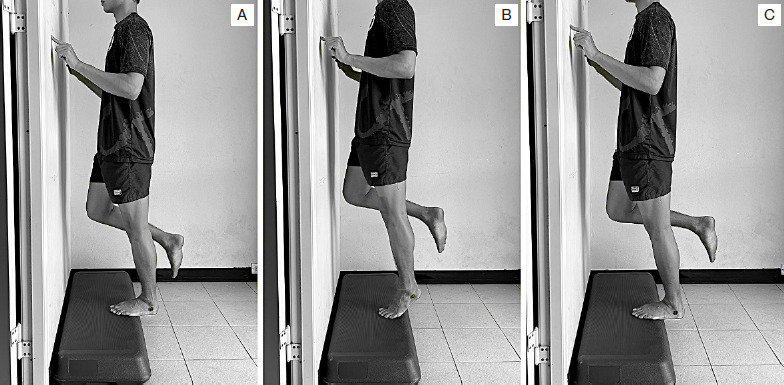
The vertical movement of the foot was tracked from the marker attached below the lateral malleolus using the Calf Raise mobile application. As per Hébert-Losier et al. [20], the number of repetitions (n), cumulative total positive vertical displacement (, cm), peak vertical displacement (peak height, cm), and total positive work (J) were extracted from the vertical displacement curve. Positive work (J) was calculated as follows:
Work = Fg × d
where Fg represents the participant’s body mass times gravitational acceleration (g = 9.81 m/s2).
Statistical analysis
The number of repetitions (n), total positive work (J), normalised total positive work (J/kg), and peak height (cm) were tested for normality using the Shapiro–Wilk test. Before analysis, logarithm base 10 transformations were employed to transform non-normally distributed data, including the number of repetitions, total positive work, and normalised total positive work. Twoway ANOVA tests were used and where significant main effects were seen, Scheffe’s post-hoc tests were used to examine the effect of sex (males, females) and sport type (running, court, racket, field) on the number of repetitions, total positive work, normalised total positive work, and peak height metrics between sexes (males, females), among sport types (running, court, racket, and field), any interaction effects between sex and sport types. In the presence of significant differences in the post-hoc tests, Hedge’s g effect sizes and 95% confidence intervals [lower, upper] were calculated to quantify the difference following Uanhoro [22], and interpreted as trivial, small, medium, and large when reaching thresholds of < 0.20, 0.20, 0.50, and 0.80, respectively [23]. All statistical analyses were performed using Jamovi 2.4.11 (Sydney, Australia) with the significance level set at p < 0.05.
Results
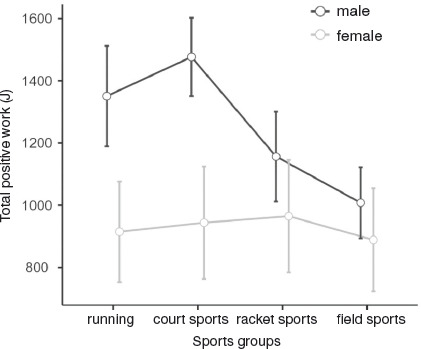
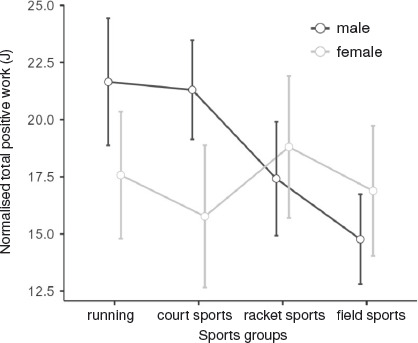
CRT outcomes of participants according to sex and sport type are presented in Table 2. The two-way ANOVA tests revealed no significant interaction effects or main effects for sex and sport type for the number of repetitions [sex: F(1,181) = 0.44, p = 0.51; sport type: F(3,181) = 1.884, p = 0.134; interaction: F(3,181) = 2.112, p = 0.1] and peak height metrics [sex: F(1,181) = 2.72, p = 0.1; sport type: F(3,181) = 2.45, p = 0.07; interaction: F(3,181) = 1.79, p = 0.15] (all p 0.100). For total positive work, a significant main effect of sex [F(1,181) = 32.83, p < 0.001, 2 = 0.14] and sport type [F(3,181) = 4.3, p = 0.006, 2 = 0.055] were observed, along with a significant sex × sport type interaction [F(3,181) = 2.82, p = 0.04, 2 = 0.036]. For normalised total positive work, significant effects were found for sport type [F(3,181) = 3.51, p = 0.016, 2 = 0.052] and the interaction between sex × sport type [F(3,181) = 3.57, p = 0.015, 2 = 0.052], but not for sex [F(1,181) = 1.97, p = 0.162, 2 = 0.01]. Scheffe’s post-hoc tests revealed that within males, court sport players exhibited large significant differences in total positive work than field sport players (46.53% for total positive work, p < 0.001, Cohen’s d = 1.26 [0.78, 1.74]), with similar results for normalised total positive work (43.92%, p = 0.006, Cohen’s d = 1.06 [0.59, 1.54]). Within court sports, males demonstrated greater total positive work than females (56.46%, p = 0.002, Cohen’s d = 1.47 [0.85, 2.09]), though the sex difference was not significant when normalised to body mass. No significant sport-type differences were found in females (all p > 0.05), and no sex differences were observed within racket, field, or running sports (all p 0.05) (Table 2).
Table 2
Peak height, total positive work, and number of repetitions obtained from dominant legs of runners,court sport players, racket sport players, and field sport players
[i] a significant differences ( p < 0.001) between total positive works of male court sport and field sport players b significant differences (p = 0.006) between normalised total positive works of male court sport and field sport players c significant differences (p = 0.002) between total positive works of male and female court sport players
Discussion
Calf muscles are known to contribute to various movements in sports, including acceleration and deceleration [2, 3], which directly influence athlete performance indicators [8] and susceptibility to sports injuries [5]. The physical requirements and attributes of athletes are sport-specific; however, the number of studies investigating calf muscle function across different sport types and sexes, especially those highlighting repetitive jumping and sprinting, remains limited. Gaining a deeper sport-specific understanding of muscle function can result in more effective plans for injury prevention, recovery, and optimising athletic performance. The CRT was used in this study to examine the endurance capacity of the calf muscle–tendon unit in male and female athletes across different sports. Our study demonstrated that there were no significant differences across sports or between sexes in the number of repetitions completed, consistent with Sara et al. [24]. In general, males have greater muscular mass, which results in a higher force production ability, thus achieving superior sports performance compared to females. In contrast, the greater body mass also requires greater muscle force to lift the body during the CRT, which might result in uniformity in the number of repetitions observed between sexes [25]. The absence of a sex difference in the number of repetitions and peak height was also demonstrated in children (8–17 years) [6]. Although Hébert-Losier et al. [17] found a lower number of repetitions were accomplished by females (17%, 3–5 repetitions), they argued that the difference observed may not have clinical significance due to the low number of repetitions in the study. The similarity in peak height and repetitions observed in our study suggests the effectiveness of the test in measuring a consistent range of performance metrics for the CRT across sports. Furthermore, the test may capture strength–endurance more than endurance per se since it emphasises repetitive force production against body weight rather than prolonged force production under load.
In contrast, significant interaction effects between sex and sport were detected for the total positive work and for the body mass normalised total positive work completed during the CRT. Specifically, within court sports, males achieved a significantly greater total positive work than females (i.e., 533 J, 36%); however, when total positive work was normalised with body mass (i.e., 5.5 J/kg, 26%), the statistical significance was absent between sexes (p = 0.162). The disparity further emphasises in part the contribution of the significantly greater body mass of the male players (i.e., 12.4 kg, 17%) to work generation, demanding an increased muscle force to elevate the body during the CRT in absolute terms [25]. We suspect that with an increased sample size of female court players, however, differences in body mass normalised total work between sexes would likely reach significance.
Male court sport athletes also outperformed male field sport athletes in terms of total work, both in absolute terms (i.e., 469 J, 46.53%) and when normalised for body mass (i.e., 6.5 J/kg, 43.92%). In this comparison, even though body mass between sport, peak height, and number of repetitions do not individually account for the variance, these small, non-significant differences in each variable compounded through the multiplicative work equation (Work = mass × gravity × height × number of repetitions) to produce a significant cumulative effect in total work. The difference is most likely underpinned by the sport-specific demands of court and field sports. The court sports of basketball and volleyball rely considerably on vertical acceleration and deceleration abilities evident in both defensive and offensive actions, such as blocks and shooting in basketball and jump serves and spikes in volleyball. In basketball, players perform approximately 40–60 jumps per game, while in volleyball, they average around 75 jumps [26, 27]. Overall, when adding training loads, these athletes experience high repetitions of jumping and landing. These actions require strong continuous activation of calf muscles for generating ankle power during the jump push-off [10], supporting the body weight upon landing, and the overall need for explosive force against gravity. As a result of these repetitive and powerful activations, calf muscle strength–endurance needs to be well developed.
On the other hand, field sports, such as soccer and futsal, incorporate more horizontal and lateral acceleration, deceleration, and multi-directional movements compared to court sports. These movements are employed in both attacking and defensive manoeuvres, such as during repetitive forward and backward sprints and sudden changes of direction. Horizontal actions require greater contributions from the hip muscles than vertical ones [28]. Compared with court sports, which involve frequent high-intensity vertical jumping and landing actions, these tasks likely require greater calf muscle and tendon stiffness to facilitate rapid elastic energy storage and release under the stretch-shortening cycle [29]. Repeated exposure to vertical plyometric loading within the stretch–shortening cycle may therefore reinforce neuromechanical characteristics that support vertical force production [30]. Such adaptations may preferentially enhance calf raise performance, particularly in tasks dominated by vertical force production rather than longer horizontal movement distances. Court sports involved significantly less running prevalence compared to field sports. In the analysis of 207 rallies, elite female volleyball spikers cover an average distance of 8.5 m per rally and 34.12 m for the maximum distance. For one set, it was only 398 m per set distance that was covered [31]. In addition, Mroczek et al. [32] reported a mean total distance of 1221 ± 327 m and 1757 ± 462 m distance covered in a 3-set and a 4-set match, respectively. The noticeably greater distance was achieved in soccer players with an average of 9–12 km per match, with some players reaching distances of approximately 14 km [33]. Runners, however, cover varied distances depending on the type of competition. Middle- and long-distance running events span from 800 to 1000 m, while the marathon is a distance of 42.2 km, which is significantly greater than that covered by court sports [34, 35]. These linear-dominant movement patterns are also demonstrated in racket sports, with the training relying heavily on repeated accelerations, decelerations, and short sprints. In racket sports, although explosive movement requiring distinct neuromuscular coordination through a kinetic chain from lower extremity to racquet-shuttlecock impact is demonstrated [36], the movement patterns are more linear and direction-specific compared to court sports. These patterns include lateral footwork from a split-step position, as well as forward movements toward the ball. The predominant linear trajectories decrease the demand for repetitive vertical force production compared to the constant directional changes in court sports. Therefore, runners and racket sport athletes exhibit plantar flexor functional demands comparable to field sports athletes, reflecting their greater reliance on horizontal rather than vertical movement. This phenomenon potentially accounts for the lack of difference in the measured variables found in the sports groups. Likewise, no significant sex differences were observed, suggesting that the specific physical qualities measured in this study are influenced more by the demands of the sport-specific training than by sex. Future research employing sport-specific testing protocols (e.g., split-step assessments for racket sports or repeated jump tests for court sports) may reveal further insights into the plantar flexor function specific to each sport.
Our findings demonstrated that the CRT can effectively identify disparities in total positive work between sports with different levels of repetitive jumping and running. This indicates that the CRT serves not only as a pure endurance test but also as a systemic power capacity assessment that reflects the ability to repeatedly move the body mass vertically over time, rather than purely assessing local calf muscle endurance. The endurance of the lower extremity muscles is crucial for maintaining prolonged activity, particularly in long-distance runners. In endurance sports, repetitive muscle contractions are necessary for an extended period with minimal fatigue to accomplish the task. However, our findings did not show any significant differences in the number of repetitions, total positive work, total positive work normalised to body mass, or peak height of the runners compared to athletes of other sports. This circumstance may be because our participants were 10 km runners rather than marathon runners, but this assumption is difficult to ascertain given the lack of research in these population groups. Moreover, the absence of a significant difference in CRT metrics overall between sports supports that the CRT serves more as a strength–endurance test rather than a pure endurance test.
This study has some limitations. Firstly, there were discrepancies across participants’ anthropometric data, including the absence of training-load quantification and the unbalanced sex distribution between groups, which may affect CRT metrics. Our exclusion criterion, which only considered a 6-month injury-free period, might not have fully captured the long-term negative effects of injuries on ankle movement and muscle–tendon unit function, potentially influencing the CRT results. To generate a broader context for understanding calf muscle performance, future studies should consider participants’ histories of lower extremity injuries beyond 6 months. Incorporating more information on athlete profiling regarding training frequency, training volume, or competitive level would also have provided greater context for interpreting the sport-specific comparisons. Furthermore, the unilateral calf-raise test is a single-plane, non-sport-specific assessment, while the sports analysed in this study are all multidirectional. This may limit the capacity to reflect the complex, multi-directional demands placed on plantar flexors during real sport performance. Additionally, expanding the investigation into relevant physiological differences such as changes in capillary density, muscle fibre adaptation, body fat and muscle mass, anaerobic threshold, and lactate production could provide a more comprehensive understanding of factors affecting muscle endurance among sport types and sexes.
Conclusions
Our study revealed significantly greater calf muscle strength–endurance in male court sport players compared to male field sport players based on total work metrics using the CRT. This disparity reflects sport-specific adaptations to repetitive vertical loading in court sports players, supported by the differences in normalised work demonstrated between groups. However, sex differences in absolute work are attributable to body mass rather than superior muscular endurance, since normalised work exhibited no sex differences. Our findings suggest that incorporating calf muscle training into programs for court sport players could be beneficial overall, with further studies needed to determine whether this approach minimises injury risk and improves performance.