
Introduction
Soccer is characterised by intermittent high-intensity efforts and requires athletes to perform repeated sprints throughout gameplay [1]. In addition, sprinting is one of the most important activities in soccer, although it accounts for only 1–11% of a player’s total distance covered during a match, i.e., 0.5–3% of playing time [2, 3]. The importance of sprinting for elite soccer players, given its necessity for speed and its ability to be maintained over repeated efforts, has been well documented [4–6].
Recently, conditioning tools such as wearable resistance (WR) loads have been integrated into conventional soccer warm-up and practice routines [7]. Post-activation potentiation (PAP) is the commonly acknowledged phenomenon by which muscular performance is acutely and temporarily enhanced because of muscular contractile history [8]. After a conditioning contraction, the time course of PAP closely corresponds to the time course of the phosphorylation of the myosin regulatory light chain [9]. Therefore, PAP has a short duration (seconds to 5 min) [9]. Recent studies have shown that increases in voluntary force production may partly result from changes in muscle temperature, muscle/cellular water content, and muscle activation, via a phenomenon known as post-activation performance enhancement (PAPE) [9, 10]. PAPE demonstrates a delayed onset, taking several minutes to manifest (6–10 min) and exhibiting a prolonged duration of over 15 min [9]. Furthermore, WR refers to the attachment of external loads to segments of the body, including the lower limbs [11, 12], ankles [13], and forearms [14], while executing a physical task. Empirical studies indicate that incorporating WR loads applied to the lower limbs during training regimens can significantly improve performance in activities requiring repeated sprints [15, 16]. WR loads impose rotational overload and engage stabilising muscles, which may benefit athletes during specific sports movements, such as the 20-m sprint [13, 14, 16]. For example, a recent study has shown that wearing WR on the calves with loads ranging from 200 g to 600 g, 2–3 times per week for the eight-week warm-up period (23 sessions) improved soccer players’ 10-m and 20-m sprint times (with effect sizes ranging from –0.96 to –1.06) compared to unloaded training [7].
More recently, a literature review reported that lower-limb WR loading schemes of 0.6–5% body mass (BM) significantly increased contact time by 2.9–8.9%, decreased step frequency by –1.4 to –3.7%, and slowed total sprint times by 0.6–7.4% in sprint runners [16]. These results support the hypothesis that WR warm-ups can enhance sprinting performance, particularly over short distances. More recently, Uthoff et al. [12] investigated whether adding WR during warm-ups affects the training load in subsequent soccer sessions. In their study, soccer players underwent a WR warm-up while wearing 200–600 g on their lower legs over 8 weeks during the transition from late preseason to early in-season, with no changes in training load observed. The WR had trivial-to-small effects on the session rating of perceived exertion (RPE). Results indicated that applying WR to the lower limbs during warm-ups does not negatively impact the quality or quantity of the warm-up or subsequent training once the WR is removed. Using WR attached to the lower legs during on-field warm-ups may be a means to ‘microdose’ strength training while not unduly increasing training load and could serve as a preconditioning tool to enhance sprinting capacity in adolescent elite soccer athletes before the game [7, 16].
Pre-conditioning exercises are designed to activate deep muscles and structures involved in a specific sport, thereby enhancing performance in subsequent motor activities [17]. However, in the scientific literature, only a very limited number of studies have examined the effects of WR applied to the lower limbs during warm-up as a pre-conditioning activity in sports disciplines requiring sprinting, such as soccer [7, 16] or combat [18]. In this context, a warm-up routine incorporating repeated sprints with WR could serve as an effective pre-conditioning activity, potentially boosting sprint power during games. The importance of this study lies in its potential to provide empirical support for the use of WR in pre-game preparations, offering a novel approach to enhancing explosive soccer-related performance such as sprint performance in elite athletes during actual match-play. By evaluating the effects of WR on sprint capacity and perceived exertion, the study aims to optimise training protocols for soccer players, potentially improving performance and reducing injury risk during competitive play. This research could thus have significant implications for coaches and sports scientists seeking to refine athletic training methodologies. Therefore, this study aimed to evaluate the effects of WR applied to the lower limbs during the warm-up as a preconditioning strategy for enhancing sprint performance in adolescent soccer players.
Material and methods
Participants
Twenty male elite soccer players (age: 14.55 ± 0.51 years; body height: 1.73 ± 0.06 cm; BMI: 61.20 ± 7.57 kg) recruited from a first-division club in Tunisia, voluntarily participated in this study. Both consent and assent were obtained after an explanation of the experimental protocol and its potential benefits and harms. The participants were randomly assigned into preconditioning training groups using WR with different loads and controls as: (i) passive rest (control), (ii) sprint unloaded (WR-0), (iii) sprint using WR with 5% BM (WR-5), and (iv) sprint using 10% BM (WR-10).
All players had at least 8 years of soccer training, encompassing technical skills, tactical understanding, mental preparation, and physical conditioning, and played an average of 16 ± 03 matches, with a mean match duration of 71.3 ± 1.2 min. The participants had no prior experience with WR applied to the lower limbs and reported no substantial musculoskeletal harm during the 3 months before the study. Inclusion criteria comprised 100% adherence to the training program. Athletes taking dietary supplements or presenting any type of injury were excluded from the study.
A priori sample size determination
The sample size was determined a priori using the open-source software G*Power® (Version 3.1, Düsseldorf, Germany) [19]. For this calculation, we considered the F statistic for repeated measures, with a beta of 0.90, an alpha of 0.05, and an effect size of 0.333, derived from an η2p of 0.1 (low). Consequently, the minimum sample size indicated was 18 subjects for four repeated measurements (before × after × 5th min of play × 45th min of play), which indicated a sample power of 0.913 (high) [critical F (3.00) = 2.78]. Given the possibility of sample loss, we added 10% to the indicated sample size, resulting in a final sample of 20 subjects. We note that no samples were lost during the procedures in this study.
Procedures
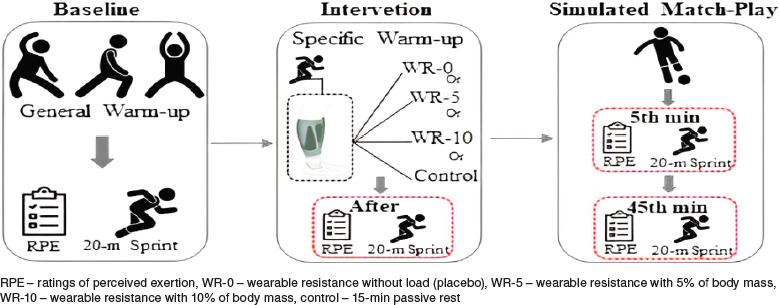
There were two sessions of protocol familiarisation followed by four testing sessions. In the first session, the anthropometric data were registered – age, BM, and height – and participants were introduced to the RPE scale. In the second session, participants were instructed in the warm-up procedures for the WR and the 20-m sprint test to mitigate potential learning biases. After a one-week break following the familiarisation phase, the next four sessions were conducted over two consecutive weeks. A 72-hour rest was maintained between individuals’ tests. Data collection occurred between 9:00 p.m. and 11:00 p.m., which was consistent with the regular training schedule. The data collection venue was a soccer stadium (temperature: 35.5°C, humidity: 46%, wind: 21 km h–1). A schematic representation of the experimental design is shown in Figure 1.
Intervention
The testing sessions were initiated with a 10-min dynamic warm-up routine comprising 5 min of general warm-up exercises and 5 min of dynamic stretching routines [20]. Thereafter, RPE and 20-m sprint test evaluations were conducted before and after participants completed a 10-min WR warm-up while wearing an ankle-attached WR corresponding to 0% (WR-0), 5% (WR-5), or 10% (WR-10) of their BM, or an unloaded control condition. In the case of WR-0, WR-5, and WR-10, the WRs were worn exclusively during the latter phase of the following warm-up [21]: (i) running in a straight line across a 10-m distance, repeated twice, with a 10-s recovery period (lasting 90 s); (ii) running in a straight line covering a 15-m distance, repeated thrice, with a 10-s recovery interval (spanning 2 min); and (iii) featuring zigzag running over a 20-m distance, reiterated twice, with a 10-s recovery period (lasting 2 min). For the control conditions, participants executed exercises (i), (ii), and (iii) without wearing WR loads, essentially remaining unloaded. The WR warm-ups were administered in a counterbalanced, randomized order using an online random number generator (Research Randomizer [version 4.0]) on different days.
The 20-m sprint tests were conducted on an outdoor soccer pitch with a 4G artificial turf field. This distance of 20 m was deliberately selected to mirror the average sprint distance commonly observed in field-based team sports evaluations [22]. This specific distance was also the regular fitness testing regimen for the participants [3]. Each player completed a pair of maximal 20-m sprints, separated by approximately 3 min, allowing participants to walk back to the starting line and await the subsequent trial. For analysis, the shortest time from the two trials was retained. The participants initiated each trial independently, beginning from a stationary position 0.5 m behind the initial timing gate. Their sprint maintained maximal exertion until reaching the concluding timing gate. To ensure accurate timing, photocell gates (Brower Timing Systems, Salt Lake City, UT; accuracy 0.01 s) located 0.4 m above the ground were utilised. The participants were highly motivated and were urged to exert their utmost effort, striving for peak performance in each 20-m sprint test. Participants utilised a professional WR for the lower limbs (Adjustable Loading Weighted Leg Strap for Exercise Training, Functional PT Products, Heber City, UT), which was attached to the ankle.
Subsequently, participants participated in a 45-min first-half soccer match, with new data collection points at the 5th and 45th min. Post-match assessments were completed within 5 min to avoid interference from fatigue [23]. After that, the testing sessions followed four conditions, namely: (1) control, (2) WR-0, (3) WR-5, and (4) WR-10.
Statistical analysis
Normality of the data was assessed using the Shapiro–Wilk test and visually inspected via QQ plots. The data were expressed as means and standard deviations. A general linear model (GLM) was used in the analysis, considering the time factor (before × after × 5th min of play × 45th min of play) and the condition factor (control × WR-0 × WR-5 × WR-10). Tukey’s post-hoc test was employed to verify specific differences. In all analyses, the effect size was assessed using partial eta-squared (η2p) and interpreted according to its magnitude [24]: small (< 0.01), medium (between 0.02 and 0.06), and large (> 0.14). All analyses were conducted using the open-source software Jamovi® (version: 2.3.18, Sydney, Australia), with significance set at p < 0.05. The power of the analyses was calculated post-hoc using the open-source software G*Power® (Version 3.1, Düsseldorf, Germany) [19]. For this, we used the F statistic for repeated measures, with a standard alpha of 0.05, accounting for the η2p values for time, condition, and interaction. Finally, we used η2p values from the GLM models to assess the strength of the analyses in each model. Models were considered reliable when the indicated power was > 0.800 (80.0% reliability) [25].
Results
RPE measures
The results indicate a significant effect of condition (η2p = 0.049; power: 0.974), time (η2p = 0.842; p: 0.998), and condition × time interaction (η2p = 0.150; power: 0.999) for RPE (Figure 2). We note that the GLM model shown in Figure 2 exhibited very high power (0.999) for the analyses, suggesting that the results are reliable.
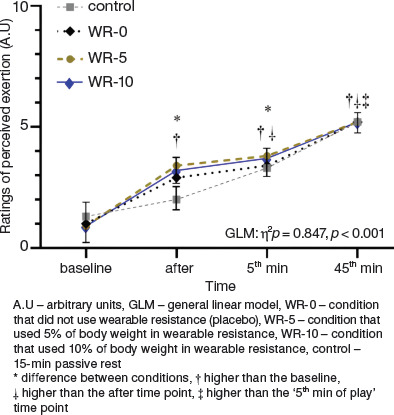
Higher RPE values were observed at the ‘After’ time point for the WR-0, WR-5, and WR-10 groups compared to the controls (p = 0.02) (Figure 2), and the RPE values in the WR-5 condition were significantly superior to the WR-0 condition (p = 0.04). At the ‘5th min of play’ time point, the WR-5 and WR-10 conditions indicated higher RPE values compared to the WR-0 and control conditions (p = 0.001). No significant differences were found between groups for RPE at the ‘baseline’ and ‘45th min of play’ time points (p = 0.1).
20-m sprint performance
The condition had an effect on the 20 m sprint at the ‘5th min of play’ (η2p = 0.033; power: 0.850) and ‘45th min of play’ (η2p = 0.054; power: 0.976) time points (Figure 3). We note that the GLM model in Figure 3 showed high power (0.908) for the analyses, suggesting that the results are reliable.
Figure 3
General linear model analysis to verify the effect of time and different conditions on 20-m sprint performance
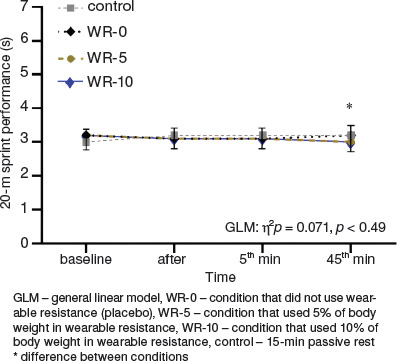
Regarding the differences between conditions, for the first 20-m sprint, the ‘control’ and WR-0 conditions presented values in time (s) higher than the WR-5 and WR-10 conditions (p = 0.049). For the second 20-m sprint, the control condition presented higher time values than the WR-0, WR-5, and WR-10 conditions (p = 0.04).
Discussion
This study aimed to evaluate the effects of a WR warm-up targeting the lower limbs as a preconditioning strategy to enhance sprint performance in adolescent soccer players. Our results demonstrate that applying the WR to the warm-up of adolescent athletes before the soccer match enhances their sprint performance during the game. The effect of the WR warm-up on sprint performance during the game appeared more consistent when the loads were between 5% and 10% of players’ BM.
Incrementing the WR loads on the lower limbs is commonly used to alter the kinetic patterns and workload of a sprint, thereby evoking adaptive changes in sprint performance [26]. In our study, we show that WR with micro-loads can be used as a preconditioning exercise to immediately enhance sprint performance. Consistent with our results, resisted sprint exercise on ice with elastic bands has been shown to increase top speed in young hockey players [27]. Studies consistently show that sprinting with a horizontally oriented resistance load improves sprint performance [28, 29]. For example, Kawamori et al. [30] recorded performance enhancements of 3–5% on a 10-m running sprint after 16 sessions of sled-resisted training with a load corresponding to 13 and 43% BM in 21 physically active men. Similarly, Ltifi et al. [31] showed that sprinting for 3 min with a 10% BM vest resulted in the highest RPE scores and substantial improvement in the 20-m sprint performance in highly trained youth soccer players. The authors concluded that youth elite soccer players should incorporate 10% BM-weighted vests in their re-warm-ups to boost post-break sprint performance. The observed enhancement in sprint performance at the end of the break is likely attributable to various physiological factors, including elevated heart rate, core and muscle temperature, improved muscle oxygenation, altered blood metabolite responses, and increased neuromuscular activity [32]. In this regard, changes in muscle temperature, muscle/cellular water content, and muscle activation have been pointed to (at least partly) underpin voluntary force enhancement through PAPE, which typically exhibits a delayed onset, with effects taking several minutes (6–10 min) to become apparent [9].
Furthermore, as conditioning contractions from sprint tasks are known to induce both PAPE and fatigue [33], incorporating additional 15-m sprint repetitions during the re-warm-up phase may improve 20-m sprint performance. It is important to note that in competitive soccer, time constraints during the half-time break may make it challenging to incorporate the required number of repetitions of WR activities. For instance, performing 6 sets of 15-m sprints as a WR activity would take a total of 6 min, which may not be feasible during a break in a competition. Cumulatively, future research should focus on manipulating the intensity of WR conditioning by using individualised, load-based exercises according to participants’ BM.
Players’ perceived effort during the game was greater when the loads were higher. These findings are consistent with previous reports of WR studies, which assessed RPE scores immediately after the break and found that active interventions resulted in higher perceived exertion compared to passive rest [31, 32]. In agreement with our study, González-Devesa et al. [32] advocate the use of sport-specific activities, such as WR interventions, to facilitate transfer from the first to the second half of the game. Based on the study’s findings, several practical applications can be recommended for athletes, coaches, and sports practitioners. Implementing 5- to 10-min warm-up routines that include sprinting with resistance of 5 to 10% of body weight can significantly enhance sprint performance at the beginning of play, which is crucial for sports requiring explosive speed; however, these warm-ups lead to higher RPE immediately after the warm-up and during the early stages of play. Strategic warm-up planning can also ensure peak performance during the critical early stages of competition without overly taxing athletes for later stages. For scenarios in which lower exertion levels are essential, alternative routines or phased approaches with brief rest periods may be considered to balance exertion and performance. By incorporating these strategies, athletes can achieve optimal performance during key phases of their sports, and coaches can design more effective and individualised warm-up protocols.
The current study is subject to certain limitations. Firstly, the study protocol did not include crucial physiological measurements such as heart rate, core or muscle temperature, and electromyography, which could have provided a more comprehensive understanding of the effects of the WR protocols. Secondly, the impact of performing the WR in different environments remains unclear. For instance, in colder environments, core and muscle temperatures may decrease to a greater extent than in thermoneutral or hotter environments. Lastly, given that players typically return to the changing room and passively rest for 20–25 min after the pre-competition warm-up before the match begins, an intriguing avenue for future research is to examine the integration of short, high-intensity WR activities preceding the warm-up phase. Future research should explore the long-term effects of wearable resistance training on sprint performance and perceived exertion in adolescent athletes. Studies could also investigate the optimal resistance loads and the potential benefits of varying the duration and frequency of WR warm-ups. Further examination of the physiological mechanisms underlying the observed improvements in performance and perceived exertion will enhance our understanding of WR training. Including a larger, more diverse sample across different age groups and athletic levels can also yield more generalisable findings and practical applications.
Conclusions
The use of WR applied to the lower limbs, with 5% or 10% of body mass as loads (5–10 min of running and sprinting), during pre-soccer game warm-ups can effectively enhance sprint performance and perceived exertion immediately after the warm-up and during the initial stages of play. These insights can inform the design of warm-up protocols to optimise performance and manage exertion in competitive sports settings.