Introduction
Basketball is a sport that requires not only a high level of physical fitness [1] but also well-developed cognitive abilities within the competitive game environment. For players of open sports such as basketball, it is essential to distribute attention across multiple stimuli in the game setting [2, 3] while simultaneously performing automated motor actions such as defensive movements or dribbling. Offensive and defensive activities in basketball demand the concurrent engagement of motor and cognitive skills, which is especially visible during changes in locomotion during game tasks that demand execution [4, 5].
The influence of mental factors on athletes’ performance is generally well-documented, but only a limited number of studies have utilised qualitative methodologies that provide a detailed and in-depth perspective on identifying specific cognitive-motor ‘markers’ of player performance [6], such as selective attention, reaction speed, and decision-making ability. Research suggests that players with superior cognitive skills make more effective decisions and handle complex game situations with fewer errors [7].
Studies in sports psychology highlight that personality traits play a key role in the process of a player’s adaptation to environmental demands [8]. In competitive contexts where performance is further modified by stress factors, cognitive flexibility appears to differ across playing positions [9] and may be crucial in forming players’ anticipatory strategies [10]. During competitive matches, it is well-known that athletes face situations of high cognitive stress [11] and cognitive fatigue [12], which can lead to decreased performance and satisfaction during competition, as well as impair their ability to cope with acute stress. Interactional and avoidance strategies are known to depend on the type of stressful event [13], particularly in activities associated with significant situational tension. Evidence suggests a higher level of stress tolerance (ST) in players with high functional fitness levels [14].
Variability of player activity requires a high degree of concentration, which is influenced by emotions [15], physiological indicators [16], and the level of selective attention [17], but there is also evidence of the effect of concentration on skill quality [18]. Concentration involves the ability to focus on a task while ignoring distractions to work effectively [19]. The effects of concentration on performance and visual focus in sports psychology have been measured using eye-tracking methods. Research generally confirms that elite players exhibit higher levels of attentional focus, effective information searching, and precise information processing [20].
The ability to anticipate actions is critical in many performance contexts, such as predicting escape direction or passes. It involves perceiving and processing visual information from an observed sequence of actions and predicting its outcome. Trained athletes also focus on areas containing key information and avoid looking at irrelevant locations [21]. It has been shown that experienced players systematically focus on specific cues indicating the direction and nature of an opponent’s actions [22] and integrate these cues without becoming overloaded by them [23]. Research suggests that this kinaesthetic detection is beneficial in perceiving object distance, identifying relevant visual information (e.g., ball or opponent movements), and ignoring or mitigating distracting factors, all of which are essential for skilled behaviour [24, 25]. The intended action of an opponent, which can be inferred from the characteristics of kinaesthetic cues [26] and the player’s ability to extract them [27], is often selectively masked or preceded by deceptive signals [28, 29]. For predictive measures, elite players must therefore possess higher levels of memory and selective attention, which can, among other things, be improved through basketball-specific exercises [30]. It is important to determine the relationship between memory, the ability to select attention and decision-making in offensive and defensive situations occurring in the game.
The main aim of the work was to conduct an exploratory study of the relationship between cognitive predispositions (independent variables – IV) and decision-making in offensive and defensive basketball players’ behaviours (dependent variables – DV). Specifically we aimed to: (1) study simple linear relationships between all variables, (2) explore multidimensional associations, and (3) examine the extent to which the DVs depended on the IVs, building simple or multivariate models. The research findings may contribute to the development of specific training programs aimed at improving player skills.
Material and methods
Study design
This cross-sectional study involved 13 highly trained female basketball players from a university sports club participating in the Polish University Championships in Women’s Basketball. Anthropometric measurements (body height and mass, body mass index – BMI) and cognitive assessments (Cognitrone and Determination tests via the Vienna Test System) were conducted individually under controlled conditions. Following cognitive tests and a 15-minute warm-up, offensive and defensive decision-making skills were evaluated using basketball-specific video tasks. The average of the three best trials out of six attempts was used for analysis. Details of the measurements were described below.
Participants
The sample consisted of 13 adult competitive female basketball players, detailed in Table 1 (in the Results section), who play in an academic league and have significant sports achievements in Poland (14th place in the Polish University Championships Women’s Basketball ranking in 2021–2024). The female basketball players represented a university sports club. The inclusion criteria included a minimum participation of players in training at least twice per week before the start of the study. Before the study, athletes were excluded if they reported any musculoskeletal injuries, pain syndromes, or other conditions within the past year that may have been exacerbated by their participation in the measurement survey. The study was conducted two weeks before the semifinals of the Polish University Championships in Women’s Basketball in 2024.
Table 1
Descriptive statistics of age, anthropometric measurements, training activities, cognitive/executive measurements (Viena Test System), offensive and defensive skills in basketball female players
Measures and procedures
Two anthropometric tests were conducted: body height (BH) and body mass (BM) using a stadiometer (Seca 213, Hamburg, Germany). BMI was calculated based on the standard formula. Two tests were then conducted to assess cognitive predispositions. After completing them, each subject participated in a standard 15-minute warm-up. Then, they performed offensive and defensive tasks, assessing decision-making.
Two subtests (Cognitrone test, Determination test) from the Vienna Test System (VTS; Schuhfried GmbH, Mödling, Austria) were used to determine the cognitive predispositions in the female basketball players. The testing was conducted in a quiet and enclosed room equipped with a computer, allowing participants to focus comfortably on completing the tests.
Before the testing began, the administrator provided an oral explanation of the procedure. Testing commenced after the participants signed the required ethical consent forms. The VTS was completed in Polish. The Cognitrone test (COG) and Determination Test (DT) were supported by hardware devices, including a response panel and pedal, which enabled the measurement of concentration performance and reactive stress tolerance with millisecond accuracy [31].
The administrator was present throughout the testing session to provide assistance if needed (e.g., resolving technical issues, explaining tasks, or facilitating breaks). The total test duration was up to 30 minu, including breaks.
COG with form S4 (standard form with fixed presentation time per item)
The test assesses concentration performance. During the measurement, participants compared a geometric shape with other geometric shapes and determined whether the comparison shape was identical to one of the four additional shapes. In forms with a fixed working time, participants had a short window to respond only if the shape matched the comparison.
DT with form S1 (adaptive standard form)
The test determines reactive stress tolerance and the ability to respond under complex stimulation conditions. During the measurement, participants were presented with both visual colour stimuli and acoustic signals. Responses were made by pressing corresponding buttons on the response panel and using foot pedals. The stimuli were presented at a sufficiently high frequency to challenge the participant beyond their capacity, inducing a situation where not all required reactions could be performed.
Offensive and defensive skills
For the assessment of decision-making, tasks were used in which the tested person ran in the opposite direction to the direction of the demonstration person displayed on the TV monitor. The speed of performance was measured by a Witty (Microgate®) electronic timer with an accuracy of 0.01 s. For the purposes of testing offensive and defensive skills, video sequences were recorded in advance with a Sony HDR-CX450 digital camera. The demonstrations were performed by an independent person, a 23-year-old player with a sports age of 12 years. The person presented six different defensive and six offensive skills. The video sequences were projected to the tested person in random order on a 60-inch TV screen 4 m away from the player. Each activity ended with a change of direction to the left (3×) or right (3×).
For testing offensive skills performance (OP), the tested participant was projected defensive activities, and for testing defensive skills performance (DP), offensive activities were projected. The tested person was instructed in advance to perform a movement in the opposite direction to the person performing the demonstrations. The sequences were technically adjusted using the Kinovea® software, and the length of each sequence was 3s. A reference point (RP) was created in each sequence by the expert – the point at which the direction change began. For each individual video sequence, the point of initiation of the extension of the rebound leg (opposite to the direction of motion) was individually determined as the point of initiation.
The offensive and defensive decision-making time (OD, DD) and overall offensive and defensive performance time (OP, DP) variables were monitored. The time was triggered by the test subject crossing the first photoelectric cell and was time-synchronised with the video sequence. The variables OD and DD were classified as the time interval between the reference point and the time of crossing the second photoelectric gate (Figure 1B, 1C). The overall offensive and defensive performance (OP, DP) was determined as the time interval between the reference point and the time of crossing the third photoelectric gate (Figure 1A). The time interval between the second and third photocell was defined as the agility time in attack and defence (OA, DA). The reference point was identified individually in each sequence. Proper instructions and practice trials of the test were given to the athletes, allowing for adequate familiarisation.
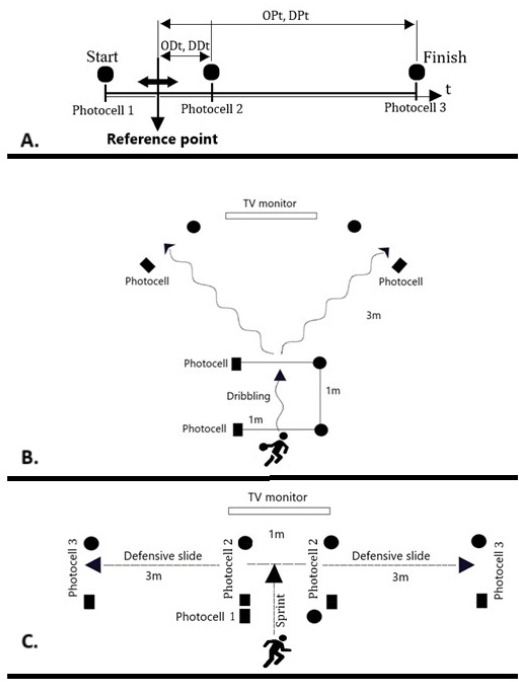
A. Offensive performance (OP)
A subject with a ball dribbled forward, and crossing the photocell triggered a video sequence displayed on the TV monitor in parallel. As soon as she saw the change of direction of the person on the screen (defender), the subject had to dribble in the opposite direction (from the tested person’s perspective) and escape to the 3rd photocell as quickly as possible (Figure 1B). The side of the dribbling hand (left, right) was the player’s individual choice. The average of the three best times from 6 repetitions was used to analyse the results.
B. Defensive performance (DP)
The subject performed a run in a 1 × 1 m area. Crossing the photocell triggered a video sequence displayed on the TV monitor. As soon as she registered the change in direction of the person on the screen (attacker with the ball), she had to perform a movement (defensive slide) in the opposite direction (from the tested person’s perspective) and perform a defensive movement to the 3rd photocell as quickly as possible (Figure 1C). The average of the three best times from 6 repetitions was used to analyse the results.
Statistical procedures
The Shapiro–Wilk test was used to evaluate the normality of the distribution of the continuous variables. The variables showed a normal distribution with p > 0.05. Descriptive statistics were presented as means, standard deviations, and 95% confidence intervals (CI).
To study simple linear relationships between variables, the Pearson product-moment correlation coefficients were calculated. Interpretation of the correlation’s strength was based on Hinkle et al. [32] where: 0.00–0.10 = negligible, 0.10–0.30 = small but meaningful relationship, 0.30–0.50 = medium strength relationship, 0.50–0.70 = strong relationship, 0.70–1.00 = very strong relationship. Multidimensional, complex associations were explored with a cluster analysis (CA), using Ward’s method of linkage and 1 – Pearson’s r distance calculation. Prior to analysis, all variables were standardised to have a mean of 0 and a standard deviation of 1. Results are presented in figures as dendrograms.
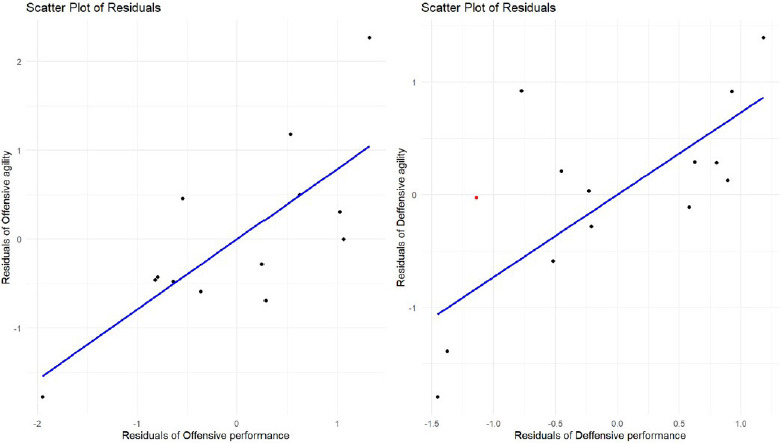
A multivariate regression analysis (MRA) was conducted to evaluate the effect of perception fatigue on two sets of dependent variables: (1) offensive performance and offensive agility, and (2) defensive performance and defensive decision-making. Wilks’ Lambda was calculated to assess the strength of the multivariate effect. The correlation of residuals was examined to evaluate unexplained relationships between the dependent variables in each set.
Statistical significance was set at = 0.05. We used Statistica version 13.0 (StatSoft Polska, Cracow, Poland 2022) and RStudio (Version: 2024.09.1+394, released: 2024-11-04; R Team, 2024) with the R language [R version 4.3.3 (2024-02-29 ucrt)] for data analysis.
Results
Descriptive statistics are presented in Table 1. The mean age of the female players was 21.21 years (SD = 1.52), while body height and body mass were 173.65 cm (SD = 2.95) and 73.06 kg (SD = 9.37), respectively. Body mass index indicated a normal range, but at the upper limit (24.23 ± 3.13). Female players had an average of 104 months of experience, while practice activity was 466 minutes per week (Table 1).
Table 2 presents the simple linear relationships between offensive and defensive skills and cognitive dispositions. As can be seen, most of the correlation coefficients indicated weak, although meaningful, relationships. Both attention (ATT) and stress resistance (STRESSR) suggested that a higher level of these dis-positions was associated with a higher level of offensive and defensive performance (as shown with negative values). While attention and stress resistance components such as perceptual fatigue and vigilance fatigue were linked positively, this suggested that higher fatigue (missed or incorrect reactions) was associated with higher test results (which indicated worse performance because of the time unit). Interestingly, impulsivity was related to decision-making components (both offensive and defensive) with negative correlations. Someone who is impulsive makes decisions quickly but is more likely to risk making mistakes. Another notable finding is the positive associations between hypervigilance and all offensive tasks, while negative associations were observed with all defensive tasks.
Table 2
Pearson product-moment correlation coefficients between sets of cognitive dispositions and offensive and defensive skills
[i] OP – offensive performance, OD – offensive decision-making,
OA – offensive agility, DP – defensive performance,
DD – defensive decision-making, DA – defensive agility,
ATT – attention, PERCFAT – perception fatigue,
IMP – impulsivity, STRESSR – stress resistance,
VIGFAT – vigilance fatigue, HVIG – hypervigilance
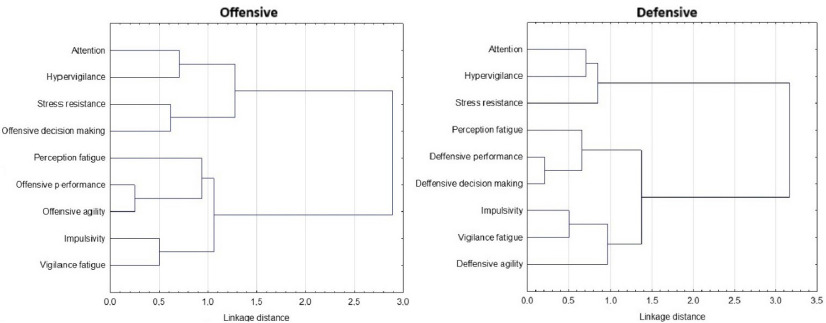
Next, the multidimensional relationship was studied with a hierarchical cluster analysis. The results are the dendrograms presented in Figure 2. As can be seen, offensive tasks and cognitive dispositions created two clusters. The first cluster consisted of attention, hyper-vigilance, stress resistance, and offensive decision-making. An interesting relationship was observed in the second cluster, where offensive performance was closely related to offensive agility, and both were joined to perceptual fatigue. This three-element subgroup was joined to impulsivity, connected with vigilance fatigue. Defensive tasks and cognitive dispositions also created two clusters (Figure 2). The general pattern of the relationships was similar to the offensive associations. The first cluster consisted of attention, hypervigilance, and stress resistance. In the second cluster, the first subgroup included defensive performance closely related to defensive decision-making, and the second subgroup included impulsivity connected to vigilance fatigue and defensive agility.
Figure 2
Dendrogram of the multidimensional relationship between all offensive and defensive tasks and cognitive dispositions
A multivariate regression analysis (MRA) was conducted separately for: (1) offensive performance and offensive agility, and (2) defensive performance and defensive decision-making. The starting point was the assessment of simple linear regression models. Results are presented in Table 3. As can be seen, a higher effect of perception fatigue was observed in defensive decision-making ( = 0.46) and defensive performance ( = 0.45) (Table 3). In contrast, the effect of perception fatigue on offensive performance and agility was lower ( = 0.33, = 0.13, respectively). None of the coefficients were statistically significant.
Table 3
Simple linear regression coefficients on the effect of perception fatigue on offensive performance and agility, defensive performance and decision-making
| Parameter | Offensive performance | Offensive agility | Defensive performance | Defensive decision- making |
|---|---|---|---|---|
| b0 | 0.33 | 0.13 | 0.45 | 0.46 |
| p | 0.267 | 0.661 | 0.124 | 0.110 |
| β | 0.33 | 0.13 | 0.45 | 0.46 |
However, when analysing the multivariate regression results to assess the combined effect, a better model was observed in the combined defensive tasks (Wilks’ Lambda = 0.27, p = 0.266), than in the combined offensive tasks (Wilks’ Lambda = 0.86, p = 0.471) (Figure 2). The effect of perception fatigue on defensive tasks was stronger (perception fatigue explained 73% of the variation) than on offensive tasks (perception fatigue explained 14% of the variation). However, after accounting for the effect of perception fatigue, all offensive and defensive tasks showed a strong unexplained relationship (residual correlation coefficients of 0.75 and 0.74, respectively, in Figure 3).
Discussion
This study explored the relationships between cognitive functions and decision-making in offensive and defensive basketball behaviours. Most cognitive measurements showed weak but statistically significant linear correlations with decision-making tasks. Higher attention and stress resistance were associated with better offensive and defensive performance, while higher levels of perception fatigue and vigilance fatigue were linked to poorer decision-making, as reflected in the test outcomes. Impulsivity negatively correlated with decision-making, indicating that impulsive individuals tended to make quicker decisions but were more prone to errors. Hypervigilance positively correlated with offensive tasks but negatively with defensive tasks, suggesting distinct cognitive demands between these domains. Hierarchical cluster analysis revealed distinct groupings, with offensive tasks clustering with cognitive factors such as attention, hypervigilance, and stress resistance in one group, and offensive performance, agility, and perception fatigue in another subgroup. Defensive tasks exhibited a similar clustering pattern, with cognitive dispositions grouped separately from performance-related measures, highlighting the shared cognitive demands of defensive tasks. The regression analysis showed that perception fatigue had a stronger effect on defensive tasks (decision-making and performance) compared to offensive tasks. However, the unexplained relationships between offensive and defensive tasks remained high, indicating additional factors influencing decision-making and performance.
To date, few studies have assessed the role of cognitive abilities in agility through VTS testing. The only study was conducted by Matlák et al. [33]; therefore, it is hard to discuss our results in relation to the outcomes of other authors due to differences in methodology. However, our findings align with those of Matlák et al. [33] in recognising the importance of cognitive functions in sport task decision-making and performance. The mentioned study underscores the role of cognitive abilities, such as reaction time and stress tolerance, in sports performance in soccer players. Matlák et al. [33] identified a moderate-to-large significant relationship between reaction time and decision-making speed during agility tasks among elite young soccer players, suggesting that cognitive factors like choice reaction time can influence agility performance. Similarly, our research highlights the significant role of cognitive predispositions – such as attention, stress resistance, and impulsivity – in influencing offensive and defensive decision-making and performance in basketball players. Importantly, we also found that perception fatigue has a stronger impact on defensive tasks compared to offensive tasks, which may suggest task-specific cognitive demands in team sports.
In another study, Horníková et al. [34] found no significant relationship between reaction time (RT) and total agility time in adult handball players, nor any correlation between choice RT and total agility time. Similarly, the mentioned study by Matlák et al. [33] reported low shared variance between decision time and results from a choice RT test. These findings suggest that decision-making in agility tasks is only partially explained by general cognitive functions assessed through laboratory-based tests. This is in line with our results, in which the regression analysis showed a high prevalence of unexplained relationships between agility tasks, in both offensive and defensive conditions, and cognitive measures. Indeed, agility is a multifactor skill connected to both physical and mental skills [35]. The results confirm the role of cognitive factors; thus, further investigations are required.
Decision-making, especially in team sports, involves greater complexity, including the ability to anticipate [36]. Players often base decisions during agility manoeuvres on visual cues from the movements of opponents and teammates [37]. This complexity is supported by evidence showing faster reactions in higher-level athletes who rely on anticipation compared to lower-level players in sports [38, 39]. Our study showed that impulsivity showed a negative correlation with decision-making (offensive and defensive), indicating faster but riskier decisions. Hypervigilance was positively associated with offensive tasks and negatively with defensive tasks. Even while performance was directly associated with agility tasks, which may be linked with the mentioned cognitive functions, the links were not strong. One potential reason for the weak-to-moderate relationships between agility test outcomes and results from laboratory-based cognitive tests is the use of general visual stimuli, such as lights and sounds, rather than sport-specific stimuli, like the movement of other players [36]. Moreover, the VTS tests are performed with limited musculoskeletal system functions, mainly based on hand and foot movements, which also differ significantly from agility tasks.
Another possible explanation for the observed weak relationships is the differing time demands of the agility test and the cognitive tests. This discrepancy likely engages different cognitive processes. The VTS tests, with a longer duration, emphasise sustained attention, working memory, and reactive stress tolerance [31], while the agility test relies on a rapid response to a single, brief stimulus, placing less emphasis on prolonged attentional or stress-related capacities. Also, the lack of physical effort may cause differences in response to VTS test-affected scores [40].
Despite the novel insights provided by this pilot study, several limitations should be acknowledged when interpreting the findings. First, the small sample size (n = 13) substantially limits the statistical power of the analyses and increases the risk of both Type I and Type II errors. Although the exploratory nature of the study justifies the use of a smaller sample, the results should be interpreted with caution and cannot be generalised beyond the investigated group. Second, the study involved a homogeneous sample of adult female university-level basketball players, which restricts the generalisability of the findings to other populations, such as male players, youth athletes, or elite professional basketball players. Cognitive demands, stress responses, and decision-making strategies may differ substantially across sex, age, and competitive levels. Third, the cross-sectional design does not allow causal inferences. While associations between cognitive dispositions and offensive and defensive performance were identified, it cannot be determined whether cognitive abilities directly influence basketball performance, or whether long-term basketball training itself enhances specific cognitive functions. Longitudinal or intervention-based designs are required to clarify the directionality of these relationships.
Another limitation relates to the ecological validity of the cognitive assessments. Although the Vienna Test System provides standardised and reliable measures of cognitive functions, the tests rely on abstract visual and auditory stimuli and simplified motor responses (hand and foot reactions). These conditions differ considerably from the complex, whole-body, and perceptually rich environment of basketball gameplay. Additionally, physical and physiological factors such as lower-limb strength, speed, neuromuscular coordination, aerobic fitness, and acute fatigue were not directly controlled for or included in the analyses. Given the multifactorial nature of agility and decision-making performance, these unmeasured variables may have contributed to the substantial unexplained variance observed in both offensive and defensive tasks.
Finally, the study focused on a limited set of cognitive variables, primarily attention, stress tolerance, impulsiveness, and vigilance-related measures. Other relevant cognitive components, such as working memory, inhibitory control, anticipation skills, visual search strategies, and tactical knowledge, were not assessed and may play an important role in basketball decision-making. This study is the first to examine the relationship between cognitive function assessed by the Vienna Test System and an agility test in defensive and offensive tasks in female basketball players. These findings collectively reinforce the critical role of cognitive functions in sports performance. However, our study extends the discussion by addressing not only isolated tasks like agility but also broader performance domains such as decision-making and game-specific behaviours. Future research could benefit from integrating the methodologies of both studies to examine how specific cognitive functions, like reaction time, interact with task-specific demands across various sports and age groups. This would help refine training strategies to enhance both cognitive and motor performance in athletes.
Conclusions
These findings provide valuable insights into the interplay between cognitive dispositions and basketball decision-making. Cognitive predispositions such as attention, stress resistance, and hypervigilance significantly impact basketball performance, but their influence varies between offensive and defensive tasks. Perception fatigue emerged as a critical factor, particularly for defensive tasks, underscoring the importance of cognitive endurance in high-pressure sports scenarios. The unexplained relationships between tasks suggest the presence of other unexamined factors, such as team dynamics, situational awareness, or environmental stressors, warranting further investigation. The results of this pilot study emphasise the need to incorporate cognitive training to enhance decision-making and performance, especially under fatigue-inducing conditions. Future studies should aim to integrate these insights with biomechanical and situational variables to develop more comprehensive training models.