Introduction
The midsole plays a pivotal role in running shoe design. Recently, carbon-fibre plates have become integral to midsoles due to their high stiffness and elastic rebound, which enhance propulsion efficiency and running economy. This innovation has been widely embraced by elite athletes and recreational runners for improving marathon performance [1].
Most studies on carbon-fibre plate design have focused on longitudinal bending stiffness or thickness, with limited attention to the impact of plate shape [2]. In practice, carbon plates can be flat or upward-curved (‘spoon-shaped’) to conform to the foot arch, and such geometric differences may affect foot mechanics, joint kinematics, and neuromuscular control during running [3, 4]. While stiffness is well-studied, the biomechanical effects of shape remain largely unexplored.This study addresses that gap using high-resolution motion capture and symmetry analysis. Running is a popular sport, but carries a high injury risk due to factors such as joint mechanics, foot structure, foot-wear, and training variables. Lower limb symmetry is essential for efficient movement and postural stability, yet many studies analyse only the dominant limb, overlooking asymmetry’s effects on performance and injury [5, 6]. Evidence links asymmetry with injuries like tibial stress fractures, which often result from uneven load distribution [7, 8]. Fatigue can exacerbate asymmetries, particularly in knee joint rotation and stiffness. Iliotibial band syndrome and Achilles tend-initis have also been associated with asymmetric hip and ankle movement patterns [9–11]. Moreover, asymmetry tends to increase with running speed, potentially impairing performance and elevating injury risk [12].
Recent studies suggest that shoe modifications can influence step frequency and propulsion mechanics, thereby affecting lower limb symmetry during running [13]. Moreover, recent studies have shown that changes in foot strike pattern and plantar pressure distribution between minimalist and traditional running shoes, as well as the interaction between footwear type and lower-limb dominance, can substantially modulate running gait and asymmetry in more ecologically valid conditions [14, 15]. However, any functional enhancement must align with natural locomotor demands to avoid introducing new injury risks [16]. Although mid-sole stiffness, shoe weight, and upper design have been examined, there remains a lack of biomechanical evidence on how variations in carbon-fibre plate shapes influence limb asymmetry. Thus, investigating the effects of plate geometry on symmetry and its implications for injury risk is both necessary and timely. Recent advances in sports biomechanics have emphasised that new methods and technologies should be developed with two main objectives in mind: enhancing performance and reducing injury risk [17].
This study examined how flat and curved carbon-fibre plate designs affect lower limb symmetry during running. By comparing symmetry patterns across key joint variables, we aimed to determine whether plate geometry influences asymmetry and to identify which design better optimises symmetry, thereby informing functional running shoe design. Accordingly, this study tested the hypothesis that a curved carbon-fibre plate configuration would yield more symmetrical lower-limb kinetics than a flat-plate configuration, owing to its smoother rollover profile and load-transfer characteristics.
Material and methods
Participants
Sixteen well-trained, healthy male marathon runners (age: 27.72 ± 2.30 years; height: 1.72 ± 0.04 m; weight: 67.05 ± 5.16 kg; BMI: 21.27 ± 2.06 kg/m2) were recruited. Inclusion criteria included: age 18–34, right-leg dominance, rearfoot-to-forefoot running style, EU size 41 shoes, no recent injuries or gait abnormalities, and a marathon best under 2 h 55 min with a weekly mileage of 100–160 km.
Experimental shoes
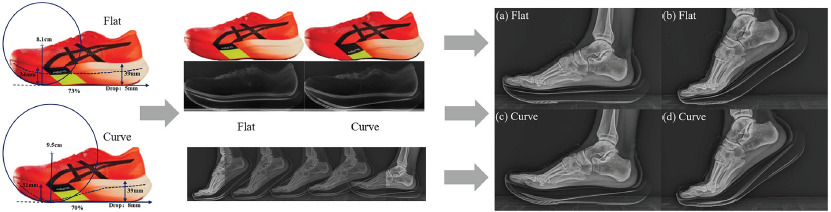
Two visually identical pairs of EU size 41 running shoes were used, with the primary design difference being the shape of the embedded carbon-fibre plate (flat vs. curved). In addition to plate geometry, key parameters differed slightly between models, including shoe mass (208 g vs. 212 g), forefoot stack height (34 mm vs. 31 mm), rocker axis position (73% vs. 70%), and rocker radius (8.1 cm vs. 9.5 cm, all respectively). Stiffness was high in both models. Rocker geometry (rocker radius and rocker axis position) was quantified from standardised side-view images of the shoes by using the Kinovea software (https://www.kinovea.org/) to digitise points along the forefoot rocker line and fit a circular arc, from which the rocker radius and rocker axis position were derived [18]. Figure 1 presents these specifications and fluoroscopic images of participants wearing each shoe. All participants completed randomised running trials in both conditions at a consistent time of day to control for circadian effects.
Experimental protocol
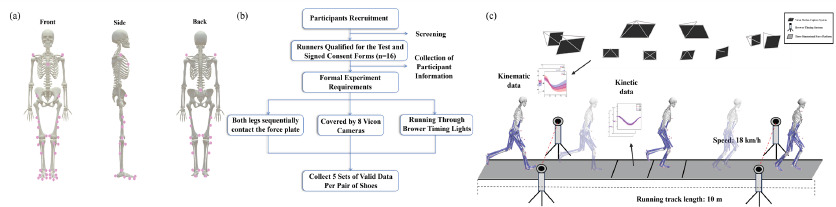
Participants first familiarised themselves with the lab, had their height and weight recorded, and completed a treadmill warm-up. During testing, they wore standardised attire. Kinematic and kinetic data were collected using an eight-camera Vicon system (200 Hz) and AMTI force platforms (1000 Hz), synchronised for temporal alignment. Running speed was monitored via an infrared timing system (Brower Timing). Thirty-eight reflective markers were placed on anatomical landmarks to capture full-body motion. After static calibration, participants ran at 18 km/h along a 10 m runway with embedded force plates [19]. A valid trial required full foot contact on both plates during left– right heel strikes within a single stride. Five valid trials per shoe condition were recorded. To ensure consistency, participants maintained natural running form and rested for 10 s between trials.
Data processing
Visual 3D 6.0 (C-Motion Inc., USA) was used to build static and dynamic models based on marker positions and participants’ anthropometrics. Joint angles were computed via inverse kinematics, and joint moments were derived using inverse dynamics. All moment data were normalised to body weight to reduce inter-individual variability.
Symmetry between the left and right sides was assessed using the symmetry angle (SA) based on discrete data points. This metric is based on the angle formed by the vector connecting the left and right values in a coordinate system:
If
Then
Joint stiffness is related to injury and performance, and is defined as follows:
Here, joint stiffness (Kjoint) was calculated as ΔM/ROM. The stance phase was defined from initial heel contact (heel-strike) to toe-off. Within this interval,ΔM was defined as the difference between the maximum and minimum joint moment of the ankle, knee, and hip (peak-to-peak moment during stance), and ROM was defined as the corresponding difference between the maximum and minimum joint angle (peak-to-peak angle during stance).
Statistical analysis
Data normality was assessed using Shapiro–Wilk tests in SPSS 22.0 (IBM, USA). Continuous joint angle data were analysed via one-dimensional statistical parametric mapping (SPM_1d, paired t-tests) in MATLAB R2022a (MathWorks Inc., USA). Statistical significance was set at = 0.05. Two-way ANOVA compared peak joint moments and stiffness between limbs and shoe types, while paired t-tests evaluated differences in symmetry angles of joint ROM, moments,and stiffness. Given the relatively small, well-trained sample and the limited number of pre-specified scalar outcome variables, no additional across-test correction such as Bonferroni or false discovery rate procedures was applied.
Results
Kinematics
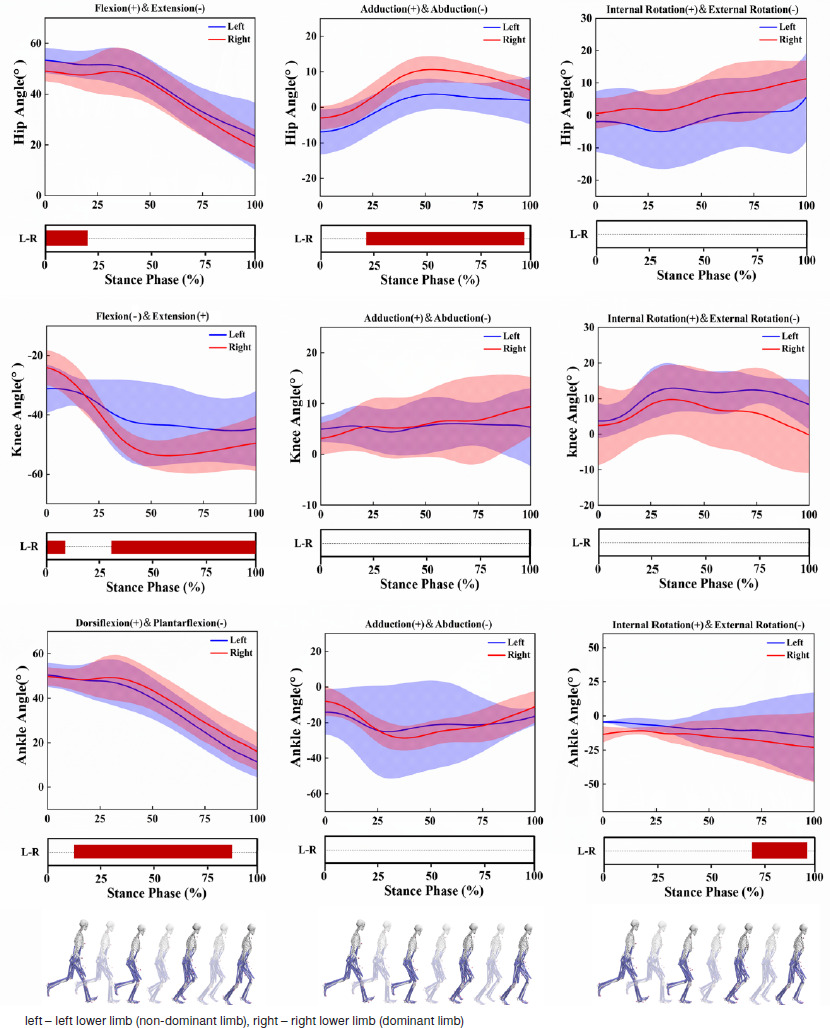
According to the SPM_1d analysis under the flat carbon plate condition (Figure 3), significant bilateral differences were found in hip flexion during early stance (0–18%, p = 0.043), with greater flexion on the left side, and in hip abduction during mid-to-late stance (22–94%, p = 0.001), with smaller values on the left. Knee extension showed asymmetry in early (0–11%, p = 0.037) and mid-to-late stance (29–100%, p = 0.001), with directional differences between sides in each phase. Ankle dorsiflexion differed significantly across most of the stance (12–87%, p = 0.001), with higher values on the right, and external rotation was also greater on the right in late stance (70–95%, p = 0.029).
Figure 3
SPM_1d analysis of joint angle variations during the stance phase in the flat carbon plate shoe condition
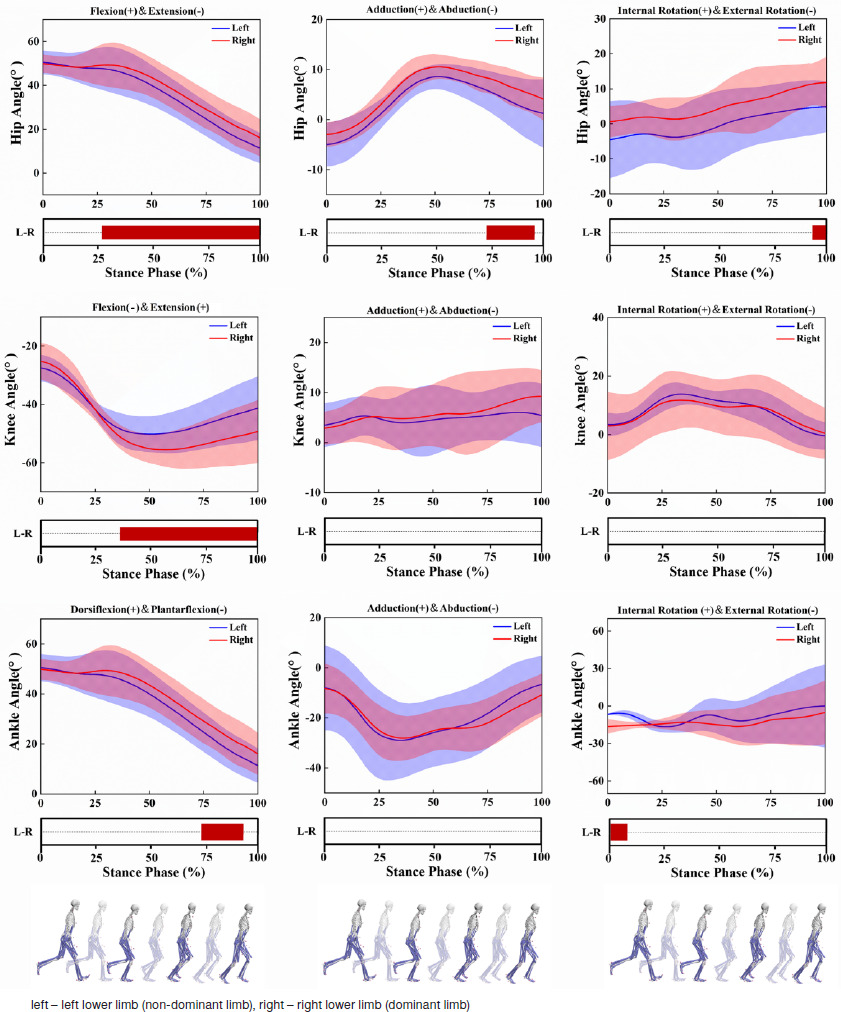
Under the curved carbon plate condition (Figure 4), SPM_1d analysis revealed significant bilateral differences in hip flexion (27–100%, p = 0.001), adduction (74–97%, p = 0.043), and internal rotation (93–100%, p = 0.050), all greater on the right. Knee extension was also higher on the right during mid-to-late stance (35– 100%, p = 0.001). At the ankle, right-side plantarflexion (74–89%, p = 0.001) and external rotation (0–13%, p = 0.036) exceeded left-side values.
Kinetics
As shown in Table 1, both shoe type and limb side significantly affected ankle, knee, and hip joint kinetics.
Table 1
Comparison of bilateral ankle, knee, and hip joint moments and stiffness between the two carbon plate shoe types
[i] left – left lower limb (non-dominant), right – right lower limb (dominant), sagittal – flexion-extension, frontal – abduction-adduction, horizontal – rotation, S – shoe types, L – limbs, S*L – shoe types and limbs interaction * indicates significant differences (p < 0.05)
Bold values indicate statistical significance.
For the ankle, the inversion (p = 0.001) and external rotation moments (p = 0.044) were consistently greater on the right. Flexion-extension stiffness differed by shoe type (p = 0.003), with significant limb differences (p = 0.001) and an interaction effect (p = 0.001). Specifically, the flat plate condition showed higher stiffness on the left, whereas no bilateral difference was observed under the curved plate condition.
For the knee joint, peak external rotation moments differed significantly by shoe type and limb (p = 0.001), with an interaction effect. The flat plate condition showed higher values on the left, while the curved plate showed the opposite. Flexion-extension stiffness also varied by condition (p = 0.002), being higher on the left with flat shoes and on the right with curved ones. In the coronal plane, stiffness differed between shoe types (p = 0.039), limbs (p = 0.001), and their interaction (p = 0.018); however, in both conditions, the left knee showed greater stiffness than the right.
For the hip joint, the peak extension moments differed between shoe types (p = 0.004), with higher values on the left under the flat condition and on the right under the curved. Flexion-extension stiffness also varied by shoe type (p = 0.035), but remained consistently higher on the left across both conditions. Rotational stiffness in the transverse plane differed significantly by shoe type (p = 0.002), with a significant interaction effect (p = 0.018); it was higher on the left with flat shoes and on the right with curved shoes.
Symmetry
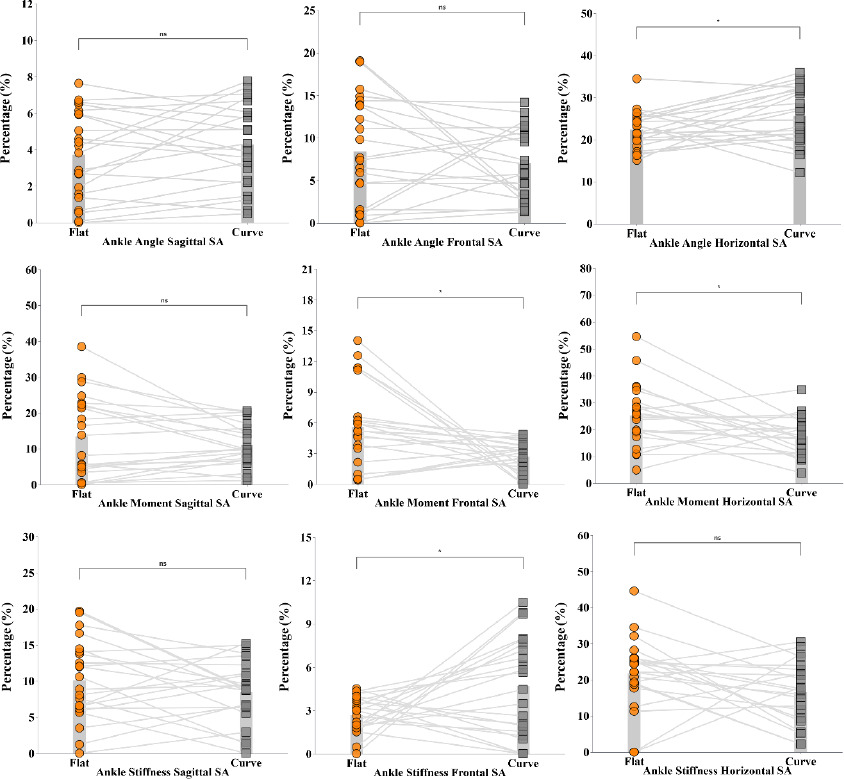
As shown in Table 2, ankle rotational angle symmetry was significantly poorer in the curved plate condition (p = 0.046, ES = –0.452), with a 2.7% increase in SA. In contrast, SA values for peak eversion and external rotation moments were reduced by 2.94% and 12.27%, respectively (p = 0.014, ES = 0.571; p = 0.016, ES = 0.556), indicating improved symmetry. Frontal plane stiffness symmetry was also worse with the curved plate (p = 0.032, ES = –0.491), as reflected by a 1.65% increase in SA. Figure 5 illustrates these individual and paired differences in angle, moment, and stiffness symmetry across all planes.
Table 2
Comparison of ankle joint angle, moment, and stiffness SA results between the two carbon plate shoe types
Figure 5
Paired dot plots comparing the SA of ankle joint angle, moment, and stiffness between the two carbon plate shoe types
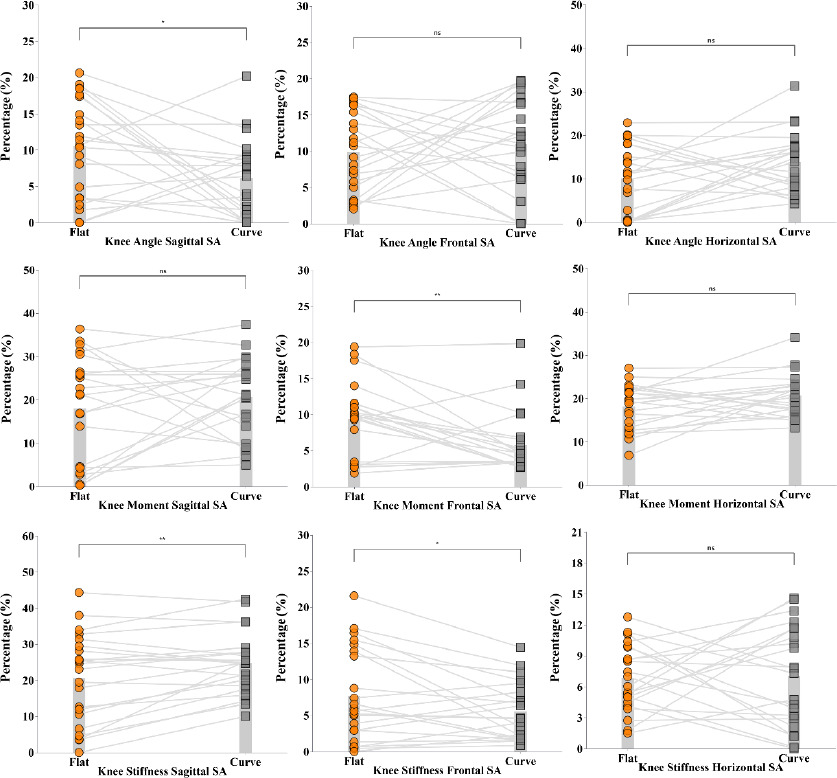
As shown in Table 3, the curved plate condition yielded better symmetry in knee flexion-extension angles and peak external rotation moments, with SA reductions of 4.56% (p = 0.029, ES = 0.501) and 2.94% (p = 0.003, ES = 0.710), respectively. However, sagittal plane stiffness symmetry worsened (p = 0.008, ES = –0.622), with a 4.2% SA increase. In contrast, frontal plane stiffness symmetry improved (p = 0.044, ES = 0.457), with SA reduced by 2.15%. Figure 6 illustrates individual and paired differences across all knee symmetry metrics.
Table 3
Comparison of knee joint angle, moment, and stiffness SA results between the two carbon plate shoe types
Figure 6
Paired dot plots comparing the SA of knee joint angle, moment, and stiffness between the two carbon plate shoe types
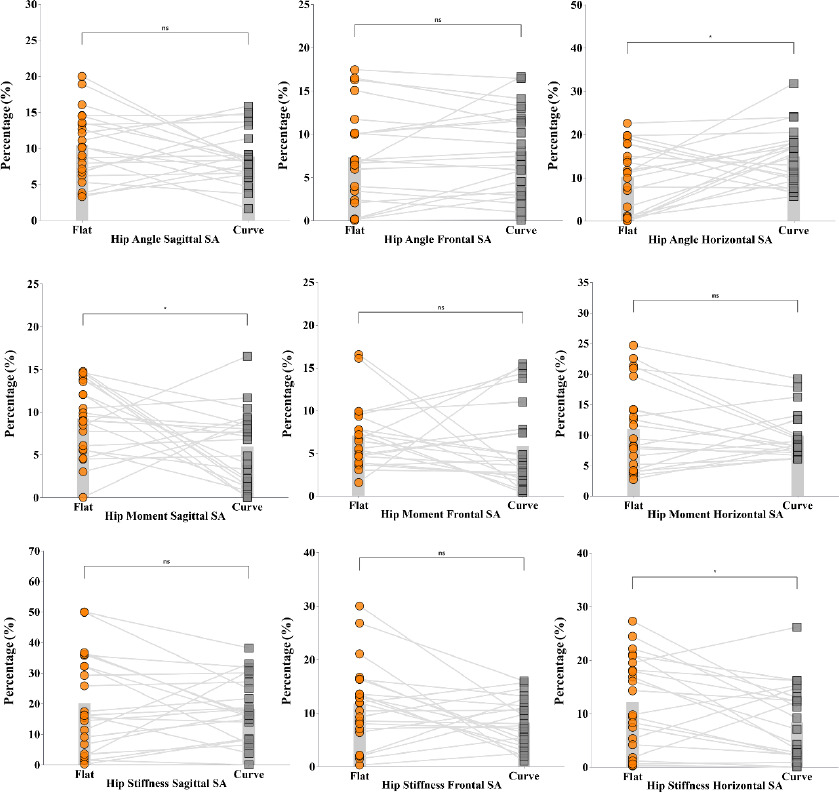
As shown in Table 4, no significant difference was found in hip flexion-extension angles (p = 0.202, ES = –0.197), though SA slightly decreased (–1.52%) with the curved plate, suggesting improved symmetry. Conversely, hip rotational angle symmetry worsened (p = 0.028, ES = –0.502), with SA increasing by 2.73%. In contrast, the curved plate improved symmetry in peak flexion-extension moments (p = 0.037, ES = 0.475) and rotational stiffness (p = 0.033, ES = 0.485), with SA reductions of 4.53% and 3.76%, respectively. Figure 7 illustrates individual and paired variations across all hip symmetry metrics.
Table 4
Comparison of hip joint angle, moment, and stiffness SA results between the two carbon plate shoe types
Discussion
This study examined how flat and curved carbon plate shoe designs affect lower limb joint symmetry in well-trained marathon runners. The results showed that plate geometry significantly influenced joint kinematics and kinetics, particularly symmetry. The curved plate improved symmetry in select ankle and knee kinetic variables, despite minor asymmetries in kinematics, highlighting its role in modulating lower limb symmetry during running.
The carbon plate geometry affected hip joint symmetry in a phase-specific manner. The flat plate induced greater left-side hip flexion during early stance, while the curved plate increased right-side hip flexion, adduction, and internal rotation during mid-to-late stance. These differences likely reflect variations in load distribution: the flat design may heighten initial impact on the left side, requiring greater flexion for stabilisation, whereas the curved design facilitates smoother foot rollover [1] but may elevate asymmetry in hip motion, which may theoretically increase the risk of hip joint overload and related overuse problems [20].
Knee joint symmetry differed between the two shoe types. The flat plate showed reduced right knee extension early in the stance and greater extension later, while the curved plate consistently exhibited larger right knee extension angles throughout. These phase shifts may cause uneven joint loading, increasing the risk of instability and tibial stress injuries [21]. Kinetically, the curved plate improved symmetry in external rotation moments and coronal stiffness, suggesting more balanced load distribution and a more favourable profile of overuse-related injury risk factors. From a lower limb kinetic chain perspective, such knee-level changes are unlikely to occur in isolation. Improved frontal plane knee symmetry may partly reflect altered hip neuromuscular control and ankle and foot rollover mechanics, and may influence how the hip and ankle are loaded during stance [22]. Enhancing knee load symmetry is widely considered important for managing biomechanical risk factors underlying chronic injuries, especially in high-load training for well-trained runners [23]. The results thus suggest that the improvements in symmetry are primarily associated with differences in plate geometry, while acknowledging that other midsole and rocker parameters may also have played a role.
Ankle joint kinematics were strongly influenced by carbon plate geometry. The flat plate increased right-side dorsiflexion across much of the stance, possibly due to its straight design limiting forefoot flexion and disrupting efficient force transfer [4]. In contrast, the curved plate enhanced right-side plantarflexion during late stance, likely by better matching the foot’s arch and improving rollover mechanics [3]. Kinetically, the curved plate improved symmetry in ankle eversion and external rotation moments by promoting more uniform plantar pressure and balanced moment generation [24]. This may reduce compensatory actions in proximal joints, enhancing overall stability. However, the curved design may limit rotational mobility, increasing stiffness and reducing adaptive capacity during stance [25]. In some cases, it may elevate midfoot loading, reducing the ankle’s shock-absorbing function and increasing rotational stiffness during propulsion [26]. These findings highlight a trade-off between support and flexibility with curved plate designs [27].
This study found that the carbon plate shape significantly influenced the stiffness symmetry in the ankle, knee, and hip joints, with notable interaction effects. While the curved plate improved knee stiffness symmetry in the coronal plane, it reduced that of the ankle, highlighting that biomechanical responses extend beyond individual joints and reflect inter-joint interactions across the kinetic chain [28]. Such asymmetries may trigger compensatory muscle activation or contralateral overloading, potentially increasing the risk of tendinopathy or joint degeneration over time [10, 29]. Future studies should incorporate both EMG and in-shoe plantar pressure measurements to assess how carbon plate geometry modulates stiffness symmetry, neuromuscular patterns, and local plantar loading, thereby aiding the development of designs that enhance performance and address biomechanical risk factors for injury [30, 31].
Carbon plate geometry affects not only individual joint mechanics but also overall lower limb coordination via the kinetic chain. This study revealed inconsistent joint responses to plate shape, suggesting potential disruption in movement coordination and reduced efficiency over time. Prior studies have linked poor coordination with increased energy cost and higher risks of chronic injuries such as stress fractures, Achilles tendinopathy, and iliotibial band syndrome [32, 33]. For well-trained marathoners, even small asymmetries can compound with long-term training, elevating injury risk. In this context, the SA changes observed in our study should be viewed as small but systematic deviations from perfect symmetry that may help identify runners who warrant closer monitoring rather than as indicators of overt pathology. Longitudinal studies are therefore needed to evaluate the sustained effects of carbon plate design on coordination and on biomechanical indicators related to injury risk, guiding shoe design that balances performance with safety.
Despite systematically investigating the impact of carbon plate geometry on lower limb symmetry and kinetics in well-trained marathon runners, this study has limitations. First, the fixed running speed may not reflect effects across varying intensities, limiting the generalisability of the results. Second, the exclusive inclusion of well-trained, healthy male runners employing a rear-foot strike running technique restricts the applicability to broader populations, and the present findings may not be generalisable to female runners. Third, lab-based testing, though precise, lacks the ecological validity of real-world running environments. Fourth, plantar pressure data were not collected, which precludes a direct link between joint-level asymmetry, local plantar loading patterns, and potential stress fracture risk. Future studies should integrate in-shoe plantar pressure measurements and include more diverse participant samples in outdoor running conditions to better characterise how carbon plate geometry affects joint mechanics and local tissue loading, thereby improving the practical relevance of design recommendations for performance and injury prevention [34]. In addition, applying artificial intelligence and machine learning to these datasets may help identify subtle movement patterns and improve data-driven injury risk prediction in carbon plate footwear research [35, 36].
Conclusions
This study demonstrated that carbon plate geometry meaningfully modulates lower limb biomechanical symmetry in well-trained marathon runners. Curved plates were associated with improved symmetry in ankle inversion–eversion and internal–external rotation moments, knee adduction–abduction moments and stiffness, and hip rotational stiffness, which may promote more balanced lower-limb load distribution and help mitigate injury risk. In contrast, flat plates yielded more symmetrical hip rotational angles and knee flexion–extension stiffness, suggesting a potential advantage for maintaining coordinated lower-limb movement. Taken together, these plane-specific effects highlight plate shape as a functional design parameter and offer practical guidance for optimising carbon-plated shoe design and using lower-limb symmetry profiles in athlete screening and monitoring.