Introduction
Small-sided games (SSGs) are popular training tasks in soccer, enabling coaches to integrate technical, tactical, physical, and psychophysiological elements within a single practice format [1]. By manipulating task constraints such as playing area, number of players, or game rules, coaches can design SSGs that target different demands of match play while adjusting the training stimulus to specific objectives [2–4]. Because of this versatility, SSGs are frequently used as part of the training process across different age groups and/or competitive levels [5–8]. However, to optimise the use of SSGs in training, it is important to understand how specific training structural features may influence players’ physical, psychophysiological, technical, and tactical responses.
Two primary approaches are commonly employed [9]: (i) continuous formats, in which players engage without pauses for a set duration, and (ii) intermittent formats, where periods of play are interspersed with rest intervals. Continuous SSGs are more similar to real match scenarios because they are prolonged and involve fluctuating demands, just like in competition [10]. In contrast, intermittent SSGs may allow players to perform actions at higher intensity during work bouts, based on the recovery period provided by the rest intervals [11, 12].
Within intermittent designs, further variation is possible through manipulation of the work-to-rest ratios [13]. A high-density format [short rest periods relative to work, (e.g., 1:0.3–0.5)] typically promotes greater cardiovascular and metabolic stress, while a lower-density format [longer recovery periods relative to work, (e.g., 1: > 0.5–1)] may favour repeated high-intensity efforts with better technical execution [14]. Thus, the choice of regimen – continuous, intermittent, or intermittent with varying densities – may influence the psychophysiological responses [e.g., heart rate (HR), lactate, rating of perceived exertion (RPE)], physical outputs (e.g., distances, accelerations), and technical-tactical performance exhibited during SSGs [13, 14].
While previous reviews have successfully mapped the effects of variables like player numbers or pitch size [15–19], a critical gap remains, as there has been no comprehensive synthesis mapping how different SSG training regimens – specifically continuous vs intermittent formats – influence players’ physical, physiological or technical/tactical outcomes. As a result, there is a limited understanding of the state of knowledge in this domain and a lack of clarity about where the evidence is consistent, where it is fragmented, and where gaps remain.
Previous reviews have not systematically compared continuous and intermittent SSG formats, nor the variations in the work-to-rest ratio within intermittent play [15–19]. Given the heterogeneity of study designs, populations, and outcome measures in this field, a scoping review was considered the most suitable approach. Unlike a systematic review, which typically assesses study quality and pools effect sizes, a scoping review allows us to map and categorise the breadth of the available evidence, highlight conceptual and methodological gaps, and clarify how training regimen characteristics have been studied to date [20].
Accordingly, this scoping review aims to provide a comprehensive overview of how different training regimens in SSGs – including continuous formats, intermittent formats, and intermittent formats with varying work-to-rest ratios – affect physical, psychophysio-logical, technical, and tactical outcomes. To achieve this, we conducted a scoping review to systematically map and synthesise the available evidence. This approach seeks to clarify how the training structure modulates responses to SSGs and to identify gaps that warrant further investigation. The lack of this synthesised information hinders coaches from making informed, evidence-based decisions on how to structure SSGs to achieve specific training goals.
Material and methods
The protocol for this scoping review was prospectively registered in the Open Science Framework (OSF) on 28/08/2025 (registration code: osf.io/3nmqd). The review was conducted in accordance with the Preferred Reporting Items for Systematic Reviews and Meta-Analyses extension for Scoping Reviews (PRISMAScR) guidelines [21].
Eligibility criteria
We defined the eligibility criteria in line with the Population – Concept – Context (PCC) framework developed by the Joanna Briggs Institute and recommended for scoping reviews [22].
Population
Inclusion: Soccer players of any age, sex, or competitive level. Studies must involve healthy participants who are actively engaged in training or competition.
Exclusion: Non-athlete populations (e.g., physical education students without organised training, recreational adults not involved in structured sport) and athletes from sports other than soccer. Clinical or injured players are also excluded.
Concept
Inclusion: Studies explicitly examining and comparing training regimens within SSGs, including: Continuous formats (uninterrupted play of fixed duration); Intermittent formats (play interspersed with predefined recovery periods); Intermittent formats with different work-to-rest ratios (e.g., 1:1, 1:2). SSGs implemented as structured training interventions, whether acutely (single session) or longitudinally (multiple sessions/seasonal). Game format (e.g., 3v3–7v7), the presence of a goalkeeper, and pitch dimensions were not used as inclusion or exclusion criteria. Outcomes of interest: Physical (e.g., external load measured by means of distances covered or accelerations or compounds of variables); Psychophysiological (e.g., HR, RPE, hormonal or metabolic responses); Technical (e.g., passing accuracy, number of technical actions); Tactical (e.g., team organisation, positional and spatial-temporal variables).
Exclusion: Studies focusing only on other SSG task constraints (playing area, number of players, rules modifications) without manipulating the training regimen. SSGs used solely as an assessment or testing tool, not as a training stimulus. Studies where SSGs are combined with other interventions (e.g., resistance training, sprint training), unless the isolated effect of the regimen structure can be discerned. Studies reporting exclusively psychological (e.g., enjoyment, motivation) or sociological outcomes without physical, psychophysiological, technical, or tactical data.
Context
Inclusion: Training-based studies conducted in competitive sport contexts (e.g., grassroots, club, academy, professional team environments). No restriction on geographic location or competitive season.
Exclusion: Non-sport contexts (e.g., general education or recreational programmes for older adults).
Types of sources
Inclusion: Original empirical research of any design (randomised controlled trials, quasi-experimental studies, crossover, repeated-measures, cross-sectional, or longitudinal/observational) was eligible. In principle, both cross-sectional studies (examining acute responses within single sessions) and longitudinal studies (evaluating training adaptations across multiple sessions or weeks) were considered, as they provide complementary information. However, all included studies in this review were designed to examine the acute, sessional effects of different SSG regimens. Although some protocols involved repeated bouts, sets, or testing sessions, no study investigated longitudinal training adaptations over weeks or months. Accordingly, all included evidence was classified as cross-sectional. Full-text articles published in peer-reviewed journals with adequate methodological detail were considered, with no restrictions on publication year or language.
Exclusion: Reviews, meta-analyses, editorials, commentaries, opinion papers, book chapters, theses, conference abstracts/articles, and dissertations. Abstract-only publications without sufficient methodological detail.
Information sources and search strategy
Searches were conducted in PubMed, Scopus, and Web of Science (Core Collection). These sources were selected as they represent some of the most relevant databases for sports science, exercise physiology, and sports medicine literature. The final searches were conducted on 28 August 2025. To ensure the evidence base was as complete as possible, additional searches of grey literature were carried out on Google Scholar. Reference lists of all included studies and related reviews were manually screened to identify further eligible articles, and a snowballing process was applied to capture additional studies through forward and backward citation tracking. Moreover, domain experts in SSGs and sport science were consulted to verify the comprehensiveness of the search and to identify studies that may not have been retrieved through database searching.
The search strategy was developed by combining free-text terms with Boolean operators to optimise retrieval. The final search string was:
[Title/Abstract] ("small-sided game" OR "small-sided games" OR "SSG" OR "SSGs" OR "conditioned game" OR "conditioned games" OR "reduced game" OR "reduced games" OR "modified game" OR "modified games" OR "sided-game" OR "sided-games" OR "medium-sided game" OR "medium-sided games" OR "large-sided game" OR "large-sided games" OR "constrained game" OR "constrained games")
AND
[Title/Abstract] ("training regimen" OR "continuous" OR "intermittent" OR "work-to-rest ratio" OR "interval" OR "training format" OR "fractionated" OR "recovery" OR "rest")
The search syntax was adapted to the specific requirements of each database. In addition to the database searches, grey literature was screened through Google Scholar (first 200 hits per query, retrieved on 28 August 2025). Forward and backward citation tracking of all included records was also conducted on 29 August 2025. All additional records identified through these procedures were screened using the same PCC criteria.
Selection of sources of evidence
All records identified through the database and supplementary searches were exported into the End-Note online software, and duplicates were removed prior to screening. The selection of sources of evidence was performed in two stages. First, titles and abstracts were independently screened by two authors (FMC and DM) against the eligibility criteria. Second, the full texts of potentially relevant articles were retrieved and assessed in detail for final inclusion. Any disagreements between authors at either stage were resolved through discussion, and when consensus could not be reached, a third author acted as arbiter (RT).
The entire selection process was documented in accordance with the PRISMA-ScR flow diagram, reporting the number of records identified, screened, excluded (with reasons), and included in the final synthesis. Reasons for exclusion at the full-text stage were systematically recorded.
Data charting process
Data from the included sources of evidence were charted using a standardised extraction form developed a priori in line with the objectives of this review. The form was designed iteratively: an initial version was piloted independently by two authors (FMC and DM) on a random sample of five studies. Based on this pilot phase, adjustments were made to refine the definitions of data items and to harmonise the charting procedure.
Following piloting, two authors (FMC and DM) independently charted data from all included studies. Extracted information covered bibliographic details (author, year), study characteristics (design, sample size, sex and competitive level of participants), details of the SSG training regimen (continuous, intermittent, or intermittent with varying work-to-rest ratios), session parameters (duration, frequency, total intervention period), and SSG design (e.g., format of play [e.g., 3v3, 4v4], pitch dimensions, task objectives, presence of goalkeeper (yes/no) and other task conditions). Operational definitions for training regimens were: (i) Continuous SSGs: Games played for a predetermined duration without planned intra-set rest intervals; (ii) Intermittent SSGs: Games structured in bouts separated by planned rest intervals (e.g., 4 × 4 min with 2 min rest); (iii) Density: The within-set work–rest structure, defined as the work-to-rest ratio (work duration ÷ rest duration), reported as x:y or as a single quotient.
Any discrepancies in data extraction between authors were resolved through discussion. When important information was missing or unclear, attempts were made to contact study authors to obtain additional details through e-mail and the ResearchGate platform.
Data items
Outcome measures were grouped into four categories aligned with the objectives of this review. Physical outcomes included external load indicators such as total distance (TD); distance covered in standardised speed zones [e.g., walking, jogging, moderate-intensity running (MIR), high-intensity running (HIR), very high-intensity running (VHIR), sprinting]; distance above test-based thresholds [e.g., > 80% of peak speed from Carminatti’s intermittent running test (PST-CAR)] or fixed cut-offs (e.g., 13, 17, 18, 21 km • h–1); maximal velocity (Vmax); accelerations (ACC) and decelerations (DEC); per-minute expressions (m • min–1); combined load metrics such as PlayerLoad (PL, accelerometer-derived composite workload); GPS-derived time–motion data (TMD); and repeated sprint or metabolic power indices.
Psychophysiological outcomes comprised heart rate (HR) measures [mean, peak, percentage of maximum heart rate (%HRmax), and time spent in HR zones]; blood lactate concentration (La–); ratings of perceived exertion (RPE) and sessional ratings of perceived exertion (sRPE, Borg CR-10 scale); enjoyment or mood scales; internal training load indices such as training impulse (TRIMP); and hormonal or metabolic markers, including total testosterone (TT), free testosterone (FT), cortisol (C), testosterone-to-cortisol ratio (T/C), and free testosterone-to-cortisol ratio (FT/C).
Technical outcomes included the number of passes, successful versus unsuccessful passes, pass accuracy (%), number of shots (on and off target), goals scored, dribbles, tackles, turnovers, goal-scoring opportunities, ball contacts, and ball involvements.
Tactical outcomes were derived from notational or positional analyses and included team surface area, pitch coverage, stretch index, inter-player synchronisation, team dispersion, player interactions, and spatial– temporal patterns.
In this review, technical outcomes were defined as discrete, individual-level actions (e.g., passes, shots, tackles) typically captured through notational analysis, while tactical outcomes were defined as collective behaviours derived from positional data (e.g., team dispersion, synchronisation, stretch index). We recognise that several validated observational instruments, such as the Game Performance Evaluation Tool [23] and the Football Assessment System (FUT-SAT) [24, 25], provide tactical indicators without positional tracking; however, no eligible study in our sample employed these tools in the context of comparing training regimens.
Synthesis of results
Data were organised into evidence tables that mapped the extent, range, and nature of the literature examining different training regimens in SSGs. Studies were grouped according to the format of play (continuous, intermittent, or intermittent with varying work-to-rest ratios) to allow comparisons across training regimens. Within each category, findings were further classified according to outcome domains: physical, psychophysio-logical, technical, and tactical. Two authors (FMC and DM) independently coded each included study into outcome domains (physical, psychophysiological, technical, and tactical). Disagreements were resolved by consensus. For studies reporting outcomes across multiple domains, all relevant domains were coded.
Patterns of evidence were summarised narratively, consistent with the objectives of a scoping review, with emphasis on convergent results, conflicting findings, and areas of insufficient evidence. Particular attention was paid to how variations in training regimens influenced responses across outcome domains, as well as to methodological gaps. The synthesis also incorporated visual mapping of evidence through figures and tables to illustrate the distribution of studies across regimens, outcomes, and populations.
Results
Selection of sources of evidence
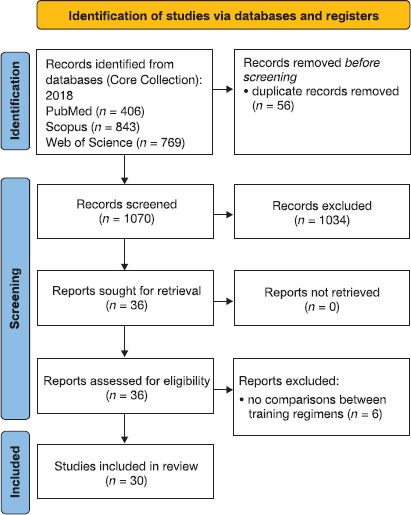
A total of 2,018 records were identified through database searches (PubMed, n = 406; Scopus, n = 843; Web of Science, n = 769). After the removal of 948 duplicates, 1,070 records remained for screening. Of these, 1,034 were excluded based on title and abstract. Thirty-six (36) full-text reports were retrieved and assessed for eligibility, with none being unobtainable. Following the assessment, six (6) studies [26, 31] were excluded because they did not include comparisons between training regimens. Ultimately, thirty (30) studies met the inclusion criteria and were incorporated into the review (Figure 1).
Characteristics of sources of evidence
Across the 30 studies synthesised in Table 1 (see end of paper), most comparisons focused on continuous versus intermittent SSG formats [10, 14, 32–35]. Comparisons between intermittent formats manipulating the bout duration were also frequently reported [13, 26, 36]. Additionally, studies examined the effects of different recovery times, with workout density emerging as a common variable of interest [37, 38]. Psycho-physiological outcomes, especially HR, RPE, and lac-tate concentration, were the most consistently reported measures in the literature [10, 39], whereas technical actions were scarcely quantified [32, 34].
Table 1
Characteristics of the included studies
| Study | Sex | Competitive level | n | Age (years) | Format | Pitch dimensions (length per width, m) | Task goal and rules | Continuous regimen | Intermittent regimens (sets × reps × work × rest; rest mode) | Outcomes - physical | Outcomes - psychophysiological | Outcomes - technical | Outcomes - tactical |
|---|---|---|---|---|---|---|---|---|---|---|---|---|---|
| Alcantara et al. [32] | male | sub-elite (U14, Brazilian professional club academy) | 11 | 13.0 ± 0.8 | 3v3 and 5v5 (both with GK) | 3v3: 37 × 24: 5v5: 48 × 31 | regular goals with GK | 1 × 20 min | 2 × 10 min (rest 300 s, passive); 4×5 min (rest 150s, passive); all «2:1 work-to-rest ratio | total distance, high- intensity running (13-18 km/h), sprinting (> 18 km/h), distance > 80% PST-CAR | RPE (CR-10) | successful/ unsuccessful passes, ball contacts, ball involvement, goals, shots (on/off target) | none reported |
| Branquinho et al. [33] | male | professional (Portuguese, senior) | 20 | 25.2 ± 6.1 | 5v5 (no offside) | 40 × 40 | regular goals with GK | 1 × 24 min | 2 × 12 min (2-min passive rest); 4×6 min (2-min passive rest); 6×4 min (2-min passive rest) | total distance, displacement at very low, low, moderate, and high/very high speeds; maximum speed | HR (max, average) | none | none |
| Branquinho et al. [14] | male | semiprofessional (Portuguese, senior) | 20 | 23.9 ± 2.1 | 5v5 (with GK) | 40 × 40 | regular goals with GK | 1 × 18 min | 3×6 min with 30s rest (passive); 3×6 min with 1-min rest; 3×6 min with 1.5-min rest; 3×6 min with 2-min rest | total distance, distance in moderate, high, very high, and max intensity zones; maximum speed | HR (max, average) | none | none |
| Casamichana et al. [10] | male | semiprofessional (Spanish, 3rd Division) | 10 | 21.3 ± 3.4 | 5v5 (no GK) | 55 × 38 | ball possession | 1 × 16 min | 2×8 min (2-min passive rest); 4×4 min (1-min passive rest) | total distance, distance in speed zones (0-6.9, 7-12.9, 13-17.9, 18-20.9, >21 km/h); accelerations; PlayerLoad | HR (mean, %HRmax, time in HR zones) | none | none |
| Castillo et al. [68] | male | national U16 division (youth competitive) | 10 | 14.8 ± 0.6 | 5v5 + GK | 38 × 26 m («100 m2 per player); 53 × 37 m («200 m2 per player) | regular goals with GK | none | 4×6 min (2-min passive rest); 6×4 min (2-min passive rest) | total distance, distance by velocity zones (walking, jogging, cruising, sprinting), maximum velocity | HRmean, HRmax | none | none |
| Chmura et al. [49] | male | elite youth (U18, Polish 1st Division Academy) | 18 El:10 E2:8 | 17.2 ± 0.9 | Iv1 | 15 × 10 | regular goals (with boards, 1v1 duels) | none | E1: 6 × 30 s × 2 min passive rest; E2: 6 × 45 s × 3 min passive rest | none | blood hormones: TT, FT, C; T/C and FT/C ratios | none | none |
| Christopher et al. [34] | male | elite youth (U16, Category 1 English Academy - Chelsea FC) | 12 | 15.8 ± 0.6 | 6v6 (with GK) | 50 × 32 | regular goals with GK | 1×8 min | 2×4 min (1-min passive rest); 4×2 min (45-60 s passive rest) | total distance, low/moderate/ high-speed running (> 17 km/h), accelerations (> 2 m/s2), decelerations (< -2 m/s2) | HR (mean, %HRmax, time > 85%HRmax), RPE (CR-10) | passes, successful passes, unsuccessful passes, shots, shots on target, goals, possessions, regains | none |
| Clemente et al. [11] | male | amateur (regional-level Portuguese) | 10 | 23.7 ± 1.1 | 5v5 (no GK, small goals) | 42 × 22 | mini-goals (2×1 m), no GK | none | 6×3 min (2-min passive rest); 3×6 min (2-min passive rest) | total distance (m/min), running distance (14-19.9 km/h), sprinting distance (> 20 km/h), accelerations > 2 m/ s2, decelerations > 2 m/s2, PlayerLoad | HRmean, RPE (CR-10) | none | none |
| Clemente et al. [13] | male | amateur (Portuguese regional-level) | 10 | 19.8 ± 1.6 | 5v5 (no GK) | 30 × 30 | mini-goals (2 × 1 m) | none | 6×3 min (2-min passive rest); 3×6 min (2-min passive rest) | total distance (m/min), running distance (14-19.9 km/h), sprinting distance (> 20 km/h) | HRmean, RPE (CR-10) | none | none |
| Daryanoosh et al. [35] | male | sub-elite (Iranian Youth League, U19) | 16 CSSG:8 ISSG:8 | 19.5 ± 0.5 | 4v4 | 40 × 20 | ball possession (touch limit = 2; turnovers and 10 passes = 1 point) | 25-40 min continuous play (progression: 25 → 40 min across 8 weeks) | 5-8 × 5 min with 1-min passive rest (progression: 25 → 40 min total across 8 weeks) | none | HRmean, HRmax, RPE (Borg 6-20) | none | none |
| Dios-Âlvarez et al. [37] | male | semi-professional (Spanish 3rd Division) | 16 | 24.8 ± 6.8 | 4v4 + GK | 30 × 25 | regular goals with GK | none | 4×4 min bouts; recovery durations: 1 min, 2 min, 4 min (passive) | total distance, distances by intensity (walking, low, medium, high, sprint), max speed, accelerations, decelerations, Player- Load, power score, HMP | RPE (Foster 0-10) | none | none |
| Esqueda et al. [36] | male | elite youth (U17, professional academy, Mexico) | 8 | 16.3 ± 0.5 | 4v4 + GK | 24 × 17 | regular goals with GK | none | LB: 3×6 min (2-min passive rest); SB: 6×3 min (2-min passive rest) | total distance, distance in intensity zones (< 12, 13-17.9, > 18 km/h), explosive distance (> 1.2 m/s2), accelerations > 2 m/s2, decelerations < -2 m/s2, PlayerLoad | HRpeak, HRmean | none | none |
| Farhani et al. [46] | male | semi-professional (Tunisian national league, high-level) | 16 | 20.7 ± 0.7 | 3v3 and 4v4 (with GK) | 3v3: 20 × 30; 4v4: 25 × 32 | regular goals with GK | 1×12 min | 2×6 min (2-min passive rest); 3×4 min (2-min passive rest) | none | %HRpeak, HRpeak, blood lactate, RPE (CR-10), PACES | successful passes, tackles, duels, ball losses (%) | none |
| Farhani et al. [47] | male and female | high-level national league (Tunisia) | 32 M:16 F:16 | M: 20.7 ± 0.7: F: 20.1 ± 0.5 | 4v4 + GK | 25 × 32 | regular goals with GK | 1 × 12 min | 2 × 6 min (2-min passive rest); 3×4 min (2-min passive rest) | none | %HRpeak, HRpeak, blood lactate, RPE (CR-10), PACES | successful passes, tackles, duels, ball losses (%) | none |
| Farhani et al. [42] | male | semiprofessional (Tunisian national league, high-level) | 16 | 20.7 ± 0.7 | 3v3 and 4v4 + GK | 3v3: 30 × 20; 4v4: 25 × 32 | regular goals with GK | 1×12 min | 2×6 min (2-min passive rest); 3×4 min (2-min passive rest) | none | mood state (POMS: TMD, fatigue, depression, anger, tension, confusion, vigor) | successful passes (%), successful tackles (%), successful duels (%), ball losses (%) | none |
| Hidalgo-de Mora et al. [69] | male | sub-elite (U18, British Local League Division) | 14 | 17.1 ± 0.6 | 7v7 + GK | LSG: 68 × 40 (194 m2/player): SSG: 40 × 34 (97 m2/player) | regular goals with GK | 3×8 min with 5-min passive rest (large pitch, LSG:8) | 6×4 min with 2-min passive rest (large pitch, LSG4); 6×4 min with 2-min passive rest (small pitch, SSG4) | total distance, low- intensity running, high-intensity running, very high-intensity running, sprinting distance, mean velocity, max velocity, accelerations, decelerations | none | KV | none |
| Hill-Haas et al. [43] | male | elite youth (U18, Australian top domestic competition) | 16 | 16.2 ± 0.2 | 2v2, 4v4, 6v6 | 2v2: 28 × 21: regular goals 4v4: 40 × 30: (not specified 6v6: 49 × 37GK) | 1 × 24 min | 4×6 min (1.5-min passive rest) | total distance, distance in speed zones (0-6.9; 7-12.9; 13-17.9; >18 km/h), sprints, sprint activity ratio | HR (every 5s, %HRmax, time in HR zones), blood lactate, RPE (Borg 6-20) | none | none | |
| Ispirlidis et al. [70] | male | semi-professional (Greek regional league) | 8 | 21.5 ± 0.3 | 4v4 | 40 × 30possession (score a goal after 6 passes, man-to-man marking, no goalposts) | Con: 2×8 min (3-min rest) | Int-I: 4×4 min (3-min passive rest); Int-II: 4×4 min sets (each set = 1 min work + 10, 20, 30 s recovery, +1 min work; 3-min passive rest between sets) | total distance, distance in speed zones (3-6.99, 7-10.99,11-14.99, 15-18.99, > 19 km/h), accelerations (> 3 m/s2), decelerations (< -3 m/s2) | HRmean (%HRmax), time in HR zones, RPE (Borg 1-10), sRPE | none | none | |
| Köklü [9] | male | elite youth (U17, Turkish academy league) | 20 | 16.6 ± 0.5 | 2v2, 3v3, 4v4 (no GK) | 2v2: 15 × 20: free play with 3v3: 18 × 24: coach encour- 4v4: 24 × 36 agement, no GK | 2v2: 1×6 min: 3v3: 1 × 9 min: 4v4: 1 × 12 min | 2v2: 3×2 min (2-min passive rest); 3v3: 3×3 min (2-min passive rest); 4v4: 3×4 min (2-min passive rest) | none | HRmean, %HRmax, blood lactate | none | none | |
| Köklü et al. [38] | male | elite youth (U15, Turkish academy league) | 12 | 15.4 ± 0.5 | 3v3 (no GK) | 18 × 30 ball possession (90 m2/(keep ball in play player)as long as possi ble; no GK, coach encouragement, spare balls) | none | 4×4 min bouts; recovery durations: 1 min (R1), 2 min (R2), 3min (R3), 4min (R4) (all passive) | total distance, distance in speed zones (walking, LIR, MIR, HIR > 18 km/h) | %HRmax, %HRreserve, blood lactate, RPE (CR-10) | touches of the ball, total passes, successful passes, passes received, tackles | none | |
| Köklü et al. [55] | male | elite youth (U17, Turkish academy league) | 15 | 17 ± 1 | 2v2, 3v3, 4v4 (no GK) | 2v2: 16 × 25; ball possession 3v3: 20 × 30; (maintain pos- 4v4: 25 × 32 session, coach encouragement, spare balls, no GK) | 1×12 min (CON) | SBD: 6×2 min (1-min passive rest, 1:1 ratio); MBD: 3×4 min (2-min passive rest, 2:1); LBD: 2×6 min (3-min passive rest, 3:1) | total distance, distance in speed zones (walking, LIR, MIR, HIR), max speed | %HRmax, blood lactate, RPE (CR-10) | none | none | |
| Kryściak et al. [40] | male | elite youth (U18, Polish 1st Division Academy) | 20 (El:10: E2:10) | 17.2 ± 0.9 | 1v1 | 15 × 10 small goals, no GK, coach-fed balls to maintain tempo | none | E1: 6 × 30 s (120-s passive rest, 1:4 ratio); E2: 6 × 45 s (180-s passive rest, 1:4 ratio) | total distance, distance per min, player load, player load per min, Vmax | %HRmax, blood lactate, pH, HCO31, BE | none | none | |
| Kryściak et al. [41] | male | elite youth (U18, Polish 1st Division Academy) | 20 SEP1:10 SEP2:10 | 17.2 ± 0.8 | Iv1 | 10 × 15 small goals, no GK, continuous ball supply by coach | none | SEP1: 6 × 30 s (120-s passive rest, 1:4 ratio); SEP2: 6 × 45 s (180-s passive rest, 1:4 ratio) | TD, PlayerLoad, accelerations (> 2 m/s2), decelerations (> 2 m/s2), all also expressed per min; max velocity | none | none | none | |
| McLean et al. [44] | male | sub-elite (Australian 2nd tier league, experienced players) | 12 | 21.3 ± 2.9 | 3v3 | 15 × 20 ball possession (no goals, no GK, unlimited touches, no coach encouragement) | none | 6×2 min; recovery durations: 30 s (REC-30, passive walking) vs 120 s (REC-120, passive walking) | total distance, distance in speed zones (0-6.9, 7-12.9, 13-17.9, > 18 km/h) | vastus lateralis oxygenation (HHb, O2Hb, tHb, via NIRS), HRmean, HRpeak, RPE (CR-10) | none | none | |
| McLean et al. [45] | male | semi- professional (2nd tier, Australia) | 12 | 21 ± 3 | 3v3 | 15 × 20 | ball possession (no goals/GK, unlimited touches, no coach encouragement) | none | 6×2 min bouts; 30 s recovery (REC-30, passive walking) vs 120 s recovery (REC-120, passive walking) | distance, speed zones (via TMD, GPS) | HR, RPE (CR-10) | 16 TS variables: total passes, successful passes, first-touch passes, passes received, time in possession, individual touches, successful tackles, etc. | none |
| Mulazimoglu and Kartoglan [48] | male | universitylevel, sub-elite (Turkey) | 12 | 20.8 ± 1.6 | 3v3 | 34 × 26 | free play, spare balls, no GK | 1×12 min | 3×4 min (2-min passive rest, ~1:½ work:rest ratio) | total distance, distance per min, sprint distance, max speed, PlayerLoad | HR (mean, %HRmax, time in 5 zones), RPE not reported | none | none |
| Nagy et al. [39] | male | elite youth (U15, Slovak 1st Division, DAC 1904) | 8 | 14.5 ± 0.5 | 4v4 + GK | 30 × 20 | regular goals with GK | none | SSG1: 4×2 min with 4-min active rest (1:2); SSG2: 4 × 2 min with 2-min active rest (1:1); SSG3: 4 × 2 min with 1-min active rest (1:0.5) | none | HRmin, HRmean, HRmax, time in HR zones, % time > anaerobic threshold | none | none |
| Pancar et al. [56] | male | youth (domestic Turkish club, pre-season) | 16 ISSG:8 CSSG:8 | ISSG: 16.50 ± 0.53 CSSG: 16.63 ± 0.52 | 4v4 | 25 × 32 | ball possession (2-touch rule, no GK, spare balls for continuity) | CSSG: 1 × 16 min (wk 2) → 1 × 28 min (wk5), continuous play | ISSG: 4×4 min (wk2) → 4 × 7 min (wk5); 2-min passive rest seated/standing between bouts | none | RPE (CR-10 Borg, sessional), BMI | none | none |
| Sanchez- Sanchez et al. [71] | male | junior players (Spanish regional-level team) | 12 | 17.2 ± 0.44 | 4v4 + GK | 40 × 30 (150 m2/ player) | regular goals with GK; external wildcard used | none | fixed recovery: 2-min play, 2-min rest (BF, EF); variable recovery: play until goal scored or 2-min max (BV, EV); order manipulated (beginning vs end of session) | total distance, relative distance (m/min), distance in speed zones (0-0.4, 0.5-3, 3.1-8, 8.1-13, 13.1-18, > 18 km/h), HID (> 13 km/h), max speed | none | none | none |
| Zanetti et al. [54] | male | elite U20 (Brazilian 1st Division, Red Bull Brazil) | 18 | 19 ± 1.0 | multiple: 3vl, 3v3, 5v5v5, 5v4, 7v7v7, 10v9 (with GK) | ranged: 15×15 (3vl) to 40 × 55 (7v7v7, 10v9) | regular goals with GK, possession, transition, goal attempts | extensive: longer bouts (e.g., 1 × 20 min, 1 × 25 min, 1 × 30 min, 6×3 min, etc.) | intensive: shorter bouts, more sets (2 × 30 s, 5 × 3 min, 6×3 min, 3×8 min, etc.), rest intervals 30 s-3 min | TDR, high-speed running (> 20 km/h), accelerations (> 2 m/s2), decelerations (< -2 m/s2), all per min | session-RPE (CR-10), ITL = RPE × duration | none | none |
[i] BE – base excess, BF – fixed recovery, BMI – body mass index, BV – variable recovery, C – cortisol, CAR – Carminatti’s Test Peak Speed, CB – continuous bout, CC – accelerations, CMJ – countermovement jump, CON – continuous regimen, CSSG – continuous small-sided game, DEC – decelerations, E – exercise, EF – at the end of the session with fixed recovery, ETL – external training load, EV – end of session + variable recovery, F – female, FT – free testosterone, GK – goalkeeper, GPS – global positioning system, HCO3 – – bicarbonate, HID – high-intensity distance, HHb – deoxyhaemoglobin, HIR – high-intensity running, HR – heart rate, HRmean – mean heart rate, HRmin – minimum heart rate, HRmax – maximal heart rate, HRpeak – peak heart rate, ISSG – intermittent small-sided game, ITL – internal training load, KV – kick velocity, LB – long bout, LBD – long bout duration, LIR – low intensity running, LSG – large-sided game, M – male, MBD – medium bout duration, MIB – medium intermittent bout, MIR – moderate-intensity running, NIRS – near-infrared spectroscopy, O2Hb – oxyhaemoglobin, PACES – Physical Activity Enjoyment Scale, PL – PlayerLoad, POMS – profile of mood states, PST-CAR – peak speed from Carminatti’s intermittent running test, R – regimen, RAST – running-based anaerobic sprint test, RD – relative distance, REC-30 / REC-120 – recovery conditions with 30 s or 120 s rest, RPE – rating of perceived exertion, SB – short bout, SBD – short bout duration, SEP – special endurance protocol, SSGc – continuous small-sided game, SSGi – intermittent small-sided game, sRPE – session rating of perceived exertion, T/C – testosterone to cortisol ratio, TD – total distance, TDR – total distance running, tHb – total hemoglobin, TMD – time–motion data (or total mood disturbance, context-dependent), TT – total testosterone, VHIR – very high-intensity running, Vmax – maximal velocity, wk – week
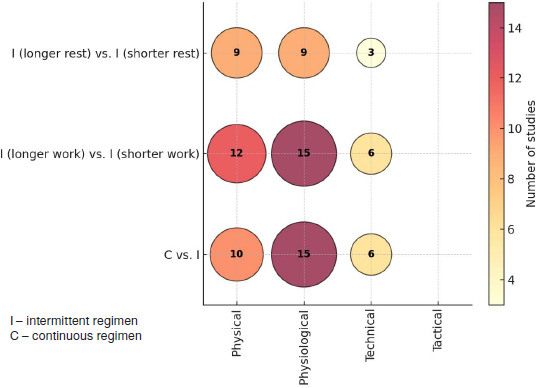
The evidence gap map (Figure 2) highlights this imbalance, showing dense coverage in the physical and psychophysiological domains but considerably fewer studies addressing technical or tactical outcomes. In reality, tactical measures of collective behaviour remain almost absent. Moreover, although work has begun exploring metabolic stress markers such as acid– base balance in high-intensity 1v1 SSGs [40, 41] and mood-related outcomes [42], these remain underrep-resented in the broader dataset.
Figure 2
Evidence gap map of training regimen comparisons by outcome domain. Numbers in cells indicate the number of studies contributing to each cell.
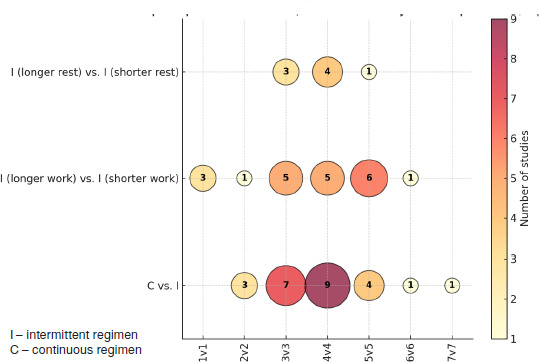
Analysis of study designs by format of play showed that most evidence was accumulated in 4v4, 3v3, and 5v5 SSGs, particularly when comparing continuous and intermittent regimens (Figure 3). For example, 9 studies contrasted continuous and intermittent structures in 4v4 formats, while 7 and 4 studies did so in 3v3 and 5v5, respectively. In contrast, evidence for larger formats (6v6, 7v7) or very small-sided designs (1v1, 2v2) remains unstudied, with only isolated comparisons reported. Intermittent–intermittent contrasts (longer vs shorter bouts or longer vs shorter recovery) have been studied in 3v3 to 5v5 formats but are virtually absent in 6v6 and 7v7.
Results of individual sources of evidence
Comparisons between continuous and intermittent regimens (Table 2, see end of paper) consistently indicate that intermittent formats tend to elicit greater distances covered at high speeds and more accelerations, while continuous play sustains higher cumulative workloads [10, 32, 43]. The work-to-rest ratio was also a critical determinant: longer recoveries allowed greater high-intensity outputs, whereas shorter rests constrained physical performance [38, 44, 45].
Table 2
Main findings for physical outcomes
| Study | Comparison tested | Outcome(s) | Main findings |
|---|---|---|---|
| Alcântara et al. [32] | shorter vs longer bouts; 3v3 vs 5v5 | TD, > 80% PST-CAR | shorter bouts ↑ TD and > 80% PST-CAR (sig); 3v3 > 5v5 for actions per player (sig) |
| Branquinho et al. [33] | continuous 1 × 24 vs 2 × 12 vs 4 × 6 vs 6 × 4 | TD + speed zones | fractionated formats ↑ TD (esp. low-moderate speeds) vs continuous (sig) |
| Branquinho et al. [14] | 3 × 6 with 0.5, 1, 1.5, 2 min rests | TD, Vmax | longer rests (1.5-2 min) ↑ TD and Vmax vs 0.5-1 min (sig) |
| Casamichana et al. [10] | Con 1 × 16 vs 2 × 8 vs 4 × 4 | TD, PlayerLoad | intermittent ↑ TD (small; sig/MBI), continuous ↑ PL (sig) |
| Castillo et al. [68] | 4 × 6 vs 6 × 4-min, 2 min rest | TD, HSR, Vmax | no significant differences between 4 × 6 min and 6 × 4 min in TD, HSR, or Vmax; differences were mainly due to pitch size (200 m2 > 100 m2) |
| Christopher et al. [34] | 1 × 8 vs 2 × 4 vs 4 × 2 | TD, HSR, ACC/DEC | no differences across formats (ns) |
| Clemente et al. [11] | 6 × 3 vs 3 × 6 | TD, running, ACC/DEC | 6 × 3 > 3 × 6 for TD, running, ACC/DEC (MBI: almost certainly/very likely) |
| Clemente et al. [13] | 6 × 3 vs 3 × 6 | TD, running, sprint | 6 × 3 > 3 × 6 for TD and running (sig); sprinting ns |
| Dios-Álvarez et al. [37] | 1 vs 2 vs 4-min rest (4 × 4 + GK) | ACC/DEC, TD/HSR, Vmax | 4-min rest ACC/DEC vs 1-min (sig); TD/HSR/Vmax ns |
| Esqueda et al. [36] | 3 × 6 vs 6 × 3 (4v4 + GK) | TD, low-int, explosive, ACC/DEC | 3 × 6 > 6 × 3 for all listed metrics (sig) |
| Hidalgo-de Mora et al. [69] | LSG8 vs LSG4 vs SSG4 | TD, HIR/VHIR, sprint, Vmax | larger pitch + short bouts (LSG4) ↑ TD/HIR/VHIR/ sprint/Vmax vs others (sig) |
| Hill-Haas et al. [43] | Con 1 × 24 vs Int 4 × 6 | HIR ≥ 13 and > 18 km • h-1), sprints | intermittent > continuous for HIR and sprints (sig) |
| Ispirlidis et al. [70] | Con (2 × 8) vs Int-I (4 × 4) vs Int-II [4 × (1 min work + micro-rests)] | TD, HSR | Int-II > Int-I > Con for TD and HSR (sig) |
| Köklü et al. [38] | 3v3 with 1, 2, 3, 4-min rest | TD, MIR, HIR | 3-min rest ↑ TD and HIR (sig); 4-min ↑ MIR (sig) vs shorter rests |
| Köklü et al. [55] | Con 1 × 12 vs SBD 6 × 2 vs MBD 3 × 4 vs LBD 2 × 6 | TD, MIR, HIR, Vmax | SBD > LBD/Con for TD and MIR (sig); HIR largely ns; some Vmax advantages for SBD (sig, 2v2) |
| Kryściak et al. [40] | 1v1: 6 × 30 s (1:4) vs 6 × 45 s (1:4) | TD • min-1, Vmax | 30 s > 45 s for TD • min-1 and Vmax (sig); but lower total volume (sig) |
| Kryściak et al. [41] | same formats across 6 reps | TD/PL/ACC/DEC (per rep) | all ↓ across reps (sig); sharper drops with 30 s vs 45 s (sig) |
| McLean et al. [44] | 6 × 2 with 30 s vs 120 s rest | distance and speed zones | no between-condition differences (ns) |
| McLean et al. [45] | 6 × 2 with 30 s vs 120 s rest | GPS TMD | no differences (ns) |
| Mulazimoglu and Kartoglan [48] | Con 1 × 12 vs Int 3 × 4 | PL, TD, sprint | Int > Con for PlayerLoad (sig); TD/sprint/Vmax ns |
| Sánchez-Sánchez et al. [71] | begin vs end; fixed vs variable recovery | TD, HID, Vmax | begin > end for TD/HID (sig); variable > fixed for Vmax (sig) |
| Zanetti et al. [54] | ‘extensive’ vs ‘intensive’ sessions | TDR, HSR | extensive > intensive for TDR and HSR (ES > 0.8; sig CLs) |
[i] ACC – accelerations, CB – continuous bout, CL – confidence limits, Con – continuous format, DEC – decelerations, ES – effect size, HIR – high-intensity running (study-specific, often 18 km ・ h–1), HSR – high-speed running (study-specific threshold, commonly 17–20 km ・ h–1), Int – intermittent format, ISSG/CSSG – intermittent/continuous small-sided game, LSG – large-sided game, MIR – moderate-intensity running, PL (PlayerLoad) – accelerometer-derived composite workload, PST-CAR – peak speed from Carminatti’s intermittent running test, RAST – running-based anaerobic sprint test, SBD/MBD/LBD – short/medium/long bout duration, SSG – small-sided game, TD – total distance, TDR – total distance running, TMD (GPS) – time–motion data (GPS-derived movement metrics), VHIR – very high-intensity running, Vmax – maximal velocity sig – statistically significant, ns – non-significant, ・ min–1 – per-minute expression
Across formats, continuous regimens generally produced higher mean HR and RPE [43, 46, 47]. Conversely, intermittent regimens often elicited similar or higher HR peaks but lower sessional RPE (sRPE) [10, 35, 48]. Manipulating the bout and rest durations showed consistent patterns: shorter work-to-rest ratios increased lactate and RPE [38, 39], whereas longer recoveries attenuated internal load and improved metabolic recovery [37, 44, 45]. Some recent studies also expanded into hormonal [49] and mood-related markers [42]. Table 3 (see end of paper) presents the main findings, showing how different bout and recovery structures distinctly shape cardiovascular, metabolic, and perceptual demands in SSG training.
Table 3
Main findings for psychophysiological outcomes
| Study | Comparison tested | Outcome(s) | Main findings |
|---|---|---|---|
| Alcântara et al. [32] | short vs long bouts; 3v3 vs 5v5 | RPE | shorter bouts ↑ RPE (sig); 3v3 > 5v5 (sig) |
| Branquinho et al. [33] | Con vs fractionated | HR | fractionated formats ↑ HR metrics vs continuous (sig) |
| Branquinho et al. [14] | 0.5, 1, 1.5, 2-min rest | HR, RPE | 0.5-min rest ↑ HR/RPE vs 1.5-2-min (sig) |
| Casamichana et al. [10] | Con vs 2 × 8 vs 4 × 4 | %HRmax | all ~87% HRmax; small between-format diffs (mostly ns); continuous showed late HR drift |
| Castillo et al. [68] | 4 × 6 vs 6 × 4-min, 2 min rest | HRmean, HRpeak | no significant differences between 4 × 6 min and 6 × 4 min for mean or peak HR; pitch size explained the main variation, with larger pitches eliciting higher HR responses |
| Chmura et al. [49] | 6 × 30 s (2 min rest) vs 6 × 45 s (3 min rest) | TT, FT, C, T/C | both ↑ TT/FT/C post (sig); 45 s (3 min) > 30 s (2 min) for anabolic balance (T/C) (sig) |
| Christopher et al. [34] | 1 × 8 vs 2 × 4 vs 4 × 2 | HR, RPE | RPE: 1 × 8 > 2 × 4 > 4 × 2 (sig); HR similar (ns) |
| Clemente et al. [11] | 6 × 3 vs 3 × 6 | HRmean, RPE | RPE: 3 × 6 > 6 × 3 (sig); HRmean ns |
| Clemente et al. [13] | 6 × 3 vs 3 × 6 | HRmean, RPE | RPE ↑ in 3 × 6 (sig); HRmean ns |
| Daryanoosh et al. [35] | ISSG vs CSSG (8 wk) | HRmean, HRmax, RPE | ISSG ↓ HRmean and RPE, ↑ HRmax vs CSSG (all sig) |
| Dios-Álvarez et al. [37] | 1 vs 2 vs 4-min rest | RPE | 2-min rest > 1-min for RPE (sig); 4-min ®1-min (ns) |
| Esqueda et al. [36] | 3 × 6 vs 6 × 3 | HRmean, HRpeak | 3 × 6 > 6 × 3 for HRmean/HRpeak (sig) |
| Farhani et al. [46] | Con vs 2 × 6 vs 3 × 4; 3v3 vs 4v4 | %HRpeak, lactate, RPE, PACES | Con > Int for %HRpeak, lactate, enjoyment (sig); 3v3 > 4v4 for HR/lactate/RPE (sig) |
| Farhani et al. [47] | sex × regimen | %HRpeak, lactate, RPE, PACES | females: intermittent most enjoyable; CB ↑ HR/lactate/RPE (sig); males: CB highest enjoyment and HR/lactate/RPE (sig) |
| Farhani et al. [42] | CB vs 2 × 6 vs 3×4 | POMS (TMD and subscales) | CB and 2 × 6 ↓ TMD, depression/anger/tension/confusion (sig); 3×4 ns for TMD |
| Hill-Haas et al. [43] | Con vs Int | %HRmax, RPE, lactate | Con > Int for %HRmax and RPE (sig); lactate ns |
| Ispirlidis et al. [70] | Con vs Int-I vs Int-II | %HRmax, time in zones, RPE, sRPE | Con highest %HRmax (sig); Int-I highest RPE/sRPE (sig); Int-II maintained more time > 80%HRmax with lower RPE (sig) |
| Köklü [9] | 2v2 vs 3v3 vs 4v4; Con vs Int | HR/%HRmax, lactate | 3v3 > others for HR/%HRmax (sig); 2v2 > others for lactate (sig); Con vs int differences minimal (mostly ns; 2v2 lactate higher in Con, sig) |
| Köklü et al. [38] | 1 vs 2 vs 3 vs 4-min rest | %HRmax/%HRR, lactate, RPE | 1-min rest > 3-4 min for all (sig); 4-min lowest (sig) |
| Köklü et al. [55] | Con vs SBD vs MBD vs LBD | %HRmax, lactate, RPE | SBD and Con > LBD for lactate/RPE (sig); %HRmax highest in Con/LBD (sig) |
| Kryściak et al. [40] | 30 s vs 45 s (1:4) | HR, lactate, pH, HCO3-, BE | both ↑ HR/lactate (sig); 30 s caused greater acidosis (↓HCO3-/BE, ↓pH) vs 45 s (sig) |
| McLean et al. [44] | 30 s vs 120 s rest | HRmean/peak, HHb, RPE | during bouts: all ns; recovery HR lower with 120-s (sig) |
| McLean et al. [45] | 30 s vs 120 s rest | HR, RPE | during bouts: ns; recovery HR lower with 120-s (sig) |
| Mulazimoglu and Kartoglan [48] | Con vs Int | HR zones | Int ↑ time in zone 5 (> 94%HRmax) (sig); Con ↑ time in zone 3 (sig) |
| Nagy et al. [39] | 1:2 vs 1:1 vs 1:0.5 | HRavg, time in zones | shorter rests ↑ HRavg and time at 90-100%HRmax (sig) |
| Pancar et al. [56] | ISSG vs CSSG (5 wk) | sRPE | CSSG > ISSG for sRPE (sig) |
| Zanetti et al. [54] | extensive vs intensive | sRPE, ITL | intensive > extensive for sRPE and ITL (sig) |
[i] BE – base excess, Con/CB – continuous format/continuous bout, HCO3– – bicarbonate, HHb – deoxyhaemoglobin (near-infrared spectroscopy), HR – heart rate, HRmax – maximal heart rate, HRmean/HRavg – mean/average heart rate, HRpeak – peak heart rate, %HRmax – percentage of maximal heart rate, %HRR – percentage of heart-rate reserve, Int – intermittent format, Int-I/Int-II – intermittent models I and II (study-specific intermittent structures), ISSG/CSSG – intermittent/continuous small-sided game, ITL – internal training load (RPE × session duration), PACES – Physical Activity Enjoyment Scale, pH – blood acidity, POMS – Profile of Mood States, REC-30/REC-120 – recovery conditions with 30-s or 120-s rest, RPE – rating of perceived exertion, SBD/MBD/LBD – short/medium/long bout duration, sRPE – session RPE, T/C – testosteroneto-cortisol ratio, TT/FT/C – total testosterone/free testosterone/cortisol, TMD (POMS) – total mood disturbance, 1:2, 1:1, 1:0.5 – work-to-rest ratios, 30 s/45 s – 30-s/45-s work intervals sig – statistically significant, ns – non-significant
Continuous regimens often favoured passing accuracy and ball possession (Table 4, see end of paper), while intermittent regimens tended to increase the number of duels, tackles, and goal-scoring opportunities [43, 42, 46]. Very short recoveries reduced passing success, whereas longer rests allowed better execution of ball actions [38, 45].
Table 4
Main findings for technical outcomes
| Study | Comparison tested | Outcome(s) | Main findings |
|---|---|---|---|
| Alcântara et al. [32] | short vs long bouts; 3v3 vs 5v5 | passes/contacts/involvements | shorter bouts ↑ individual actions (sig); 3v3 > 5v5 (sig) |
| Christopher et al. [34] | 1 × 8 vs 2 × 4 vs 4 × 2 | goals, shots, passes, possessions | intermittent > continuous for goals and shots (sig); passes/possessions ns |
| Farhani et al. [46] | Con vs 2 × 6 vs 3 × 4 | % passes, tackles, duels, ball loss | Con > Int for % passes and ↓ ball loss (sig); 3v3 showed higher duels; 4v4 higher tackles (sig) |
| Farhani et al. [47] | sex × regimen | same as above | females: intermittent > continuous for overall technical execution (sig); males: continuous > intermittent (sig) |
| Farhani et al. [42] | CB vs 2 × 6 vs 3 × 4; 3v3 vs 4v4 | % passes/tackles/duels, ball loss | CB ↑ % passes and ↓ ball loss (sig); 3v3-CB ↑ duels (sig); 4v4-CB ↑ tackles (sig) |
| Hidalgo-de Mora et al. [69] | LSG4/LSG8/SSG4 | KV | KV impaired post-SSG (small pitch) vs baseline and vs LSG (sig) |
| Köklü et al. [38] | 1 vs 2 vs 3 vs 4-min rest | touches, passes (total/successful/received), tackles | 1-min rest ↓ passing metrics (sig); 4-min rest ↑total/successful passes (sig); 3-min ↑ tackles/ touches (sig) |
| McLean et al. [45] | 30 s vs 120 s rest | 16 skill metrics | 120-s rest ↑ successful tackles (sig); other skills ns |
[i] ball loss – turnovers in possession, Con/CB – continuous format/continuous bout, duels – one-vs-one contested actions, Int – intermittent format, KV – kick velocity, SSG/LSG – small-/large-sided game, tackles – defensive ball-winning actions, % passes – percentage of successful passes sig – statistically significant, ns – non-significant
Discussion
The objective of this study was to provide a comprehensive overview of how different training regimens in SSGs – including continuous formats, intermittent formats, and intermittent formats with varying work-to-rest ratios – affect physical, psychophysiological, technical, and tactical outcomes. Most studies contrasted continuous and intermittent regimens, particularly in relation to psychophysiological responses, followed by explorations of intermittent formats with differing bout durations. By contrast, fewer studies examined work-to-rest manipulations, and none provided quantitative assessments of tactical behaviour. Most evidence clustered around the 3v3–5v5 formats, with 4v4 emerging as the most studied, whereas smaller formats (1v1–2v2) and larger formats (6v6–7v7) were scarcely explored. Manipulations of bout duration suggested that shorter repetitions may help maintain higher per-minute intensity but at the expense of total volume, whereas longer rest periods appeared to facilitate greater physical output and occasionally more accurate technical execution. Findings relating to technical actions were fewer and mixed, and tactical outcomes remain absent from the comparative evidence base.
Continuous vs intermittent regimens
Across the studies that directly contrasted continuous with intermittent SSGs, intermittent formats often showed higher external intensity (e.g., more high-intensity running/sprints or greater distance per minute), whereas continuous formats more often sustained steadier workloads, although the effects were context-dependent. Intermittent formats were more intense than continuous for high-intensity running and sprint actions in young players while performing 2v2–6v6 [43], producing slightly greater total distance than continuous in 5v5 possession [10], and maintained higher external outputs when very short work bouts were used (e.g., 6 × 3 vs 3 × 6 in 5v5; [11, 13]). This pattern is consistent with the underlying physiology, as rest intervals in intermittent play likely permit partial phosphocreatine resynthesis and metabolite clearance, enabling repeated high-intensity efforts, whereas continuous play sustains a steadier cardiovascular and perceptual load across the bout [50–52].
Intermittent formats elicited higher-intensity running and sprint actions compared to continuous formats, likely due to the partial recovery periods allowing repeated maximal efforts, while in continuous formats, players may self-regulate their intensity to sustain efforts over the longer duration, resulting in lower peak actions. Pedagogically, shorter bouts can also increase the density of action – perception cycles, promoting decision-making opportunities and engagement, while longer rest intervals may preserve technical execution (e.g., passing accuracy) by reducing fatigue-related errors [53]. In the applied contexts, ‘intensive’ SSGs formats (shorter bouts/blocks) sometimes delivered less running volume than ‘extensive’ (longer bouts) but altered the load profile [54]. In 6v6, however, continuous, 2 × 4 min, and 4 × 2 min showed no clear differences in external load [34].
In the psychophysiological analysis, continuous regimens frequently elicited higher mean HR and RPE than intermittent [34, 43, 46, 55], while intermittent formats sometimes showed higher HR peaks but lower sRPE or more fluctuating intensity [10, 35, 48]. Longer continuous bouts were often perceived as harder than fractionated equivalents even when the external loads were similar [34], and ‘intensive’ sessions were associated with higher sRPE and ITL than ‘extensive’ sessions [54]. Over weeks, intermittent SSG improved anaerobic power more than continuous SSG, while continuous involved a higher perceived load [35, 56]. Intermittent formats increased shots/goals vs continuous in 6v6 [34], yet continuous play was associated with better passing accuracy and lower ball loss in 3v3–4v4 formats [42, 46].
Shorter vs longer intermittent workout periods
When the work duration within intermittent SSGs was manipulated while keeping the recovery relatively constant, shorter bouts tended to maintain higher external intensity. In 5v5 training, six 3-min bouts elicited more total distance, running distance, and accelerations/decelerations compared to three 6-min bouts [11, 13]. Similarly, in youth players, shorter repetitions (6 × 2 min) increased distance per minute and moderate-intensity running compared with longer sets (2 × 6 min), while long-bout conditions maintained higher total volumes [55]. In the 1v1 format, 30-s work intervals produced greater relative distances and higher maximal velocities than 45-s intervals, though overall work output was reduced [40, 41]. Still, not all comparisons revealed differences. In the 6v6 format, intermittent formats of varying bout lengths (8 min, 2 × 4 min, 4 × 2 min) showed no clear differences in total distance, high-speed running, or accelerations [34]. The number of players likely modulates both the magnitude and orientation of the physical response in SSGs. As player numbers increase, tactical constraints and reduced individual involvement may attenuate the physical demands, largely independent of the bout duration. This suggests that the format itself, rather than interval length alone, can play a key role in shaping training responses.
When including goalkeepers in 5v5, three 6-min bouts resulted in higher RPE values than six 3-min bouts, even though the mean HR did not differ significantly [11, 13]. Similar results were observed in 4v4, where three 6-min formats produced higher mean and peak HR compared to six 3-min [36]. Lactate responses also tended to rise more in long-bout formats [55]. Regarding the technical aspect, shorter bouts were associated with a greater frequency of individual actions and more stable execution [32]. In contrast, longer bouts allow the technical component to work under fatigue, still with higher rates of passing mistakes or ball losses, suggesting the possibility of using this constraint to represent the variability of the last periods of an official soccer match [42, 46].
From a skill-acquisition standpoint, higher action frequency provides more practice opportunities; in general motor-learning research, distributing practice (i.e., inserting rest to maintain quality across reps) improves long-term retention compared with massed practice [57]. Likewise, varying actions across bouts (contextual interference) tends to enhance retention/ transfer, supporting the use of short, intensive bouts to accumulate high-quality, variable technical repetitions [58, 59]. Consistent with these principles, SSG training programs have been shown to improve technical execution in youth players over time, indicating that well-designed formats can translate acute repetition into longer-term skill gains [60, 61]. Conversely, because fatigue degrades technical skill (e.g., passing and shooting accuracy), deliberately practicing within longer, more fatiguing bouts can target robustness of execution under match-relevant constraints (specificity) [62, 63]. This aligns with nonlinear-pedagogy guidance to manipulate task constraints (e.g., bout and rest structure) to develop decision-making and performance in representative environments [64, 65].
Shorter vs longer rest periods
When the recovery duration between intermittent SSG bouts was manipulated, longer rests generally allowed players to sustain or increase high-intensity outputs, whereas shorter rests tended to constrain external load. In the 3v3 format, 3-min rests increased total distance and high-intensity running, while 4-min rests promoted more moderate-intensity activity compared with shorter pauses [38]. Similarly, in 4v4 SSGs, extending the rest to 4 min produced more accelerations and decelerations compared to 1-min recovery, although total distance, high-speed running, and maximal velocity were unaffected [37]. In contrast, and in 6v6 format, varying the recovery from 30 s to 120 s between 2-min bouts did not significantly alter the total distances or speed zones, suggesting that players may adapt pacing strategies when rest windows are relatively short [44, 45], or that this recovery duration within this range may be insufficient to meaningfully influence external load responses.
Shorter rests consistently increased cardiovascular and metabolic stress, whereas longer rests attenuated these responses. In 3v3, 1-min rest produced higher %HRmax, greater blood lactate concentration, and higher RPE compared with 2–4 min pauses [38]. In 4v4, 2-min recovery was associated with higher RPE than 1-min, while 4-min did not further increase the perceived exertion [37]. In 6v6, HR during exercise was similar between 30-s and 120-s rest, but recovery HR was significantly lower with the longer pause [44, 45]. Regarding technical outcomes, the evidence is limited but suggests that very short rests may impair execution (similar to longer bouts). In 3v3 formats, 1-min recovery was linked to reduced successful passes, while 4-min rests increased passing success and 3-min rests favoured tackles and ball touches [38]. McLean et al. [45] also noted that 120-s rests supported more successful tackles compared with 30-s intervals.
Limitations and future research
Despite the important findings of this scoping review, there is a need to acknowledge some limitations. First, the heterogeneity in study designs, reporting formats, and outcome measures limited the ability to synthesise the results beyond descriptive mapping. Second, common methodological limitations were evident across the included studies, such as small and often homogeneous samples (mostly male, youth, or sub-elite players), short intervention periods, and a lack of longitudinal approaches. Many studies also relied on isolated sessions rather than longitudinal designs, and only a minority reported the reliability of the outcome measures. To advance this research topic, future studies should prioritise larger and more diverse samples, including female or elite players. Longer intervention studies are needed to move beyond acute responses and better capture adaptation.
Another important limitation concerns the restricted assessment of technical and tactical outcomes, which were seldom quantified and, when reported, often relied on subjective or low-resolution methods. Several factors may explain this. First, measurement is less straightforward than for physical or psychophysiological variables, as technical actions (e.g., passing accuracy, dribbles) typically require manual coding, which is both time-intensive and prone to observer bias. Second, there is no consensus on measurement approaches: some studies report absolute frequencies of actions, others focus on success rates, while still others apply composite indices, making direct comparisons difficult. Finally, the absence of widely adopted, validated tools for assessing technical and tactical skills has led to considerable variation in how ‘technical performance’ and ‘tactical performance’ are defined and measured, resulting in inconsistent findings. These limitations underscore the need for more standardised approaches to technical and tactical assessment in SSG research. Furthermore, contextual factors such as coaching strategies, task constraints, or motivational variables were largely unreported, despite their potential influence on responses to SSGs. Clearer descriptions of training regimens (e.g., playing area per player, rest type, rules, task goals) and replicability conditions would help establish findings that can better develop practice.
Finally, the inclusion of psychological and social variables may be relevant for future studies. For example, enjoyment and motivation are important moderators of training engagement and long-term adherence [66], and they may vary depending on the bout structure or work-to-rest ratio. Similarly, communication and cooperation between players influence tactical coordination and technical execution [67], yet are rarely quantified alongside physical or technical indicators. Linking these variables with dominant outcomes (e.g., relating enjoyment to external load, or communication frequency to passing accuracy) would provide a more ecological overview of how different SSG regimens shape the holistic training experience.
Beyond the limitations of the included studies, several constraints of this review should be acknowledged. Our scope was restricted to the acute, session-level effects of SSGs, and none of the included studies tracked longitudinal adaptations. As such, conclusions about training-induced changes over time cannot be drawn from this synthesis and remain an important avenue for future research. Moreover, this review followed a scoping methodology, which is designed to map the nature and extent of research rather than to appraise the risk of bias or conduct quantitative synthesis. While this approach is appropriate in a field characterised by heterogeneity in study designs, outcomes, and measurement tools, it limits the ability to draw conclusions about effect magnitude or causal certainty. A systematic review incorporating risk-of-bias assessment and, where feasible, meta-analysis would be warranted once methodological heterogeneity is reduced, training regimens can be more clearly isolated, technical and tactical outcomes are more consistently stand-ardised, and longitudinal interventions become more available.
Practical applications
The findings of this scoping review can offer tentative considerations for coaches and practitioners, provided the heterogeneity and acute nature of the evidence are recognised. Across the studies that contrasted continuous and intermittent SSGs, intermittent formats were often associated with higher external intensity per unit of time (e.g., more high-intensity running or sprinting actions), whereas continuous formats tended to produce steadier internal load profiles (e.g., higher average HR or RPE). In some cases, shorter bouts increased the frequency of individual technical actions, while longer bouts challenged the execution of these actions under fatigue.
From a practical standpoint, such patterns suggest that continuous regimens might be useful when the goal is to expose players to sustained load and to technical execution under fatigue, while intermittent regimens may be useful for targeting repeated high-intensity efforts or for practicing technical skills with partial recovery. Alternating formats within a microcycle could therefore allow practitioners to emphasise complementary outcomes.
However, it is important to stress that these interpretations are context-dependent (e.g., age group, competitive level, game format, pitch size) and based on acute, cross-sectional evidence only. Technical and tactical outcomes remain especially scarce and inconsistently measured, making it premature to derive prescriptive guidelines. As such, the points summarised above should be viewed as indicative trends rather than firm recommendations, and further standardised, longitudinal research is required to confirm whether these acute responses translate into lasting training adaptations.
Conclusions
This scoping review provides the first overview of how training regimens may influence outcomes in SSGs, highlighting that manipulating work and rest periods is an important training constraint coaches can use to modulate players’ responses. Research on SSG training regimens has been most consistent in documenting physical and psychophysiological responses, where consensus is relatively stronger across studies. Evidence from subsets of studies suggests that intermittent formats often increase high-intensity actions and metabolic fluctuations, while continuous play tends to sustain higher cardiovascular and perceptual effort. Findings on technical outcomes are fewer and more heterogeneous and should be interpreted cautiously; some studies indicate that continuous formats may favour accuracy and possession, whereas intermittent play increases involvement in actions at higher intensity. Similarly, while certain protocols reported that a longer rest duration allowed the development of individual actions with correct technical execution, and shorter rest promoted execution under fatigue with more defensive actions, these patterns remain inconsistent and require confirmation in future research.
Importantly, no studies provided objective quantification of tactical behaviours, highlighting a major evidence gap. From a methodological point of view, the available literature is limited by small samples, heterogeneous protocols, short intervention durations, and a predominant focus on male youth or sub-elite players. Future research should prioritise standardised outcome measures, include female and elite populations, and integrate objective tactical analyses using tracking technologies or observational tools. The comparative findings noted here should be regarded as tentative hypotheses, to be formally tested in systematic reviews or experimental studies with standardised designs. More longitudinal studies are also needed to clarify how specific bout structures contribute to skill acquisition, physiological adaptation, and tactical improvement over time.