Introduction
Performance analysis is essential in football, as it provides qualified information on both individual and collective team behaviours, supports coaches in the development of game strategies, and helps them plan training sessions and competitions [1–3]. In football, there are essentially two ways to score goals: through open play (i.e., offensive organisation and offensive transitions) or set pieces (i.e., goal kicks, corner kicks, free kicks, penalties, and throw-ins) [4–6]. Winning teams tend to be more efficient than their opponents in scoring from set pieces [6–8]. Hence, deepening the understanding of set pieces is crucial for coaches and analysts to build more successful teams.
According to the 17th rule of football, the corner kick is a type of set piece used to restart play after the ball crosses the goal line [9]. On average, 9.8 corner kicks occur per match [10]. Although only around 3% of corners result in goals [11, 12], 30% to 40% of goals in elite football stem from set pieces, with approximately 2.5% coming specifically from corners [13]. Still, 76% of goals from corners have influenced the match outcome [13], and this is the type of set piece with the highest goal incidence [14]. Therefore, the effective execution of corner kicks can provide a strategic advantage during football matches [6, 14].
Corner kicks can be executed directly or indirectly. Direct corner kicks involve playing the ball into the penalty area on the first touch, while indirect corner kicks require at least two touches before the ball is played into the penalty area, shot, or retained [15]. The literature discusses various variables related to corner kicks, such as foot usage [16, 17], ball spin [7, 8], kick direction [18, 19], shooting surface [10], number of attacking and defending players [11, 13, 17], marking type [12, 14], and match status [18]. These factors, along with team comparisons based on league standings [12, 13], can influence corner kick outcomes, with the type of competition also playing a significant role [13].
Understanding the competitive context is essential for interpreting the tactical behaviour of teams across different tournaments [20]. In national team competitions, such as the FIFA World Cup, the short duration and diversity of playing styles hinder the consolidation of a collective game model, favouring more conservative decision-making [12, 13, 21, 22]. Conversely, continental club tournaments, such as the UEFA Champions League and the UEFA Europa League, although involving teams with more established playing models, require tactical adaptations due to the diversity of opponents’ styles and strategies [16, 17]. Therefore, these aspects should be taken into account in studies focusing on specific match actions, such as corner kicks.
The Brazilian football league is considered one of the most competitive in the world [23], but differences in sports culture, investment, playing styles, and player quality suggest distinct tactical behaviours compared to national team competitions and European leagues [15]. Although recent studies have advanced the understanding of corner kick strategies, most of this research has focused on European contexts, leaving a significant gap in the analysis of set-piece executions in non-European leagues. This lack of investigation makes developing tactical models suited to local realities difficult. Therefore, understanding how corner kicks are executed in Brazil becomes essential to support coaches with more context-specific data, allowing for the development of practical approaches that enhance the success of set plays and improve overall team performance [24].
Therefore, the present study aims to identify and examine the effectiveness of the most frequent execution patterns of corner kick strategies used in the Brazilian Football League during the 2023 season. Specifically, the study seeks to (1) group and characterise corner kicks according to notational variables of performance analysis; (2) identify the relationship between corner kick type (direct or indirect) and the generation of shots; and (3) determine the effectiveness of corner kicks (shots/goals) considering the type of execution. The hypotheses are as follows: (1) there will be a greater number of direct corner kicks compared to indirect corner kicks; (2) direct corner kicks will generate more shots than indirect corner kicks; and (3) indirect corner kicks will be more effective (total shots/total goals) than direct corner kicks.
Material and methods
Study’s characterisation
This observational, quantitative study analysed all matches from a full competitive season. The aim was to classify and describe corner kicks based on nota-tional performance analysis variables, and to identify which variables had the most significant influence on their outcomes, thus determining key performance indicators (KPIs).
Sample
Video footage from the WyScout platform was gathered to analyse the 3,372 corner kicks from the 380 matches of the 2023 Brazilian Championship. This system collects match events through specialised video analysts. Every ball touch is recorded with event type, timestamp, and field coordinates, and the process includes both automated and manual quality checks [25].
For the selection of indirect corner kicks, only those with fewer than four touches and a clear intent to score were considered [15]. This intent was defined when up to four players touched the ball before the shot, or up to three players touched the ball before it was delivered into the penalty area [13]. Situations in which the primary purpose of the corner kick was to waste time, which is typically observed in the final minutes of matches and lacking a clear intent of offensive progression, were excluded from the analysis [7, 8]. This methodological decision aimed to preserve sample consistency and ensure that only corner kicks with an active tactical intent were examined. Nevertheless, we acknowledge that this criterion may limit the observation of specific strategies employed late in games, particularly those focused on maintaining the scoreline.
Instrument and procedures
The matches were systematically analysed postevent by a researcher with four years of professional experience in football performance analysis. An observation instrument adapted from previous studies on corner kicks [10, 17] was used, with its variables and criteria presented in Table 1. Data were recorded in a Microsoft Excel® spreadsheet and organised according to the established categories. To ensure data reliability, inter- and intra-observer protocols were conducted by the lead researcher and an additional analyst with three years of professional experience in the field. For intra-observer analysis, both analysts re-evaluated a sample of 337 corner kicks (10% of the dataset) at two different time points, with a two-week interval to minimise potential learning effects. Cohen’s kappa was calculated to measure the agreement between the analysts. All criteria analysed achieved a minimum score of 0.97, classified as excellent [26].
Table 1
Definitions of categories used in the observation
| Variable | Definition |
|---|---|
| Time | The 90 min of a football match, divided into six 15-minute intervals. Additional game time is included in the ‘30–45’ and ‘75–90’ intervals. |
| Match status | The score situation for the team taking the corner kick, categorised as win (W), draw (D), or loss (L). This reflects whether the score is favourable, unfavourable, or tied for the attacking team compared to the defending team. |
| Corner kick side | The field is divided longitudinally, and the side of the corner kick is recorded as either left (LS) or right (RS). |
| Type of corner | The strategy used for the corner kick, either: (1) Direct: the ball is sent into the scoring area on the first touch (DI); or (2) Indirect: the ball reaches the scoring area or is finished within four touches (IN). |
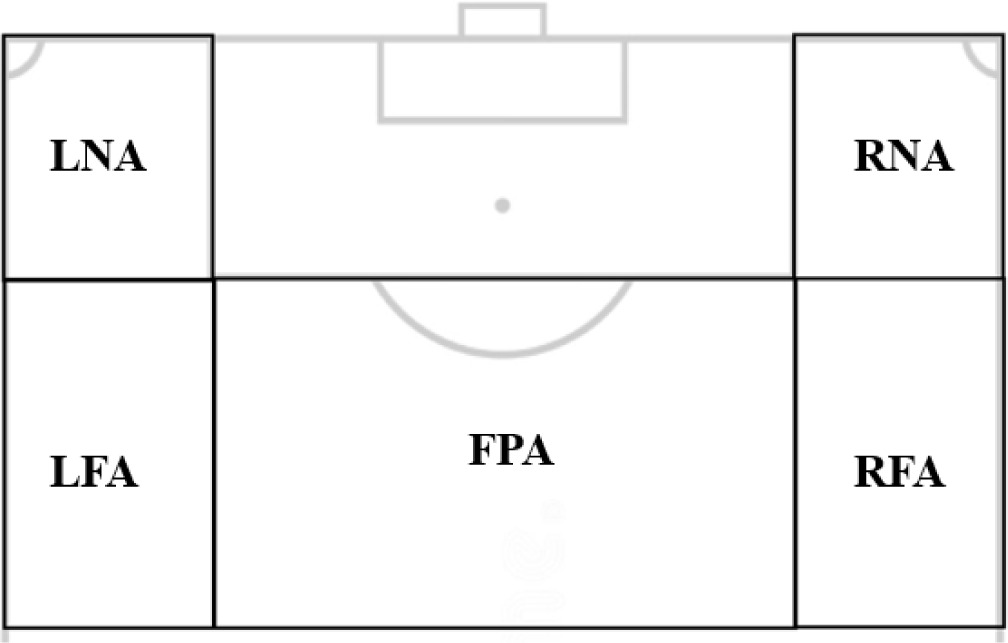
| Indirect corner kick outcome zone | The area from which the cross or finish occurs in an indirect corner kick. Five zones are defined: (1) Left near the penalty area (LNA); (2) Left far from the penalty area (LFA); (3) Right near the penalty area (RNA); (4) Right far from the penalty area (RFA); and (5) In front of the penalty area (FPA) (see Figure 1). |
| Kick type | Relates to the dominant foot of the kicker, categorised as: (1) Open foot: right-footed kicking from the left side or left-footed kicking from the right side (OF); and (2) Closed foot: right-footed kicking from the right side or left-footed kicking from the left side (CF). |
| Ball trajectory | The way the ball is delivered into the area, categorised as aerial (A) or ground (G). |
| Number of attackers in the penalty area | The number of attackers in the penalty area, divided into three categories: (1) 2–3 attackers; (2) 4–5 attackers; and (3) 6 or more attackers. |
| Number of attackers in the rebound zone | The number of attackers in the rebound zone, divided into four categories: (1) 0 attackers; (2) 1 attacker; (3) 2 attackers; and (4) 3 or more attackers. The rebound zone is from the edge of the penalty box to the semicircle. |
| Number of attackers supporting a short corner | The number of attackers supporting a short corner in two possible zones depending on the corner kick side, divided into four categories: (1) 0 attackers; (2) 1 attacker; (3) 2 attackers; and 4) 3 or more attackers. |
| Number of defenders in the penalty area | The number of defenders in the penalty area, divided into five categories: (1) 10 defenders; (2) 9 defenders; (3) 8 defenders; (4) 7 defenders; and (5) 6 or fewer defenders. These defenders are analysed regarding the marking type. The area corresponds to the ‘Number of attackers in the penalty area’ variable. |
| Number of defenders in the rebound zone | The number of defenders in the rebound zone, divided into four categories: (1) 0 defenders; (2) 1 defender; (3) 2 defenders; and (4) 3 or more defenders. This zone corresponds to the ‘Number of attackers in the rebound zone’ variable. |
| Number of defenders to contain a short corner | The number of defenders in the zone supporting a short corner, divided into four categories: (1) 0 defenders; (2) 1 defender; (3) 2 defenders; and (4) 3 or more defenders. The zone corresponds to the ‘Number of attackers supporting short corner’ variable. |
| Marking type | The marking strategy used in the penalty area, categorised as: (1) Man-to-man: each defender marks a specific opponent (I); (2) Zone: defenders cover specific spaces in the area (Z); or 3) Mixed: a combination of man-to-man and zone marking (M). |
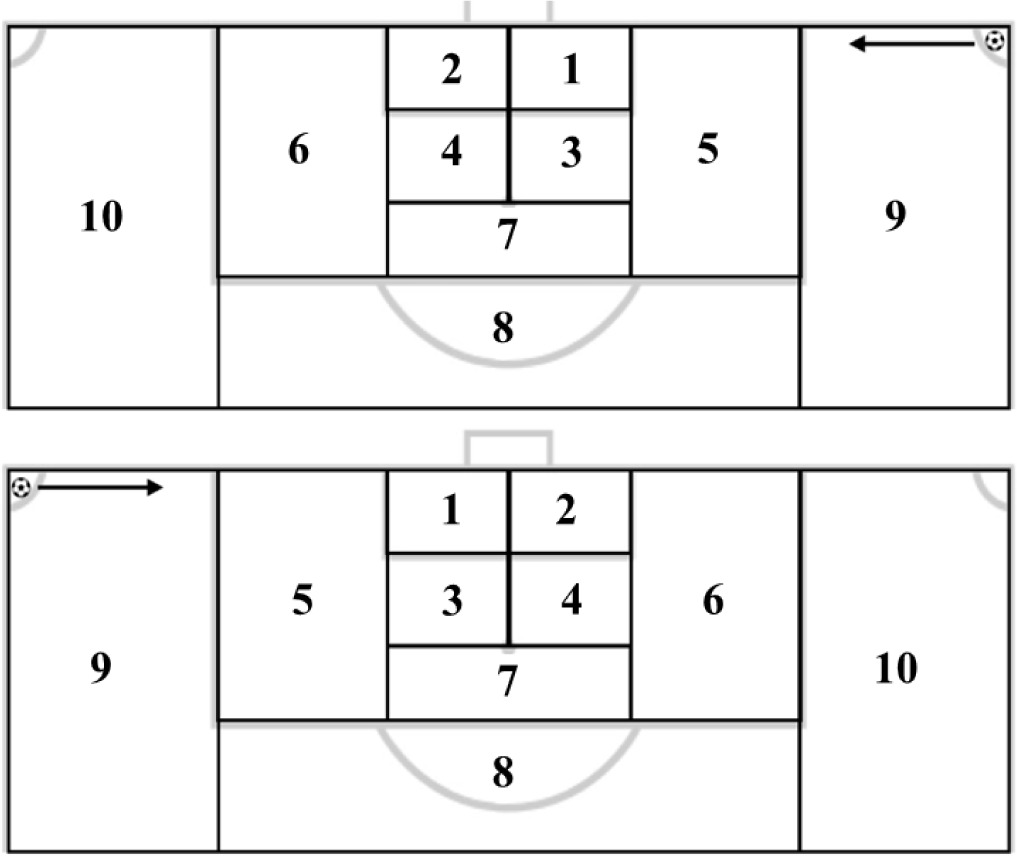
| End zone | The location of the finish within the penalty area, divided into 10 zones according to the corner kick side. Zones 1 and 2 correspond to the near and far posts in the small area; Zones 3 and 4 represent the area between the penalty mark and the small area; Zone 5 spans the side of the small area to the penalty area; Zone 6 mirrors Zone 5 on the opposite side; Zone 7 is between the penalty mark and the penalty area; Zone 8 is in front of the penalty area; Zone 9 is the sideline corridor determined by the penalty box line, extending from the end line to midfield; and Zone 10 mirrors Zone 9 on the opposite side (see Figure 2). |
| Goal weight | The effect of a goal on the attacking team’s score, categorised as: (1) Puts the team ahead (PA); (2) Ties the game (T); (3) Narrows the gap (NG); (4) Extends the lead (EL) |
Data analysis
Descriptive data are reported in this study as the frequency of event occurrences. To analyse the association between the outcome (success of the corner kick) and the independent variables presented in Table 1, a chi-square test of association was used via contingency tables. The analyses were conducted separately for direct and indirect corner kicks, providing insights into each type of execution. Adjusted standardised residuals (z) greater than 1.96 were considered significant, and the z value was interpreted as the strength of the association between the variables. The results were adopted as statistically significant at p < 0.05. Data analysis was performed using the IBM SPSS Statistics software (IBM Corp, released in 2010. IBM SPSS Statistics for Windows, Version 19.0. Armonk, NY: IBM Corp).
Results
The results will be presented in two sections. The first section will detail descriptive results, providing an overview of the main characteristics of the corner kicks within the analysed sample. The second section will present the results of the inferential analysis.
Description of corner kicks
Initially, the number of direct and indirect corner kicks, shots, and goals will be presented, along with their totals and averages per match across the 380 games of the 2023 Brazilian Football Championship. 3,372 corner kicks were recorded, of which 3,096 were direct and 276 were indirect, with an average of 8.874 per match. The total number of shots was 563, comprising 511 direct and 52 indirect, resulting in an average of 1.482 per match.
A total of 45 goals were recorded, with 41 direct and four indirect, yielding an average of 0.118 per match. This highlights the frequency and importance of corner kicks within the game context. When categorised by situational weight classifications, the majority of the goals occurred in the Take the Lead category (24), followed by Equalise (14), Extend the Lead (6), and Reduce the Deficit (1).
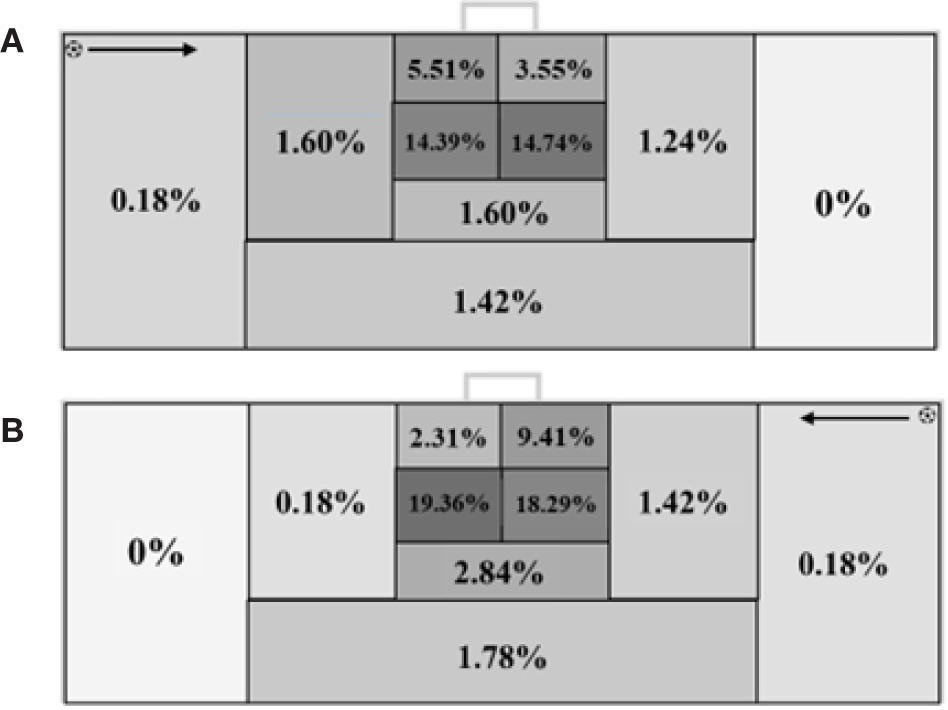
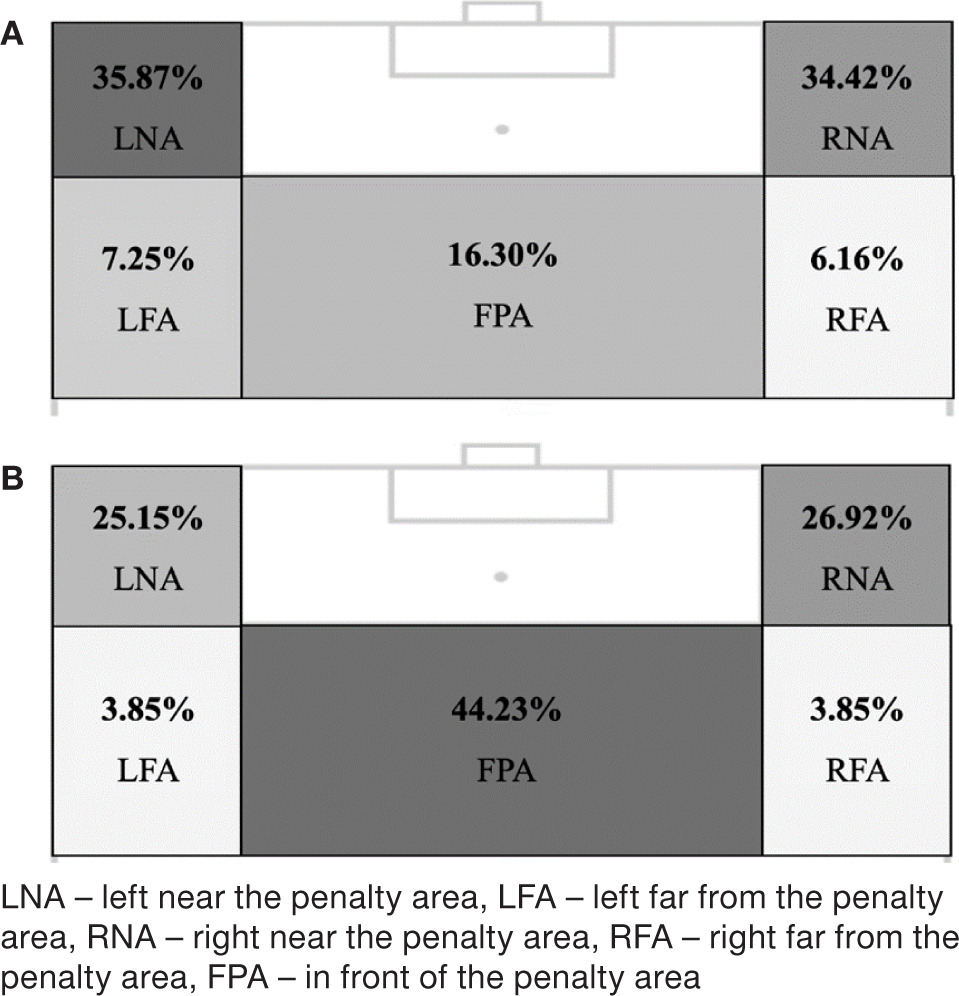
Figures 3 and 4 illustrate the areas of the field most frequently involved in corner kick plays. Figure 1 presents the distribution of shots from different finishing zones, considering corner kicks taken from the left side (3A) and the right side (3B). Figure 4, in turn, shows the frequency of use of the outcome zones in indirect corner kicks (4A) and the contribution of each zone to shot creation (4B).
Inferential analysis of the association between dependent variables and corner kick success
No significant associations were observed between outcomes and the side of execution (p = 0.074), type of corner kick (p = 0.319), trajectory (p = 0.058), number of attackers in the penalty area (p = 0.273), number of attackers in the rebound zone (p = 0.266), number of defenders in the rebound zone (p = 0.082), game time (p = 0.441), or match status (p = 0.539). These findings suggest that these contextual and tactical variables had a limited influence on the immediate outcomes of the corner kicks analysed.
Figure 3
(A) Percentage of shots on goal in each zone on shots from the left side. (B) Percentage of shots on goal in each zone on right-side shots
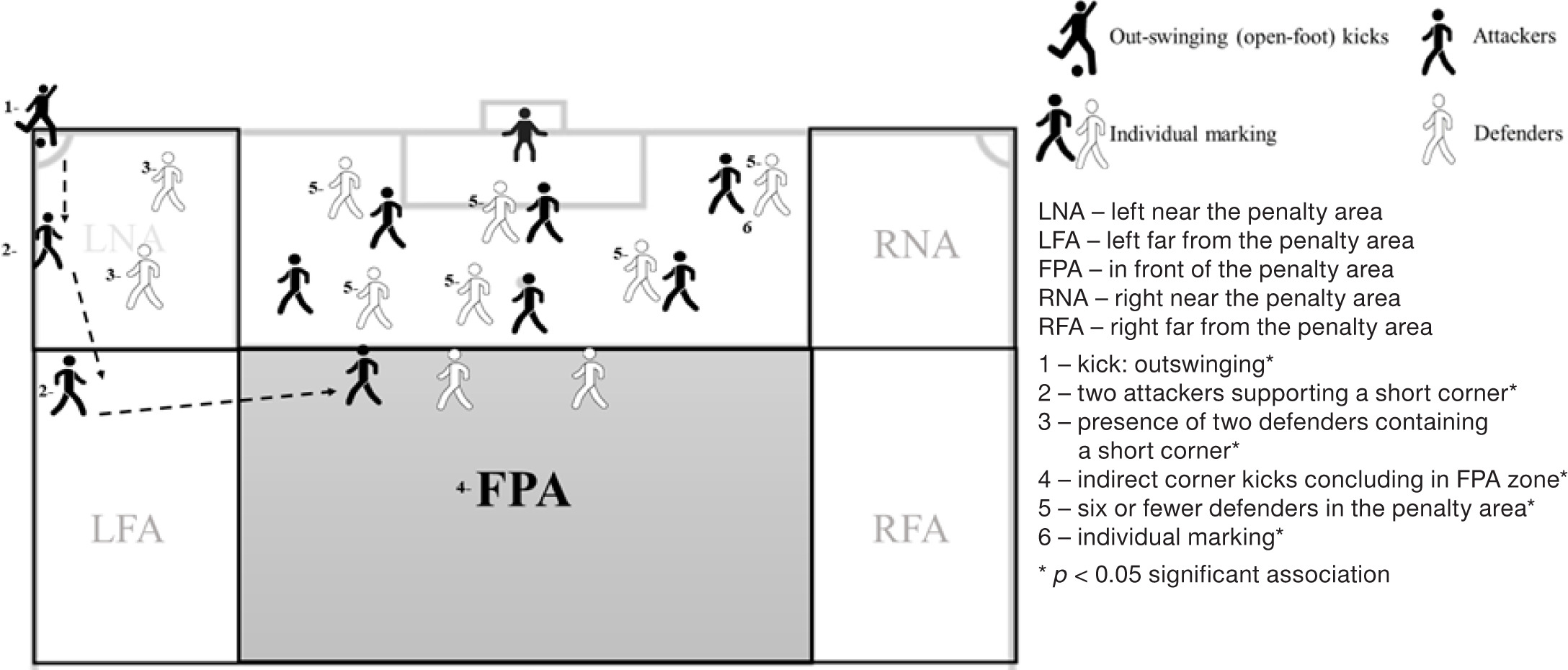
A significant association was observed between the outcome of indirect corner kicks and the finishing zone (p = 0.001). Specifically, indirect corner kicks concluding in the FPA zone increased the incidence of positive outcomes (z = 6.2). Significant associations were also identified between outcomes and the type of delivery (p = 0.015), the number of attackers supporting a short corner (p = 0.018), the number of defenders in the penalty area (p = 0.041), the number of defenders containing a short corner (p = 0.021), and the marking type (p = 0.039). Specifically, the incidence of positive outcomes increases with open-foot deliveries (z = 2.3), the presence of two attackers supporting a short corner (z = 2.4), six or fewer defenders in the penalty area (z = 2.2), the presence of two defenders containing a short corner (z = 2.0), and the use of individual marking (z = 2.2). Conversely, the likelihood of positive outcomes decreases with closed-foot deliveries (z = 2.9) and the presence of a single attacker supporting a short corner (z = 2.4). The significant variables (p < 0.05) are marked with an asterisk (*) in the figures below. To facilitate interpreting the results, a graphical summary (Figure 5) was included, visually organising the significant variables according to the findings obtained.
Discussion
The literature highlights that corner kicks are the set-piece situation with the highest incidence of goals [14, 27], and understanding their execution patterns may offer a competitive advantage during matches [6, 14, 27]. This study aimed to identify and analyse the most frequent and effective corner kick patterns in the 2023 Brazilian Championship. Most corner kicks, under draw conditions, occurred in the final 15 min of the first half, and were predominantly direct deliveries, using an outswinging foot and an aerial trajectory. These findings are consistent with the notion that corner kicks, due to their offensive potential, are often employed during decisive moments of a match as a means to increase scoring opportunities [6, 27]. On average, the attacking team positioned four to five players inside the box, two players in the rebound zone, and faced six defenders employing mixed marking. This configuration reveals an offensive numerical inferiority in the central area, which may limit the likelihood of direct finishing. Previous studies have shown that numerical superiority near the ball facilitates successful offensive actions by reducing the need for defensive shifting and increasing the likelihood of disrupting the opponent’s marking structure [1, 2]. In this context, the use of two players supporting a short corner, as observed in the present study, may represent a deliberate attempt to create numerical superiority on the flanks, drawing defenders away from the central zone and enabling the construction of plays with greater finishing potential. This type of action may align with evidence suggesting that successful attacks tend to involve fewer passes and occur in a shorter time, favouring more direct plays with less collective involvement [28]. This rationale underscores the importance of offensive strategies that manipulate defensive positioning and enhance the likelihood of success, even when starting from a position of numerical inferiority.
Descriptive analysis of corner kicks
The descriptive results of the present study indicated a total of 3,096 direct corner kicks and 276 indirect ones, confirming the first hypothesis regarding the prevalence of direct deliveries. Of these, 511 direct and 52 indirect corner kicks resulted in shots, also supporting the second hypothesis. Finally, the data confirmed the third hypothesis by demonstrating greater efficiency in indirect deliveries (13.0) compared to direct ones (12.46). These findings are consistent with previous studies, such as Casal et al. [13], who reported higher success rates for indirect corners, particularly when aimed at the far post and involving three to four players executing decoy runs, which significantly increased the chances of scoring. Moreover, this higher effectiveness of indirect corner kicks appears to reflect a more structured style of play, which is characteristic of European teams. Comparative data between the UEFA Champions League and the Copa Libertadores indicate that European teams more frequently employed quick and positional attacks, completed more passes and assists, and performed more actions in the final third of the pitch. In contrast, South American teams were more likely to attempt long-range shots, demonstrated lower accuracy, and operated more often in the middle third of the field [29]. Thus, the data reinforce existing evidence in the literature and will be further explored through the multivariate analysis presented in the following section.
Regarding the average frequency of corner kicks per match, the descriptive results of this study indicated a mean of 8.9. Although studies on national teams, such as that by Zileli and Söyler [10], reported slightly higher values – such as 9.8 corners per game during the 2018 FIFA World Cup – Clark et al. [30] reported an average of 8.91 corner kicks per match in the 2022 World Cup. Therefore, these variations do not appear to represent a consistent criterion for distinguishing between competition types. Overall, the means reported in the literature remain relatively close, ranging from 8.78 [14] and 10.24 [13]. Therefore, the average recorded in the 2023 Brazilian Championship aligns with values observed in different competitive contexts.
Of the 3,372 corner kicks analysed in the present study, 45 resulted in goals, representing 1.33% of the total. In the literature, studies of national leagues reported conversion rates of 3.1% in the 2015–2016 English Premier League [8], 2.9% in the 2019–2020 Spanish La Liga [17] and 2.6% in the 2020–2021 Greek Super League [11]. In national team tournaments and intercontinental competitions, rates of 2.6% were observed during the 2022 FIFA World Cup [30], 3.7% during the 2018 FIFA World Cup [10] and 2.2% during the 2010 FIFA World Cup, 2012 UEFA Euro, and the 2010/2011 UEFA Champions League [13]. These findings suggest a degree of consistency across studies regarding corner kick goal conversion rates, indicating, similarly to the averages per match, a potential independence from the type of competition.
With respect to the percentage distribution of shots by zone, a higher concentration was observed in zones 4, 3, 1, and 2 – corresponding to the goal area and the region between the goal area and the penalty box. These findings are consistent with the results reported by Tütüncü et al. [24], who analysed 455,898 corner kicks from 768 teams participating in 33 national leagues and UEFA competitions between 2014 and 2019. The authors identified a predominance of shots in zones 1c and 2 c, which, according to the categorisation adopted in the present study, correspond to zones 2 and 4, respectively [24]. This similarity in distribution patterns suggests that, despite variations in competitive contexts – such as sporting culture, investment levels, and playing styles – certain strategic trends related to finishing zone occupation during corner kicks may remain consistent across different football scenarios [17].
When analysing the outcome of indirect corner kicks [24], it was observed that most of them ended in zones near the corner side (LNA Zone – 35.87% and RNA Zone – 34.42%). A possible explanation for this could be the use of corner kicks to maintain possession in these zones with the objective of wasting time when leading. However, corner kicks with this objective were disregarded, and only corner kicks that resulted in a finalisation or were played into the penalty area were included in the study. Thus, a possible explanation is the attacking team’s strategy to move the defence and manipulate the offside rule. Reaching finishing zones 3 and 4 (FPA) through indirect corner kicks seems to be a strategy used by Brazilian teams. Of the 52 finalisations attributed to indirect corner kicks, 23 originated from these zones. This could be explained by the attacking team reaching areas in front of the goal with few touches, achieving a shooting angle if the defence is not properly contained.
Inferential analysis – impact of dependent variables on corner kick success
Although the literature suggests that factors such as the delivery side [11, 12], ball trajectory [24], and number of attacking players in the box [7] may influence the success of corner kicks, the present study did not identify statistically significant associations for these variables. This lack of significance may reflect tactical specificities of Brazilian football, highlighting the relevance of context-specific investigations for each competition, considering the conditions that influence performance [4].
In contrast to the aforementioned results, which did not yield significant associations, this study found clear relationships between the outcome of indirect corners and several variables, such as finishing zone [24], type of delivery [7, 8], and number of attacking and defending players [11, 13, 17]. Specifically, a higher incidence of positive outcomes was observed in indirect corners finished in zones 3 and 4 (FPA), delivered with an out-swinging kick, supported by two attackers in short corner routines, and against man-to-man marking. These findings provide relevant information about the tactical context of Brazilian football and serve as a foundation for future comparisons with other competitions described in the literature.
The finishing zone of indirect corners showed a significant association with positive outcomes, particularly when the ball was directed to zones 3 and 4 (the front end of the goal area). This finding supports previous studies that identified a higher incidence of finishes in areas near the goal area and in front of the goal. Tütüncü et al. [24], for instance, analysed 455,898 corner kicks from 768 teams across 33 domestic leagues and UEFA competitions between 2014 and 2019, reporting that the zones with the highest goal rates were 1c, 2c, 2b, and 1b (3.63%, 3.59%, 3.50%, and 3.20%, respectively). According to the authors, zones 1c and 2c differed statistically and positively from the others, increasing the probability of scoring by 1.12 and 1.08 times, respectively. In the present study, the zones with the highest percentage of positive outcomes were zones 3 and 4 (Figure 1), which correspond to zones 2b and 2c in the study by Tütüncü et al. [24]. In addition, Goodman et al. [15] found similar patterns when analysing the 2020/2021 seasons of the Northern Ireland Football League. Their study reported that finishing zone GA2, located directly in front of the goal, had the highest conversion rate (5.43%) and a statistically positive association with goal occurrence. Thus, there appears to be a positive relationship between the finishing zone and conversion rate in corner kicks across various international contexts. These findings reinforce the relevance of finishing zones for corner kick effectiveness and offer insights for the development of more efficient offensive and defensive strategies, as well as for the design of targeted training sessions.
In addition to identifying the finishing zone as a factor associated with successful corner kicks, the study by Goodman et al. [15] also discussed the type of delivery used, under the term through “laterality”. The authors observed that 79.5% of goals resulted from corner kicks with switched laterality – i.e., a rightfooted player taking the kick from the left side or a leftfooted player from the right – usually targeting the six-yard box. In the present study, outswinging (open-foot) deliveries, which correspond to this definition, also showed a higher incidence of positive outcomes, supporting these findings. Goodman et al. [15] suggest that such deliveries create curved and unpredictable trajectories, making it harder for defenders to react, especially when accompanied by coordinated offensive movements. These patterns are consistent with the data from the present study, which identified a higher frequency of shots from zone 4, on both the left and right sides, located near the six-yard box. This strategy may exploit weaknesses in densely packed defences, with at least six defenders in the box and others positioned to guard against short deliveries. Therefore, the outswinging corner kick offers greater offensive potential by aligning with attackers’ movements and increasing the effectiveness against well-organised defensive structures.
In this context, the number and positioning of attacking and defending players during corner kicks have also been associated with their effectiveness in the literature [11, 17]. Offensively, two attackers supporting short corner routines increase the incidence of positive outcomes. The role of these supporting players is fundamental, as their initial positioning and movements enhance their ability to draw markers and disrupt the defence. Drawing two players closer to the ball may represent a rehearsed strategy that alters the ball’s position, forcing the defending team to adjust its structure based on the attacker’s delivery foot [13]. Since there is a limited number of free defenders in the penalty area, defending teams must prioritise using players who are not marking attackers, which explains the mixed marking observed in the Brazilian context of this study. Defensively, when there are six or fewer players in the penalty area, combined with one, two, or more defenders positioned to counter the short delivery, the incidence of positive outcomes also increases [11, 13, 17]. This suggests that reducing the number of players inside the box to position them elsewhere, such as in short corner containment, may create numerical equality in the penalty area, facilitating unmarking and creating more space for the attacking team [11]. These offensive and defensive behaviours may represent a trend among Brazilian teams to use short corners to pull defenders out of the penalty area and exploit available space.
The present study also observed that individual or mixed marking systems increase the incidence of positive outcomes, while zonal marking reduced the chances of success. These findings are consistent with those of Kubayi and Larkin [12], who found a higher percentage of goals conceded with zonal marking (6%) than with mixed marking (3.7%) during the 2018 FIFA World Cup. Similar results were reported by Clark et al. [30], who analysed 570 corners at the 2022 FIFA World Cup and identified superior performance of mixed structures, highlighting the dominance of mixed individual marking in terms of both attempts and goals conceded. On the other hand, Pulling and Newton [14], studying 328 corners in the 2015/2016 Premier League, observed that although zonal marking was less frequently used, it conceded fewer goals (2.3%) than individual marking (4.3%). Despite this difference, the authors emphasise that coaches’ preference for individual marking is due to its operational simplicity and lower risk of organisational failures, such as zone overlap or unclear responsibilities [14]. This aspect is even more relevant in tournaments like the World Cup, which offer limited collective preparation time. In the Brazilian context, factors such as the playing style and the technical profile of the teams are also important for choosing the most effective defensive system.
Corner kick KPIs
The results revealed that the KPIs responsible for the finalisation outcome in corner kicks are as follows:
– Type of delivery: Open-foot deliveries were predominant in positive outcomes;
– Type of marking: Individual and mixed marking contribute to positive outcomes;
– Number of attackers to support a short corner: Bringing two players closer increases the chances of a positive outcome;
– Number of defenders in the area: Having eight or fewer defenders in the area helps create positive outcomes for the attack;
– Number of defenders to contain a short corner: Removing players from the area to contain a short corner aids in achieving a positive outcome for the attack;
– Finishing zone for the indirect corner kick: Ending the indirect corner kick in front of the penalty area contributes to a positive outcome.
Practical applications and limitations
This study presents relevant practical applications by identifying variables associated with the success of indirect corner kicks, such as the use of outswing-ing deliveries, finishes concentrated in zones 3 and 4 of the penalty area, and the adoption of man-to-man or mixed marking systems. These findings can inform the development of more effective offensive and defensive strategies. Furthermore, the study introduces important methodological innovations, including the categorisation of finishing and outcome zones, and the analysis of the distribution of attackers and defenders across different sectors of the penalty area. This approach seeks to address the lack of consensus in the literature regarding the delimitation and classification of zones within the penalty area, offering a systematic division of the penalty area and the finishing zones of indirect corners based on the dynamics of football and analytical methods used in both practice and field research.
Despite the large dataset and the novelty of the provided data, the study has limitations that should be acknowledged. First, it is worth mentioning its focus on a single season and the lack of detailed tracking of player movements during corner kicks – a factor that could provide valuable insights into the tactical dynamics involved. Additionally, the use of third-party data collection may have introduced some inaccuracies. Furthermore, contextual variables such as the match venue [3], the opponent’s level [7, 8], and changes in the head coach [31], which can significantly influence set-piece strategies, were not included in the current analysis. These omissions may limit the generalisa-bility of the findings and the ability to fully understand tactical variations across different scenarios. Finally, given that corner kicks are crucial for creating goalscoring opportunities in football, analysing how they are obtained – such as linking final third opportunities [32] with corner kick frequencies – would provide a broader understanding of how game styles affect performance in elite football. Despite these limitations, the study represents an advancement in the contextual analysis of corner kicks and contributes to improving training and team preparation in Brazilian football.
Recommended further research
Future studies could investigate the offensive and defensive approaches adopted by different teams in various competitive contexts. Since the data in this study were obtained from a third-party database, subsequent research could adopt a more detailed approach, with a thorough analysis of each match conducted by trained observers, ensuring greater accuracy in data collection and complete inclusion of all corner kicks. It would also be relevant to examine the impact of player movements and the kicker’s signalling, such as raising one or both hands before the kick, which may indicate set plays. This analysis would make it possible to evaluate the effectiveness of these strategies and deepen the understanding of the tactical interactions involved in corner kicks.
Conclusions
The results of the study confirmed that direct corner kicks are more frequent and result in more finalisations than indirect ones, but indirect corner kicks demonstrated higher effectiveness in terms of goal conversion. The significant associations between the outcome of corner kicks and variables such as the type of delivery, type of marking, number of attackers to support a short corner, number of defenders in the area, number of defenders to contain a short corner, and the finishing zone for indirect corner kicks indicate that strategic factors influence the success of corner kicks. These findings provide valuable insights for coaches and performance analysts, emphasising the importance of specific strategies and tactical organisation in maximising goal-scoring opportunities from corner kicks.