Introduction
Children and adolescents with developmental coordination disorder (DCD) experience marked difficulties in learning and executing age-appropriate motor skills, resulting in limitations in self-care, school participation, and leisure activities. DCD affects approximately 5–6% of school-aged children worldwide, with similar estimates reported across North American, European, and Asian cohorts [1]. Despite this relatively high prevalence and the substantial impact on everyday functioning, DCD remains under-recognised in clinical and educational services; many affected youth do not receive a formal diagnosis or targeted intervention [2, 3]. Contemporary conceptualisations emphasise that the consequences of DCD extend beyond motor coordination alone and include emotional, behavioural, social, and physical health sequelae that can persist into adolescence and adulthood [4, 5].
A robust body of recent research has highlighted the elevated risk of low physical activity and poor physical fitness among individuals with DCD. A mixed-methods systematic review showed that children with DCD engage in less voluntary physical activity and participate in a narrower range of sports than their typically developing peers, with these differences becoming more pronounced from approximately six years of age [6]. These behavioural constraints are largely driven by reduced physical capability, low self-perceptions of competence, and negative social experiences in physical activity contexts. In parallel, large population-based and survey studies have shown that children and adolescents with DCD report more emotional problems, peer difficulties, and withdrawal from physical activity, as well as reduced prosocial behaviour [4, 5, 7]. Thus, DCD is increasingly recognised as a complex, biopsychosocial condition where motor impairments, mental health vulnerabilities, and lifestyle risk factors interact across development.
One particularly important physical health concern in DCD is the increased risk of excessive body weight. A recent systematic review and meta-analysis confirmed that children with DCD are significantly more likely to present with overweight or obesity, and that this association is partially mediated by reduced physical activity and lower cardiorespiratory fitness [8]. Complementary findings from Lizoain et al. [9] demonstrated that, among children with DCD, higher body mass index (BMI) is strongly associated with low daily step counts and limited engagement in moderate-to-vigorous physical activity, reinforcing the notion that inactivity is a key, yet not exclusive, contributor to weight gain in this population. These data echo older observational work linking DCD to elevated body fat and reduced aerobic fitness, but importantly confirm that this risk persists in contemporary cohorts despite improved awareness of paediatric obesity. As a result, overweight and obese youth with DCD may face a compounded cardiometabolic burden that requires more nuanced assessment than simple weight monitoring.
Overweight and obesity themselves are closely intertwined with endocrine alterations, among which subclinical hypothyroidism (SCH) has attracted increasing attention in paediatrics. SCH is biochemically defined by elevated serum thyroid-stimulating hormone (TSH) with normal circulating free thyroxine (fT4) levels, in the absence of overt hypothyroid symptoms [10]. Although its overall prevalence in the general population is modest, recent studies show that SCH is considerably more common in children and adolescents with obesity. Two studies have reported that between 10% and 20% of obese paediatric patients meet criteria for SCH, and that TSH elevation correlates with adverse lipid profiles and atherogenic indices [11, 12]. A recent study from Bangladesh similarly found a high frequency of SCH among obese children and adolescents, with evidence of a dose-response relationship between rising TSH and markers of metabolic risk [13]. These findings support the view that paediatric SCH, particularly in the context of obesity, is not merely a benign laboratory variant but may contribute to early cardiometabolic derangements.
While the directionality of the obesity-SCH relationship remains debated, observational data suggest that excessive adiposity may both result from, and further exacerbate, mild thyroid dysfunction. Yoo and Chung [10] emphasised that even modest TSH elevations can affect energy expenditure, lipid metabolism, and vascular function, especially when accompanied by chronic low-grade inflammation. Paediatric endocrine reviews further note that SCH is relatively frequent in youth with obesity and other neurodevelop-mental conditions, and that clinical decisions about treatment should consider coexisting metabolic and developmental vulnerabilities [14, 15]. Consequently, obese adolescents with DCD constitute a subgroup in which subtle thyroid abnormalities might have disproportionate functional implications, given their pre-existing limitations in motor proficiency and physical activity.
Beyond somatic risk factors, thyroid hormones play a crucial role in brain development and neural functioning. Deficits in thyroid hormone availability during critical developmental windows can affect neuronal migration, myelination, synaptogenesis, and neuro-transmission, processes that underpin efficient cognitive and motor performance [14]. Although much of this evidence derives from overt congenital or acquired hypothyroidism, more recent work indicates that SCH may also be associated with subtle deficits in attention, processing speed, working memory, and mood, particularly in younger individuals. A comprehensive review of outcomes in SCH described increased rates of cognitive complaints, depressive symptoms, and reduced quality of life in subsets of patients, even when thyroid hormone levels remain within reference ranges [10]. For children and adolescents, persistent SCH has been discussed as a potential contributor to learning difficulties, fatigue, and reduced academic performance, especially when coexisting with other neurodevelop-mental disorders [14–16].
The interplay between thyroid function and physical activity adds another layer of complexity. Thyroid hormones modulate basal metabolic rate, cardiovascular responses to exercise, muscle energetics, and perceived exertion. A recent narrative review by Gavriilidou et al. [17] summarised evidence that both hypo- and hyperthyroid states can limit exercise tolerance, alter heart rate and blood pressure responses, and reduce an individual’s ability or willingness to participate in regular physical activity. Similarly, large population-based analyses have reported associations between habitual physical activity patterns and circulating thyroid hormone levels, suggesting a bidirectional relationship in which thyroid status shapes activity behaviour, and physical activity may, in turn, influence thyroid homeostasis [18, 19]. For youth who already struggle with motor coordination, fatigue, and low activity due to DCD, any additional decrement in exercise capacity related to SCH may further reduce participation and reinforce a sedentary lifestyle.
Taken together, these strands of evidence point to a potentially important yet underexplored nexus between DCD, obesity, and subclinical hypothyroidism. Children and adolescents with DCD are more likely to be inactive, overweight, and psychosocially vulnerable [5, 8, 9]. Obese youth, in turn, are at increased risk of SCH and related metabolic disturbances [11–13]. Yet most DCD research has focused on motor skills, gross measures of physical activity, and psychosocial outcomes, with only limited attention to endocrine correlates or their impact on neurocognitive functioning. Likewise, paediatric SCH studies seldom consider specific neurodevelopmental diagnoses such as DCD, and often rely on global cognitive or academic indicators rather than detailed assessments of motor coordination, visual-spatial abilities, or mood in adolescents. To our knowledge, no previous study has systematically examined how TSH levels relate to a constellation of motor, cognitive, and mental performance indicators in overweight or obese adolescents with confirmed DCD.
This gap is clinically meaningful. In practice, many adolescents with developmental coordination disorder and excess body weight present with fatigue, poor concentration, sleep difficulties, and reduced exercise tolerance – symptoms often attributed solely to low fitness or psychological stress. Given the documented links between subclinical hypothyroidism, metabolic risk, and neurocognitive complaints, mild thyroid dysfunction may contribute to the observed declines in motor execution, cognitive efficiency, and emotional well-being in this subgroup. Identifying such associations could support more comprehensive screening in rehabilitation and endocrine settings, inform individualised management strategies, and improve prognostic counselling for affected youth and their families.
Therefore, the present study aimed to examine the relationship between subclinical hypothyroidism and motor, cognitive, and mental performance in over-weight or obese adolescents with developmental coordination disorder. Specifically, we investigated whether elevated TSH levels were associated with poorer coordination, reduced cognitive performance, and greater mental distress compared with peers of similar age and sex but with normal thyroid function. By addressing this clinically relevant yet understudied intersection, the study seeks to clarify whether subclinical hypothyroidism represents an additional, potentially modifiable contributor to functional limitations in adolescents with DCD.
Material and methods
Study design and setting
This investigation was conducted as a cross-sectional, case-control study designed to examine differences in motor, cognitive, and mental performance among over-weight adolescents with developmental coordination disorder (DCD) who exhibited either elevated thyroid-stimulating hormone (TSH) levels or normal thyroid function. Data collection occurred between 2022 and 2024 at the Human Performance Research Center “Sport EMI” and affiliated outpatient paediatric and endocrinology clinics.
Participants
Participants were recruited from regional paediatric and endocrinology clinics where adolescents had been referred for concerns such as reduced physical activity, obesity, persistent fatigue, sleep difficulties, and attention-related complaints. Eligibility criteria required adolescents to be between 16 and 18 years old, have a confirmed diagnosis of DCD established by rehabilitation specialists, and present with a BMI at or above 25 kg/m2, consistent with contemporary international classifications for adolescent overweight [19, 20].
Participants were assigned to one of two groups based on thyroid laboratory results obtained within the preceding 12 months. The high-TSH DCD group consisted of adolescents with TSH concentrations exceeding age-adjusted reference ranges while maintaining normal free thyroxine (fT4) levels, a pattern consistent with subclinical hypothyroidism (SCH) as defined in recent paediatric endocrinology guidelines [14, 16]. The comparison group included adolescents with DCD whose TSH values were documented within reference limits. At the time of assessment, none of the participants were enrolled in structured nutritional counselling, pharmacological weight-management programs, or supervised exercise interventions. All participants were receiving standard outpatient follow-up.
Inclusion and exclusion criteria
Inclusion criteria consisted of a clinically confirmed diagnosis of DCD aligned with DSM-5-TR criteria, including clear evidence of impaired acquisition and execution of motor skills and associated interference with daily functioning; a BMI 25 kg/m2; a documented thyroid panel within the past year; and the cognitive and physical ability to complete all study assessments.
Exclusion criteria included the presence of any diagnosed endocrine disorders other than SCH, neurological or musculoskeletal conditions that could confound motor performance, psychiatric disorders that might interfere with cognitive testing, any major surgery or traumatic injury within the preceding 48 months, and use of medications known to affect thyroid function or neurocognitive processes.
Demographic and clinical data
Demographic variables, including age, sex, residence, and level of education, were collected through structured questionnaires administered to both participants and their parents (Table 1). Anthropometric measurements were obtained using standardised paediatric procedures and calibrated equipment in accordance with international anthropometric guidelines [21].
Table 1
Demographic and clinical characteristics of participants
Assessment procedures
All assessments were administered by clinicians trained in paediatric neuropsychological testing and motor coordination evaluation. Standardised administration manuals and scoring protocols were strictly followed to ensure reliability and validity.
Visual-perceptual and visual-cognitive assessments
Visual-perceptual functioning was evaluated using the motor-reduced subtests of the Developmental Test of Visual Perception-Adolescent and Adult (DTVP-A). This instrument provides a comprehensive evaluation of perceptual abilities, including visual discrimination, figure-ground differentiation, visual closure, and form constancy. Motor-reduced subtests were specifically selected to minimise the influence of fine-motor demands and isolate perceptual processing, consistent with recent methodological recommendations for research in DCD populations [22, 23]. The DTVP-A has been validated in adolescent samples, with updated psychometric evidence supporting its reliability and construct validity [24].
Verbal and nonverbal cognitive functioning
Cognitive functioning was assessed through the Wechsler Intelligence Scale for Children-Fourth Edition (WISC-IV), including the Verbal Comprehension Index, Perceptual Reasoning Index, Working Memory Index, Processing Speed Index, and Full-Scale IQ. Although the WISC-V is the most recent version, the WISCIV remains widely implemented in clinical and research contexts internationally, and its psychometric properties continue to be supported in contemporary adolescent studies [25, 26]. Furthermore, WISC-IV norms remain widely used in regional clinical practice, and local normative adaptations are aligned with the age range of the present sample, supporting their continued applicability in this context.
Academic-related reading and phonological processing
Academic performance in reading and phonological processing was measured using the reading and pseudoword decoding subtests of the Wechsler Individual Achievement Test-Second Edition (WIAT-II). These tasks assess foundational academic skills, including phonetic decoding and orthographic-phonological in- tegration, domains that are frequently implicated in developmental motor and learning difficulties [27].
Memory function
Memory performance was assessed using the Wide Range Assessment of Memory and Learning-Second Edition (WRAML-2). The Verbal Memory Composite and Visual Memory Composite were included to evaluate immediate and delayed recall abilities across verbal and nonverbal modalities. WRAML-2 continues to demonstrate strong psychometric performance in paediatric research, with current analyses supporting its structural integrity and clinical relevance [28].
Effort and response consistency testing
To ensure data validity, participants completed the computerised Word Memory Test (WMT). The WMT provides indices of immediate recall, delayed recall, recognition accuracy, and response consistency, supporting the detection of insufficient effort or response irregularities. Recent clinical research endorses its use in paediatric neuropsychological assessment [29].
Physical activity measurement
Physical activity was assessed using complementary subjective and objective measures. Self-reported habitual activity was captured through the Physical Activity Questionnaire for Adolescents (PAQ-A), a validated tool widely used in adolescent populations and increasingly applied in youth with developmental disorders [30]. Objective step counts were recorded using the Omron HJ-112 paedometer for seven consecutive days during waking hours. Following recommended device-based quality control guidelines, recordings outside the 1,000 – 10,000 steps/day range were excluded from analysis to minimise the influence of non-wear time or measurement error [31, 32]. Parents were instructed to document daily step counts to enhance adherence and accuracy. A minimum of four valid monitoring days, including at least one weekend day, was required for inclusion in the paedometer analysis. Days with fewer than 1,000 steps or more than 10,000 steps were treated as invalid, consistent with device-based quality control recommendations. If more than three days of data were missing or invalid, the participant’s paedometer data were excluded from step-count analyses. For participants meeting the minimum criteria, mean daily step counts were calculated from valid days only. It should also be noted that paedometer-based step counts may underestimate certain forms of physical activity, such as cycling, swimming, or upper-body-dominant activities, which are not fully captured by step-based monitoring.
Procedures and quality control
Participants and their parents were thoroughly briefed about study procedures. All cognitive and perceptual assessments were conducted individually in quiet, controlled environments to reduce distractions. Paedometers were calibrated prior to distribution, and assessors were blinded to participants’ TSH status to minimise observer bias. Standardised time frames were followed for cognitive testing to ensure consistency.
Laboratory measures
TSH and free T4 measurements were obtained from accredited paediatric endocrinology laboratories using standardised immunoassay procedures. Interpretation of thyroid results followed current clinical guidelines, which define subclinical hypothyroidism as elevated TSH with normal free T4 levels [10, 16]. Blood samples were collected in the morning under routine outpatient conditions, typically after an overnight fast, in accordance with standard paediatric endocrinology laboratory procedures. All analyses were performed using the same accredited laboratory systems to ensure methodological consistency.
Statistical analysis
Analyses were conducted using SPSS Version 26.0. Distributional characteristics were examined using the Shapiro–Wilk test. Between-group comparisons were performed using independent sample t-tests for normally distributed variables and Mann–Whitney U tests for non-normally distributed variables. When more than two levels of a variable required comparison, one-way ANOVA with Bonferroni correction was applied.
Associations between TSH levels and functional outcomes were evaluated using Spearman’s rho correlations, a non-parametric method suitable for small sample sizes and non-normally distributed clinical data [33]. To further explore predictors of TSH variation, multiple linear regression analyses using the enter method were performed separately for each group. Model assumptions, including normality, homoscedasticity, and multicollinearity, were evaluated according to recommended statistical diagnostics [34, 35]. Statistical significance was established at a two-tailed α level of .05. Effect sizes, including Cohen’s d and partial η2, were calculated to facilitate interpretation consistent with reporting standards in higher-tier journals. Effect size magnitudes were interpreted using conventional benchmarks (Cohen’s d: 0.2 small, 0.5 moderate, 0.8 large; partial η2: 0.01 small, 0.06 moderate, 0.14 large).
Variance inflation factors (VIF) were examined for all regression models, and no evidence of problematic multicollinearity was detected (all VIF values < 2.0).
Results
A total of thirty-two overweight adolescents with developmental coordination disorder participated in the study, evenly split between the high-TSH group and the normal-TSH group. The two groups were comparable in all demographic and anthropometric variables, including age, sex, BMI, and educational status. All participants were recruited from urban outpatient clinics and had been previously diagnosed with DCD. As expected, the only baseline difference between groups involved thyroid function, with the high-TSH group exhibiting TSH concentrations consistent with sub-clinical hypothyroidism.
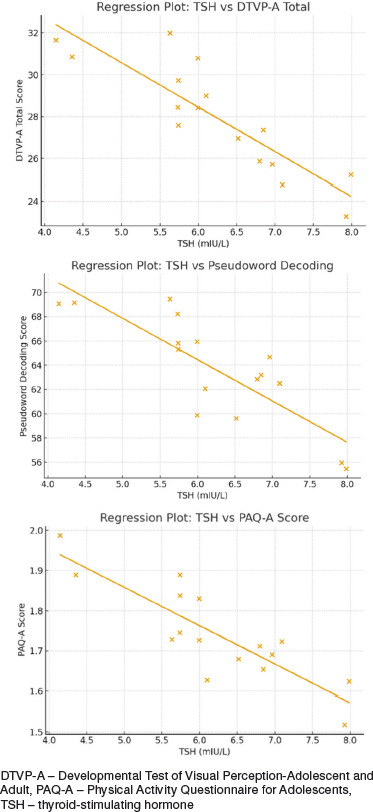
Across all visual-perceptual outcomes, adolescents with elevated TSH performed markedly worse than their peers with normal TSH. This pattern was evident in the DTVP-A motor-reduced composite score and across its subtests, including figure-ground perception, visual closure, and form constancy. The same pattern extended to related visual-cognitive measures assessed with the TVPS-3 and MVPT-3, where large, statistically significant group differences were observed (Table 2). These findings suggest that elevated TSH may be associated with additional perceptual processing difficulties among adolescents with DCD, consistent with literature describing thyroid-related alterations in visual attention and cognitive processing speed [14, 16]. The strength of the associations was further supported by moderate to strong negative correlations between TSH concentrations and visual-perceptual scores within the high-TSH group, whereas correlations were weak and nonsignificant in the normal-TSH group.
Table 2
Visual-perceptual performance (DTVP-A, MVPT-3, TVPS-3)
Cognitive measures revealed a more nuanced pattern (Table 3). Although Full-Scale IQ tended to be lower in adolescents with elevated TSH, the difference approached but did not exceed the threshold for statistical significance. More pronounced differences emerged in academic-related cognitive skills: adolescents in the high-TSH group performed substantially worse on reading accuracy and pseudoword decoding, consistent with reports that subtle thyroid dysfunction may hinder tasks integrating perceptual, linguistic, and phonological components [10, 15]. Interestingly, memory performance on the WRAML-2 was significantly higher among adolescents with elevated TSH, particularly in verbal and visual memory composites. Although unexpected, these results may reflect individual performance variability or domain-specific sparing of memory functions, as previously observed in adolescents with neurodevelopmental conditions [26]. Strong positive correlations between TSH and memory indices in the high-TSH group further underscored this complex relationship.
Table 3
Cognitive, reading, and memory measures
[i] TSH – thyroid-stimulating hormone, WISC-IV – Wechsler Intelligence Scale for Children-Fourth Edition, IQ – intelligence quotient, WIAT-II – Wechsler Individual Achievement Test-Second Edition, WRAML – Wide Range Assessment of Memory and Learning-Second Edition
Higher memory scores in the high-TSH group should be interpreted cautiously due to the modest sample size.
Physical activity levels were low across both groups (Table 4). Average daily step counts in both cohorts fell well below 5,000 steps, placing participants within the sedentary to low-active classification commonly reported in overweight youth and adolescents with DCD [6, 8]. Nevertheless, adolescents with elevated TSH demonstrated even lower levels of habitual movement. They accumulated substantially fewer daily steps and reported lower PAQ-A scores compared to their peers with normal TSH. The negative correlations between TSH and both PAQ-A scores and step counts were strong within the high-TSH group, indicating a consistent trend toward reduced physical activity with increasing TSH levels. These findings are congruent with reports suggesting that even mild thyroid abnormalities may reduce exercise tolerance and perceived exertional capacity [17, 18].
Table 4
Physical activity measures (PAQ-A and paedometry)
| Measure | Normal TSH (mean ± SD) | High TSH (mean ± SD) | p | r |
|---|---|---|---|---|
| PAQ-A Score | 2.42 ± 0.58 | 1.75 ± 0.89 | 0.02 | –0.78 |
| Daily step count | 3214 ± 368 | 2488 ± 278 | < 0.05 | –0.67 |
Multiple linear regression analyses performed separately by group reinforced these observations (Figure 1). Among adolescents with elevated TSH, TSH levels were significantly associated with a constellation of perceptual, academic, memory, and physical activity indicators, suggesting widespread functional correlates of thyroid variation (Table 5). In contrast, none of the same variables predicted TSH in the normal-TSH group, indicating that these associations likely emerge only under conditions of thyroid alteration rather than reflecting a general characteristic of adolescents with DCD.
Table 5
Regression coefficients for predictors of TSH level
Discussion
The present study examined whether subclinical hypothyroidism contributes to measurable differences in motor, cognitive, and mental performance among overweight adolescents with developmental coordination disorder. It is important to emphasise that these findings reflect cross-sectional associations rather than causal relationships, and the directionality of the association between thyroid status and functional outcomes cannot be determined from the present design. By comparing a group of adolescents with elevated TSH values to a BMI-matched group with normal thyroid function, we were able to assess the incremental influence of altered thyroid status against a background of shared motor limitations and overweight. The findings provide preliminary evidence that subclinical variations in thyroid activity may be linked to additional vulnerabilities in visual-perceptual processing, reading performance, and habitual physical activity in this population.
The most consistent differences between the two groups were found in visual-perceptual functioning. Adolescents with elevated TSH exhibited widespread deficits across multiple perceptual domains, including figure-ground discrimination, visual closure, form constancy, and general perceptual integration. These findings parallel emerging evidence that thyroid dys-function, even at subclinical levels, may impact neural processes involved in attention, visual scanning, visuospatial decision-making, and perceptual reasoning [10, 14]. In the context of developmental coordination disorder, where perceptual-motor integration deficits are already pronounced [1, 3], such additional impairment may contribute to a more complex and burdensome neurocognitive profile. The moderate to strong negative correlations between TSH and perceptual scores observed in this study suggest that elevated thyroid-stimulating hormone may interact with preexisting perceptual vulnerabilities, amplifying the difficulties experienced by adolescents with DCD.
Cognitive outcomes revealed a more differentiated pattern. Reading accuracy and pseudoword decoding were significantly poorer in adolescents with elevated TSH, a result consistent with the hypothesis that perceptual efficiency and processing speed-both potentially influenced by thyroid hormone availability-play key roles in literacy-related skills [15, 16]. In contrast, memory outcomes contradicted expectations: the high-TSH group performed significantly better on WRAML-2 verbal and visual memory composites. Such findings highlight the heterogeneity of neurocognitive functioning in adolescents with DCD, as well as the possibility that memory systems relying on rote encoding may be relatively preserved or even enhanced in some individuals, independent of perceptual or linguistic processing demands. However, the small sample size warrants caution, as a limited number of high-performing individuals could influence group-level means. Replication with larger samples is needed to validate this pattern. One possible explanation is the presence of compensatory cognitive strategies, whereby adolescents with persistent perceptual or motor inefficiencies may rely more heavily on verbal rehearsal or rote memory processes during learning tasks. Similar patterns of selective preservation or even enhancement of memory subsystems have been reported in certain neurodevelopmental conditions, where task-specific cognitive strengths coexist with broader perceptual or executive difficulties. Alternatively, the WRAML-2 composites may capture structured encoding abilities that are less sensitive to processing-speed or perceptual deficits typically associated with mild thyroid dysfunction. These interpretations remain speculative and warrant confirmation in larger cohorts.
Physical activity patterns underscore the compounded challenges faced by adolescents with both DCD and overweight. The existing literature consistently documents lower activity levels among youth with DCD due to motor inefficiency, reduced confidence, and negative social experiences in sports and exercise [5, 6, 36, 37]. The current findings indicate that elevated TSH may further discourage physical engagement. Adolescents with subclinical hypothyroidism walked fewer steps per day and reported lower habitual activity levels than their peers with normal TSH. This aligns with studies showing that SCH can modify cardiovascular responses, reduce exercise tolerance, and increase fatigue perception [17, 18]. In adolescents already struggling with coordination challenges and obesity, even mild thyroid-related reductions in energy or endurance may disproportionately decrease participation in physical activity, reinforcing sedentary patterns.
This interaction between DCD, overweight, and sub-clinical thyroid dysfunction points to a potentially important mechanistic convergence. DCD contributes to motor inefficiency and negative exercise experiences, overweight imposes metabolic and biomechanical strain, and SCH may reduce physiological readiness for physical exertion or cognitive-perceptual processing. Together, these factors may form a multidimensional barrier to participation in physical activity and academic functioning. The present study’s findings support this layered model by showing that TSH is associated not only with physical activity but also with perceptual and academic performance-domains central to daily functioning in adolescents.
Clinically, the results underscore the value of thyroid screening in overweight adolescents with DCD, particularly in cases where fatigue, perceptual difficulties, or academic declines are reported. Given that current paediatric guidelines encourage individualised management of SCH based on comorbidities and symptom burden [14, 15], the presence of DCD may represent a meaningful contextual factor in treatment decision-making. Moreover, rehabilitation professionals should consider adapting intervention strategies, such as pacing, fatigue monitoring, and perceptual-motor task scaffolding, when thyroid dysfunction is present to enhance both engagement and outcomes.
The study has several limitations, foremost its cross-sectional design, which prevents temporal or causal inference between thyroid status and functional outcomes. The absence of longitudinal data prevents conclusions about causality or the direction of influence between thyroid function and functional outcomes. Nevertheless, the strength and consistency of associations observed in this study provide a rationale for larger, multi-site longitudinal studies examining how variations in thyroid status influence developmental trajectories in adolescents with DCD. Future work should also evaluate whether interventions targeting SCH, weight management, or structured perceptual-motor training can modify the functional difficulties observed in this subgroup.
In summary, the results of this study suggest that subclinical elevations in TSH may contribute to additional perceptual, academic, and activity-related challenges in overweight adolescents with developmental coordination disorder. These findings highlight the need to integrate endocrine considerations into the broader evaluation and care of adolescents with DCD and invite further investigation into tailored, interdisciplinary approaches that address the combined influences of motor, metabolic, and thyroid-related vulnerabilities.
Conclusions
Overweight adolescents with developmental coordination disorder and elevated TSH exhibited poorer visual-perceptual performance, reading ability, and habitual physical activity than those with normal thyroid function. These findings suggest that subclinical hypothyroidism may represent an important contributor to the functional profile of adolescents with DCD and support consideration of thyroid assessment within comprehensive multidisciplinary evaluation. Further prospective studies are required to determine the clinical significance and potential therapeutic implications of these associations.