Introduction
Artistic gymnastics (AG) is a popular sport that involves the use of lower limbs to perform movements with technical accuracy and balance [1]. Gymnasts begin their training at a very young age, engaging in high-impact workouts that can range from 16 to 40 hours per week [2–4]. This intensive training raises concerns about the risk of traumatic injuries [5]. These risks are present not only at the competitive levels of gymnastics [6] but also among younger, developing athletes [7]. Moreover, asymmetry can occur in various situations when only one limb is used.
Bilateral strength asymmetry should be studied since it may increase the risk of injury [8] and affect performance [9] by requiring compensatory mechanisms, including those related to posture and movement mechanics [10]. Bilateral differences in the agonist-antagonist ratio, specific motor demands of various sports and training regimens, and insufficient or incomplete rehabilitation programs are all potential causes of bilateral strength asymmetries [11, 12]. Common techniques for evaluating lower-limb bilateral asymmetries and strength include functional hop and jump tests [13] and isokinetic knee extension dynamometry [10, 14]. However, the primary drawbacks of isokinetic testing include its tendency to measure angular velocity as constant during open-chain motions and its common focus on single-joint motor tasks. These tasks are not typical of sport movements, which often involve multi-joint motor tasks and varying angular velocities [11].
Bishop et al. [15] noted that disparities exist between dominant and non-dominant limbs (upper or lower), right and left, strong and weak, and preferred and non-preferred limbs. These differences have been evaluated extensively and primarily pertain to strength, flexibility, and jumping ability [12, 14]. Neuromuscular and perceptual characteristics, kinesthetic demands, and the athlete’s experience in event management all contribute to asymmetries [16]. Because of their simplicity of use [17], the vertical bipedal jump (i.e. counter movement jump (CMJ)) and the corresponding single-leg vertical jump (i.e. single-leg counter movement jump (SLCMJ)) tests are used to detect differences between limbs. Additionally, the isokinetic evaluation of the knee flexors and extensors is employed [18]. Bilateral differences > 15% are deemed significant for isokinetic measurements [8] as well as field tests using hops (horizontal distance) and vertical jump tests such as CMJ [12, 14]. The isokinetic assessment of knee extensor and flexor strengths at 60°/s, 120°/s and 240°/s in university students [19] and at 30°/s and 180°/s in adolescent female soccer players [20] found no significant differences between lower limbs.
In aesthetic sports such as artistic gymnastics (AG), rhythmic gymnastics (RG) and diving, flexibility is one of the most basic parameters of technical performance [21]. Bilateral asymmetry in flexibility is an important performance and injury-prevention parameter [22]. Previous studies found that 86.7% of RG athletes presented high flexibility asymmetry indices between the preferred and non-preferred lower limb [23], with the percentage of this asymmetry decreasing with increasing levels of rhythmic gymnasts [24]. Although several studies have examined lower limb asymmetry in athletes of different sports [4, 25], a limited number of studies refer to AG athletes performing acrobatic exercises during the landing phase [26]. Given that exercise programs in all AG events involve numerous jumps and landings, strength assessment is necessary to identify differences between the lower extremities [14]. Consequently, there is limited research data regarding the asymmetry of young competitive-level AG athletes. The aim of the study was to record and evaluate functional asymmetry in young male and female artistic gymnasts at the competitive level, aged 10–12 years. It was hypothesised that differences in functional asym- metry between the right and left legs in male and female AG athletes would be statistically insignificant.
Material and methods
Participants
The study involved 16 female and 14 male competitive artistic gymnasts, aged 10–12 years, with training and competition experience of 4 and 3 years, respectively, who trained 4–6 times per week, for 180–210 min per session (Table 1). The gymnasts, as well as their parents, after being fully informed about the procedure and purpose of the research, signed the consent form. A prerequisite for their participation was that they be healthy and had not sustained any lower-limb injuries in the past 6 months. Participants had to be current gymnasts in the designated age group, compete domestically, and have at least three years of coaching experience to be eligible. Those with lower-limb injuries, under the age of ten or above the age of twelve, and those who did not participate actively in the particular sport were ineligible.
Table 1
Mean value and standard deviation of participants in the total sample (n = 30) and by gender
Experimental procedure
To collect the research data, participants visited the School of Physical Education and Sport Science of Athens (SPESS) twice. On the first visit, they were informed about the purpose of the study, while their somatometric characteristics (age, body mass, body height) were recorded, and they were familiarised with the apparatus and exercises used to assess the dependent variables. On the second visit, the outdoor tests were carried out in a specially designed area at SPESS Athens (jumps, flexibility), and the laboratory tests were performed on an isokinetic dynamometer in the SPESS Ergophysiology laboratory. All measurements were carried out in the afternoon, between 5–7 p.m., by the same evaluators and under stable environmental conditions (22–23°C).
Thigh circumference and skinfold thickness were measured as indirect indicators of body composition, accounting for potential asymmetries between the two lower limbs. The evaluation of jumping ability and functional asymmetry of the lower extremities was carried out by performing the single-leg vertical jump (SLVJ) [17]. This task was completed using the Chrono Jump Bosco System platform, a reliable and effective method for detecting lower extremity asymmetries [27] that is widely applied in AG [28, 29]. To perform the SLVJ, each participant stood upright in the middle of the platform with their hands on the handrail, balancing on one leg, while the other leg remained bent throughout the jump execution. At the researcher’s verbal signal, the subject flexed the loaded leg almost 120° and, by pushing the platform, tried to rise as quickly and as high as possible. During the flight phase of the jump, the lower limbs had to remain stretched. Three attempts were performed for each lower limb, with a 60-second break between attempts, and the highest jump was used for further statistical processing. A triple single-leg horizontal jump (THSLJ) was performed to evaluate functional asymmetry of the lower extremities using a fixed 10-meter measuring tape that was placed on the floor. The triple single-leg horizontal jump test was chosen because it has demonstrated high test-retest reliability [30]. This test was selected in addition to the corresponding single-leg vertical jump test because of its similar movement and muscle recruitment patterns to running [31].
Each participant remained on one leg in a balance position at the zero (0) starting point of the tape measure, and the other leg was slightly bent in the air. The attempt was initiated upon the researcher’s command, providing verbal encouragement to ensure maximum effort. This specific test was performed with the participant performing three consecutive forward jumps, attempting to achieve the greatest possible jump length and landing on the same tested leg each time, in random order, regarding the dominant or non-dominant lower limb. Each type of jump was repeated three times, and the best score was used for statistical analysis. The order of execution of the jumps for the purpose of individual measurements was random. Half of the athletes underwent evaluation on the isokinetic machine and then performed the outdoor tests, while the other half first performed the outdoor tests and then underwent evaluation on the isokinetic machine, to control for the order effect.
The flexibility of the lower back and knee flexor muscles was assessed using the sit-and-reach box test for each leg separately. The participant, from a seated position, rested one leg on the apparatus, with the other leg bent and the sole resting on the inner thigh of the stretched leg. Two attempts were made for each leg, with a 60-second break between attempts, and the best of these was used for further statistical analysis. The asymmetry index was calculated using the equation of Impellizzeri et al. [14].
Lower limb strength assessment
Several methods have been proposed to assess bilateral strength asymmetry of the lower extremities, with the most accepted laboratory method being isokinetic assessment, which quantifies bilateral strength asymmetry of specific muscle groups such as the knee extensors and flexors [32]. To assess the strength level and bilateral asymmetries of lower limbs, an isokinetic dynamometer (Biodex System 4Pro, Shirley, NY) was used [10, 14] at 60°/s [33, 34], and field tests such as functional hops and jumping tests [13] were applied. The participants were instructed to wear athletic clothing, including shorts and a T-shirt and avoid eating for two hours before the test. After receiving the necessary instructions, each subject performed a five-minute warm-up on a cycle ergometer at a moderate intensity. Short-duration, gentle static stretches of the knee flexors and extensors ( 5 s) were then performed. Subsequently, each subject was seated on the isokinetic dynamometer to perform their effort. Subjects performed 8 familiarisation attempts for each limb, consisting of flexion and extension of the lower limb with a submaximal increase in intensity. The intensity of flexion and extension was increased based on the participant’s self-rated effort, and on the researcher’s feedback via the computer screen, which recorded the effort’s intensity. Instructions and encouragement were given throughout their efforts to achieve the best possible result. After each test attempt, a one-minute break followed to allow the subject to rest. In the final test, five attempts of increasing intensity were performed, aiming to achieve maximum force in the last two. The best effort during the second series was used for further statistical analysis. The evaluation of each lower limb was stored on the apparatus’s computer, allowing data for each participant to be extracted. The choice of lower limb was the same for all participants, while the break between the two lower limbs was two minutes. The examined variables were: (i) maximum torque of knee extensors and flexors (N × m), (ii) angle of achievement of the maximum torque (degrees), (iii) the relative maximum torque (peak torque / bw %), and (iv) work output during the repetition where the maximum torque was achieved (joule).
Apparatus
A digital scale with a precision of 0.1 kg (Delonghi Model PW-2970) and a Seca 208 stadiometer (Hamburg, Germany) were used to record body mass and height, respectively, while a skinfold calliper was used to measure the thigh skinfold thickness (Harpenden calliper, John Bull, St. Albans, England). Flexibility was measured using the sit-and-reach test, which evaluated each leg separately with a Flex-Tester box (Cranlea, UK).
Statistical analysis
The statistical analysis was conducted using SPSS, v. 24 (IBM, New York, USA). A two-way ANOVA [(2 sides (right and left) × 2 genders (boys and girls)] was performed to determine the existence of differences between genders and lower limbs, as well as for knee flexor and extensor muscles for each lower limb in relation to gender. Data normality was checked and subsequently confirmed using the Kolmogorov-Smirnov test. The independent variable was gender (male and female athletes), and the dependent variable was the lower limb (right and left). In addition, the student test method was used for dependent samples to examine (i) the difference in force (peak torque) of lower limbs, and (ii) the difference in knee extensor and flexor muscles. For partial eta-squared (η2p), the accepted cut-off values for small, medium, and large effects are: 0.01, 0.06, and 0.14, respectively. The intraclass correlation coefficient (ICC) for vertical jump and leg extension in our study in 7 athletes over 5 consecutive days was 0.992 and 0.979, respectively, whereas the coefficient of variation (CV) was 12.22% and 12.01%, respectively. The level of significance was set at p < 0.05.
Results
Functional asymmetry
Based on the results, since neither thigh circumference nor quadriceps skinfold thickness differs between the two limbs, it can be concluded that the composition of the two limbs was similar. Descriptive statistics of functional asymmetry, in the total sample as well as for gender, are presented in Table 2. No statistically significant interaction effect between gender and side was found in (i) flexibility [F(3.27) = 2.808, p > 0.05, η 2 = 0.091], (ii) thigh circumference [F(3.27) = 0.017, p > 0.05,η2 = 0.001], or (iii) femoral skinfold thickness [F(3.27) = 0.162, p > 0.05, η 2 = 0.006). However, a significant main effect for side in terms of flexibility was found [F(1.28) = 16.833, p < 0.001, η 2 = 0.375]. Examination of the mean values in this respect showed that the right side had higher values than the left side. Further, a significant main effect was observed for gender [F(1.28) = 5.454, p < 0.05, η 2 = 0.163]. Examination of the mean values showed that female gymnasts had significantly higher values compared to male gymnasts (Table 2).
Table 2
Mean and standard deviation of the lower limbs’ functional asymmetry
[i] FL – flexibility, TC – thigh circumference, FST – femoral skinfold thickness, SLVJ – single leg vertical jump, THSLJ – triple horizontal single leg jump
# statistically significant difference between genders, $ statistically significant main effect for side
! statistically significant main effect for gender
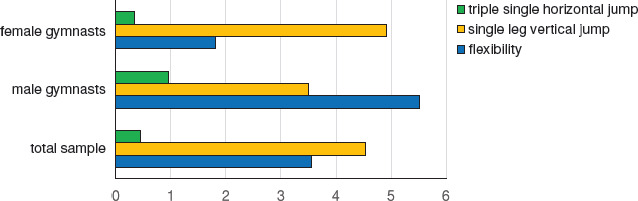
No statistically significant interaction effect between gender and side regarding the triple horizontal single-leg jump (THSLJ) was found [F(3.27) = 0.315, p > 0.05, η 2 = 0.315]. Moreover, no significant main effect was found for side [F(1.28) = 0.088, p > 0.05, 2 = 0.003], while a significant main effect was observed for gender [F(1.28) = 7.660, p < 0.01, η 2 = 0.215]. Examination of the mean values showed that male gymnasts had significantly higher values compared to females (Table 2). The percentage of functional asymmetry for the examined field tests is presented in Figure 1.
Dynamic asymmetry
Maximum knee extensor/flexor torque (N × m)
Descriptive statistics for the examined variables of dynamic asymmetry, for the total sample and their counterparts in relation to gender are presented in Table 3.
Table 3
Mean value and standard deviation of the examined variables of dynamic lower limb asymmetry in the total sample (n = 30) and by gender
A non-statistically significant interaction effect between gender and maximum torque was found in knee extension/flexion for right [F(3.27) = 0.098, p > 0.05, η2 = 0.003], and left legs [F(3.27) = 0.004, p > 0.05, η2 = 0.001].
Maximum knee extensor torque by gender (N × m)
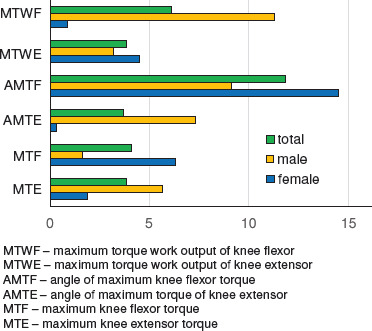
No statistically significant interaction effect between gender and side for the maximum knee extensor torque (MTE) was found [F(3.27) = 0.715, p > 0.05, 2 = 0.025] (Figure 2).
Maximum knee flexor torque by gender (N × m)
No statistically significant interaction effect between gender and side for the maximum knee flexor torque (MTF) was found [F(3.27) = 0.577, p > 0.05, η2 = 0.020] (Figure 2).
Similarly, no statistically significant interaction effect between gender and side for the angle of maximum torque of the knee extensors (AMTE) was found [F(3.29) = 1.316, p > 0.05, η2 = 0.045.
The results showed no statistically significant interaction effect between gender and side for the angle of the maximum knee flexor (AMTF) [F(3.27) = 1.366, p > 0.05,η2 = 0.047] (Figure 2).
Further, no statistically significant interaction effect was found between gender and side for the maxi- mum knee extensor torque in relation to body mass (MTE/BM) [F(3.27) = 0.501, p > 0.05,η2 = 0.018] (Figure 2).
A non-statistically significant interaction effect between gender and side for the maximum knee flexor torque in relation to body mass (MFT/BM) was found [F(3.27) = 0.223, p > 0.05, η2 = 0.008]. However, a significant main effect in this respect was found for gender [F(1.28) = 3.984, p > 0.05,η2 = 0.125] (Figure 2).
The results showed no statistically significant interaction effect between gender and side for work output during peak torque extension [F(3.27) = 3.758, p > 0.05,η2 = 0.018]. Further, there was no statistically significant interaction effect between gender and side for work output during peak torque flexion [F(3.27) = 3.028, p > 0.05,η2 = 0.098 (Figure 2).
Discussion
The results of the present study showed that there was no statistically significant asymmetry in the flexibility of knee flexor and lower back muscles in young male and female gymnasts (p > 0.05). A low level of asymmetry (3.56%) was found in the total sample, with the asymmetry levels of 5.52% and 1.82% for male and female gymnasts, respectively. Our results reinforce previous findings by Guan et al. [35], who mention an asymmetry of 1.57% in young taekwondo athletes. However, the observed lack of asymmetry between the lower limbs is contrary to the findings of Batista et al. [23], who found that young female RG gymnasts, aged 13.3 years, showed high indices of flexibility asymmetry in lower limbs.
The SLVJ results reveal no statistically significant asymmetry in the total sample (4.54%), with asymmetries of 3.49% and 4.92% in male and female gymnasts, respectively, supporting previous findings by Guan et al. [35], who found an asymmetry of 2.52% in young taekwondo athletes. These values are lower than those of Tsopani et al. [36], who reported an asymmetry of 6.25% in high-level rhythmic gymnasts aged 17 years. This difference in asymmetry may be due to the longer training period that the gymnasts underwent, and the fact that the RG gymnasts perform a significantly greater number of jumps utilising various equipment (rope, ball, ribbon, hoop, clubs) compared to the AG gymnasts, who perform similar jumps, however less frequently and using only two apparatuses (floor exercises and balance beam). Despite this, these values are significantly lower than the 10% threshold that indicates asymmetry in lower limb strength, which is a factor in causing traumatic situations [22, 37, 38]. The results of our study contrast with those of Lilley et al. [39], who reported that a high percentage of national-level elite athletes showed significantly greater limb asymmetry during the drop jump (DJ). This finding, along with results from another study of elite athletes [40], suggests that asymmetry may be related to the level of training an athlete has received. It is emphasised that the asymmetry levels of male and female gymnasts in our study (3.49% and 4.92%) are significantly lower than those reported in previous studies involving male fencing (13.8%) and taekwondo athletes (9.21%).
The asymmetry levels observed in the THSLJ were low in the total sample (0.45%) as well as in male (0.96%) and female gymnasts (0.35%). These results agree with those of Guan et al. [35], who examined young Taekwondo athletes and found a significant asymmetry of 2.69%. In summary, the findings of the present study indicate that the lower limb had a non-significant effect on SLVJ and THSLJ performance, confirming the findings of Guan et al. [35], who reported that young athletes aged 9 to 11 years, participating in lateral and non-lateral dominant sports, show an insignificant level of functional asymmetry in lower limbs. Moreover, these findings are also in line with results from studies on adult athletes participating in non-lateral-dominant [41] and lateral-dominant sports [42].
The percentage of asymmetry was found to be insignificant in the total sample with regard to the maximum knee extension torque (3.82%) and the maximum knee flexion torque (4.09%). However, the percentage of asymmetry varies when analysed by gender. Young male gymnasts showed higher values of the maximum torque of knee extensor muscles compared to young female gymnasts (5.67% and 1.89%, respectively), with this picture being reversed with respect to the maximum torque of knee flexor muscles (1.64% and 6.30% for male and female gymnasts, respectively). This finding suggests that the training load on the lower limbs of athletes aged 10 to 12, regardless of sex, is insufficient to produce a significant degree of lower limb asymmetry. This is noteworthy, considering that female athletes engage in lower-limb exercises in three apparatus events (balance beam, floor exercises and vault), while male athletes participate in only two (floor exercises and vault).
Our findings agree with those of Wiażewicz et al. [43], who report asymmetry levels of 1.90% for knee extensor muscles and 6.98% for knee flexor muscles in swimming athletes. Similarly, Daneshjoo et al. [38] observed lower asymmetries of 3.58% and 2.15% for knee extensors and flexors, respectively. Furthermore, the findings of Harper et al. [44] highlight low asymmetries in adolescent soccer players, specifically 1.98% and 1.32% during maximum extension and flexion torque, respectively.
The obtained results agree with those of Śliwowski et al. [45], who found asymmetries of 2.15% and 3.07% for knee extensors, and 5.18% and 3.76% for knee flexors in senior and junior players, respectively. Moreover, our findings are in line with those of Kellis et al. [25], who revealed that low asymmetry ranges from 1.99% to 4.17% for knee extension torque and from 3.03% to 6.52% for knee flexion torque in young soccer players aged 10–12 years. It is important to note that, although soccer is a team sport and athletics is primarily individual, soccer players use one of the two lower limbs to perform various skills, such as kicking the ball or jumping on one leg. Similarly, gymnasts use one lower limb to execute one-legged jumps or spins.
Furthermore, our results align with previous research indicating that asymmetry in young soccer players aged 10 to 12 years ranges from 1.99% to 4.17% [25]. Low asymmetries have also been observed in teenage soccer players [44, 45], teenage female volleyball players categorised as flexible and non-flexible [46], senior soccer players [34, 45, 47, 48], and both professional and elite academy soccer players [49]. Additionally, a study on knee extension torque in young gymnasts noted an asymmetry of 1.71% [50]. The observed asymmetry between gymnasts and athletes from different sports is largely due to the fact that most athletes, particularly in aesthetic sports, rely on their dominant lower limb to perform their skills. As a result, one of the two lower limbs typically demonstrates greater strength and flexibility than the other.
However, these findings contrast with those of Wia-żewicz et al. [43], who reported large asymmetries in preadolescent artistic gymnasts of 22.56% and 15.19% for the knee extensor and flexor muscles, respectively. Additionally, Yoshioka et al. [51] indicated that young male and female gymnasts exhibit asymmetries exceeding 10%. Further, our results provide a mixed picture of asymmetry in young gymnasts. According to the results of the aforementioned authors [51], the knee extensor muscles show an asymmetry of approximately 4.08%, similar to our findings, whereas the asymmetry of the knee flexor muscles is significantly higher, at 14.54% compared to the 4.09% reported in our study. While there are limited studies examining bilateral asymmetry in lower limb torque among young male and female gymnasts, our findings align with those of Mandroukas et al. [52]. They studied young female AG and RG gymnasts, reporting mean torque values of 79.85 Nm and 82.33 Nm, respectively, at an angular velocity of 60 degrees. In contrast, our mean value for flexor muscles was 35.2 Nm, which is lower than those reported by Mandroukas et al. [52], who found torque values of 41.31 Nm and 41.22 Nm for AG and RG athletes, respectively.
Due to the lack of research on these parameters, a clear report of the values for the other criteria investigated is provided for male and female gymnasts. Although males exhibit a higher percentage than females (7.34% and 0.15%, respectively), the average value of the angle of the maximum extension torque shows low asymmetry in the total sample (3.69%). In addition, maximum torque effort during extension showed a similar pattern, with asymmetry varying at the same values in both male and female gymnasts (3.17% and 4.48%, respectively). Therefore, the push-off phase of the lower limbs during jump execution is likely unaffected by slight asymmetries in these parameters.
However, in the maximum torque effort and the angle of achievement of the maximum torque during bending, females show a significant percentage of asymmetry (11.29% and 14.49%, respectively) in contrast to males, who showed a low percentage of asymmetry in these two parameters (0.87% and 9.13%, respectively). These findings can be explained by the execution of numerous single-leg jumps performed by female athletes. These jumps often feature backward swing and knee bending during floor exercises and on the balance beam, such as switch leap to ring position (FIG, 2025; number 2.505; 2.408; 2.208; etc).
Conclusions
The common belief that extensive daily training leads to structural changes in the torque performance of male and female gymnasts was not supported by the study’s findings. This is notable given the significant muscle loading that gymnasts, particularly young female gymnasts, experience during training. The dominant leg, used more frequently than the non-dominant leg, bears more load and may be subjected to greater strain. Therefore, achieving a balance in the flexibility of the lower limbs can help prevent injuries. In conclusion, the lack of dynamic asymmetry in the lower limbs of young gymnasts does not seem to be influenced by the duration of their participation in the sport. The absence of asymmetry in this age group of AG athletes is likely due to the training methods employed, which often include both single- and double- leg exercises, depending on the skills performed on different apparatuses. However, given the limited research on older AG athletes, we cannot definitively conclude that training experience has no impact on asymmetry. Therefore, further research is recommended on older gymnasts with longer training and higher workloads.