
Introduction
In sports training, there is a growing interest in op- timising training stimuli through a minimal dose ap- proach, to minimise the physical effort of athletes. This approach allows athletes to actively participate in train- ing sessions and competitions with an optimal balance between efficiency and fatigue [1, 2]. Researchers have explored this concept, recognising that a minimal dose is a specialised program that does not adhere to estab- lished guidelines regarding volume, intensity, density, frequency, etc., but still has the potential to improve physical fitness [3, 4]. Consequently, minimal training doses can be easily adapted to contexts where vari- ables such as available time for the activity, training space, material conditions and physical readiness of the practitioner do not meet previously established stand- ards [3, 5].
The concept of minimal-dose training has already been explored in other domains, especially in resistance training [4, 6, 7]. Previous studies have demonstrated that minimum or low-volume resistance training pro- tocols can lead to significant improvements in muscle strength and functional outcomes, even with markedly reduced time commitment [3, 4, 8, 9]. However, little attention has been given to the application of this con- cept to plyometric training, particularly in school-age populations [10]. This gap in the literature underscores the relevance of investigating minimal dose plyometric training (MDPT), especially in educational contexts, where logistical constraints are common.
In the school context, especially during early adoles- cence (11–13 years), a period commonly associated with accelerated neuromuscular development [11–13], the concept of a minimal dose becomes even more impor- tant. Previous studies have shown that 81% of adoles- cents between 11 and 17 years do not meet recommend- ed physical activity levels [14, 15], which is in line with data from Portugal, specifically with regard to the de- velopment of neuromuscular fitness [16]. Additionally, school settings are characterised by heterogeneous stu- dent populations, often including individuals with low physical fitness and poor adherence to physical activity [15, 17]. This presents a challenge to educators who aim to improve neuromuscular qualities in students and ensure maximum stimulation in a short time.
In this sense, the use of MDPT, when implemented using a structured and pedagogically appropriate ap- proach, may represent a viable strategy to enhance the efficiency of physical education. This may support the development of positive attitudes towards exercise, po- tentially facilitating long-term adherence, and contrib- ute to the development of neuromuscular function, which is crucial for coordination, agility, and the re- active component of the stretch-shortening cycle (SSC) [18]. Therefore, for the purpose of this study, the MDPT was operationally defined a priori as a structured ply- ometric intervention characterised by: (i) a session du- ration of ≤15 min, (ii) the use of two plyometric exer- cises per session, (iii) ≤55 ground contacts per session, (iv) a training frequency of three sessions per week, and (v) a total intervention period of six weeks. This operational definition was established to clearly dif- ferentiate MDPT from previously described low-volume plyometric protocols, which typically involve longer session durations, greater numbers of exercises, and substantially higher ground contact volumes.
In Portugal, the FITescola® (fitescola.dge.mec.pt) [19] programme was developed to promote physical ac- tivity and healthy lifestyle habits among school-age children, while also serving as a tool to assess various domains of physical fitness. Among its components, neuromuscular fitness tests include the standing long jump (SLJ), the 4 × 10 m agility (AG4X10), and the 40 m sprint (V40). The SLJ evaluates lower-limb power through horizontal jumping performance; the AG4X10 test assesses agility and change-of-direction speed; and the V40 captures sprinting speed over a linear distance. These tests are particularly relevant for assessing neu- romuscular fitness in adolescents, as they are practical, field-based, and sensitive to training-induced adap- tations. Despite their inclusion in the national curricu- lum, the extent to which these tests can be improved through targeted neuromuscular training interven- tions such as MDPT has not been fully established.
To improve neuromuscular capacity, it is important to perform exercises that challenge the SSC. Plyometric training programmes (PTP) exploit the SSC by coupling rapid eccentric muscle actions with subsequent concen- tric contractions, thereby enhancing force production, motor unit recruitment, and neuromuscular efficiency [20, 21]. In youth populations, SSC-based training has been shown to improve explosive strength, sprint per- formance, and change-of-direction ability through neural adaptations such as improved intermuscular coordination and increased rate of force development [21]. Research also highlights the role of SSC training in optimising tendon stiffness and neuromechanical efficiency, which may contribute to improvements in athletic performance and movement economy [20].
Most of the plyometric research that found positive results with children and adolescents has presented interventions with a high degree of similarity in terms of the overall design of the training process and fol- lowed previously established recommendations regard- ing volume and intensity [5, 22]. For example, in boys, the effectiveness of different strength training methods (traditional training, PTP compared with combined training) over 6 weeks has been compared [23]. It was found that PTP was more effective than traditional or combined strength training in achieving short-term gains in sprinting and jumping parameters. In that study, the training sessions lasted no more than 60 min. Interestingly, similar results were observed when the total duration of the PTP session was less than 60 min [24]. The authors found a greater effect on the partici- pants’ sprint times when compared by growth velocity peak groups (pre-, mid- and post-ones). They deter- mined that the combined PTP methods were the most effective in post-Growth Velocity Peak participants. Similarly, when comparing untrained and trained children, it was noted that the untrained participants benefited most from power training compared to tra- ditional strength training in the parameters of running and jumping speed, showing large vs. moderate im- provements in running time [25, 26]. Other studies have compared the effect of low and high-volume plyo- metric training on prepubescent soccer players over an 8-week period, with sessions held twice a week. After 8 weeks, the authors reported similar improvements in jumping ability between the two groups, suggesting that low-volume training is more beneficial from a time- efficiency perspective [27]. In light of the findings, it is recommended that a total session duration of more than 30 min and a training period between 6 and 10 weeks be observed in order to achieve positive effects in PTP [23, 25, 28]. However, it should be noted that these recommendations may not align with the total time available in the physical education curriculum, as lessons typically last 50–60 min and must cover vari- ous program contents.
A review of the literature indicates that in athletic training contexts, minimal doses (short durations, low volumes) have been shown to effectively increase strength, particularly in beginners compared to experienced in- dividuals [3, 29]. However, the concept of MDPT has not been fully explored. Our review did not uncover any proposals of MDPT or studies demonstrating positive effects with reduced PTP of 10 to 15 min in the avail- able literature. Specifically, no studies have shown pos- itive effects on the SLJ, AG4X10, and V40 tests, neuro- muscular fitness tests that are part of the FITescola® battery of tests [19]. Addressing this gap may provide a relevant framework for physical education teachers seeking time-efficient training strategies. Currently, there is limited evidence on the effects of MDPT can have on physical education students. Additionally, the potential benefits of PTPs lasting less than 10–15 min are not well established. Therefore, the aim of this study was to examine the effects of MDPT on the results ob- tained in the FITescola® neuromuscular fitness test.
Material and methods
Research design
A randomised pre-post experimental design was employed to analyse the effects of MDPT on the results of the FITescola® neuromuscular fitness test, namely the SLJ, AG4x10, and V40 tests. The training interven- tion (MDPT vs control condition) was defined as an in- dependent variable, while the performance outcomes (SLJ, AG4X10, and V40) were treated as dependent variables.
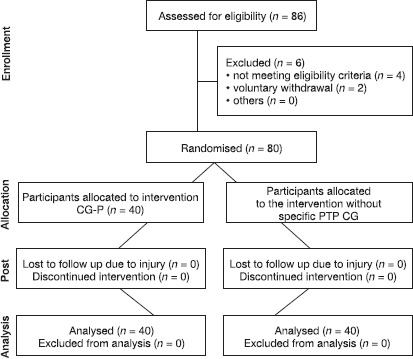
The participants were randomly assigned to either the experimental group (EG-P = 40) or the control group (CG = 40) using a computer-generated randomisation sequence generated via an online randomisation tool (http://www.jerrydallal.com/random/randomize.htm). A simple randomisation procedure was applied. Outcome assessors were not blinded to group alloca- tion due to the nature of the school-based intervention. Due to the nature of the intervention, allocation con- cealment was not implemented. The EG-P underwent MDPT consisting of a 6-week intervention with a fre- quency of three times per week and training sessions lasting only 10 to 15 min each. Meanwhile, the CG continued their physical education classes, but with- out any specific plyometric intervention. Specifically, both groups shared the same school context, were taught by the same physical education teacher, followed an identical curricular structure and lesson planning, and were exposed to comparable session duration and over- all workload. In order to eliminate potential learning effects that could confound the study results, a famil- iarisation week was performed, following previous recommendations [30]. Before and after the interven- tion, SLJ, AG4X10, and V40 tests were performed. The tests were carried out in an indoor sports hall, always at the same time. All the training sessions took place during the first part of the Physical Education classes and lasted approximately 15 min after the general warm-up [30–33]. Figure 1 shows the flow of partici- pants in each phase of the randomised trial.
Participants
A total of 86 individuals were recruited for the study, of whom 80 met the eligibility criteria (11 ± 1.8 years; height 148 ± 7.3 cm; body mass 41.57 ± 10.89 kg; BMI = 18.69 ± 3.58 kg/m2). The sample included 46 boys and 40 girls. The inclusion criterion stipulated that all subjects must have attended Physical Education classes at least three times a week. Exclusion criteria included engagement in sports outside of school hours and/or injuries sustained within the past six months. During the intervention, students who missed more than 10% of the total MDPT sessions and/or more than three consecutive sessions were also excluded. As a re- sult, participants included in the final analysis demon- strated a high level of adherence to the intervention (mean ± SD: 96.3 ± 2.1%). Prior to the commencement of the study, all participants and their legal guardians were thoroughly informed about the testing and train- ing procedures, as well as the potential benefits and risks associated with the study. Prior to the commence- ment of the experiment, verbal and written informed consent was obtained from the legal guardians, and assent was obtained from the children.
Procedures
Following a familiarisation period, anthropomet- ric data were collected in a single session. Each partici- pant’s height was measured on a stadiometer (Body- meter 206, SECA, Hamburg, Germany) with an accuracy of 0.1 cm. Body mass was measured on a scale (SECA scale, Hamburg, Germany) with an accuracy of 0.1 kg. Body mass index was subsequently calculated accord- ing to previous recommendations [34]. Prior to the as- sessment protocol (SLJ, AG4X10, and V40,), the athletes underwent a standard warm-up consisting of a 10-min- ute period of running at a self-selected comfortable pace, followed by 5 min of calisthenics exercises and mobilisation of the principal joints. After 5 min of re- covery period, measurements were obtained, and all tests were conducted in accordance with the FITescola® test guidelines.
40-meter sprint
The experiment was conducted in an indoor sports hall, with the timing of the sprints being recorded us- ing photocells (Microgate, Bolzano, Italy), positioned at 0.15 m before the start line and 0.20 m above ground level. The start of the race was standardised for all par- ticipants, with three points of support being provided.
Each athlete began the race individually, without any verbal encouragement, thus ensuring that reaction time was not a contributing factor to the recorded times. Each participant completed two attempts, separated by a three-minute recovery period, as per previous studies [25]. The best of the two attempts was recorded for data analysis.
Standing long jump (SLJ)
The experiment was conducted in an indoor sports hall. All participants stood behind a line with their feet separated to the width of their shoulders, and they per- formed a powerful horizontal push with their arms free. Each athlete executed two SLJ attempts, with a recovery period of approximately one minute between each at- tempt. Performance was measured using a 50-meter tape measure (Metal Works, Concesio, Italy), with the final footprint left by the athlete used as the reference point. For data analysis, the maximum distance achieved in the two jump attempts was documented.
Shuttle run (AG4X10)
The space was marked by signalling cones, and two parallel lines 10 m apart were indicated with adhesive tape. Three sponges were utilised in this experiment: two sponges (A and C) were positioned on the line op- posite the starting line, and the third sponge (B) was placed on the starting line. The sponges, A and C, were placed 1 m from each other. Participants were instructed to assume a standing start position behind the desig- nated starting line. Upon the auditory signal, they sprinted with maximum expediency to sponge A, crossed the line with both feet, grasped sponge A, and returned to the starting line. Thereafter, sponge A was substituted for sponge B at the starting line, and the student tra- versed the line with both feet, reversing direction to- wards sponge C. After exchanging sponge B for sponge C and crossing the line completely with both feet, the student returned to the starting line. The temporal measurement was automatically halted when the stu- dent crossed the finish line with a single foot, holding sponge C in their hand. The temporal measurements were recorded using photocells (Microgate, Bolzano, Italy), which were positioned at a height of 20 cm above ground level.
Plyometric training programme
The GE-P group performed a MDPT consisting of pogo jump on stairs (PJmE) and tuck jump (TJ) exercises as summarised in Table 1. The PJmE exercises were executed on a 10-step staircase (4.80 m length, 40 cm width). The participants were instructed to land with their legs together on each step while ascending the staircase and, when reaching either end of the stair- case, to perform a countermovement squat to approxi- mately 90° knee flexion with their legs apart. The TJ was performed at a standardised intensity, requiring participants to jump over an elastic rope positioned at a height of 0.80 m after stepping off 0.30 m platform. Given the participants’ untrained status, training vol- ume and intensity were carefully controlled to ensure safe and consistent execution. Additional details re- garding volume, frequency, and ground contacts are presented in Table 1.
Statistical analyses
Data are presented as mean ± standard deviation (SD). Additional data are presented as p-values (p < 0.05), confidence interval (CI) and effect size (ES). Normal- ity was assessed using the Shapiro–Wilk test and ho- mogeneity of variances using the Levene’s test. No for- mal correction for multiple comparisons was applied due to the limited number of a priori-defined outcomes. An independent sample t-test was used to compare the participants’ characteristics (between groups at base- line). To determine the effects of the intervention on performance adaptations, a two-way repeated-measures ANOVA (group × time) was conducted for each variable (AG4X10, V40, and SLJ). Main effects (group and time) and interaction effects (group × time) were analysed. Effect sizes for the ANOVA were calculated using partial eta squared (2p). Potential alterations in performance were interpreted using standard thresh- olds for 2p (small = 0.01, medium = 0.06, large = 0.14). The level was set at p < 0.05 for statistical signifi- cance. An a priori power analysis was conducted using G*Power software (version 3.1; Heinrich-Heine-Uni- versität Düsseldorf, Germany) for a repeated-measures ANOVA with a within-between interaction (group × time). Assuming a medium effect size (f = 0.25), an alpha level of 0.05, a statistical power of 0.95, two groups, and two measurement time points, the required total sample size was estimated at 54 participants. The data were analysed using the Project Jamovi (2022) statistical programme (Version 2.3 of the computer software).
Results
Table 2 shows the mean ± SD data of AG4X10, V40, and SLJ in both groups at pre-test and post-test. No significant differences were observed between groups for any of the baseline variables (p > 0.05), confirming initial group equivalence. We found a significant main effect of time for SLJ, F(1,73) = 4.33, p = 0.041, η2p = 0.056, as well as a significant group × time interaction, F(1,73) = 13.72, p < 0.001, η2p = 0.158, with no significant main effect of group, F(1,73) = 1.51, p = 0.223, η2p = 0.020. For AG4X10, no significant main effect of time was observed, F(1,73) = 3.58, p = 0.062, η2p =0.047, although a significant group × time interaction was found, F(1,73) = 29.31, p < 0.001, η2p = 0.286, with no significant group effect, F(1,73) = 1.43, p = 0.236, η2p = 0.019. Similarly, for V40, neither the main effect of time, F(1,73) = 0.727, p = 0.397, η2p = 0.010, nor the main effect of group, F(1,73) = 2.45, p = 0.122, η2p = 0.033, reached statistical significance; however, a significant group × time interaction was identified, F(1,73) = 8.85, p = 0.004, η2p = 0.108.
Table 2
Descriptive statistics of neuromuscular performance variables in the experimental and control groups at pre-test and post-test
Discussion
To the authors’ knowledge, this is the first study that examines the effects of a MDPT on the results obtained in the FITescola® neuromuscular fitness test. The study primary findings indicated that following the inter- vention, significant group-time interactions were ob- served in the AGX10, V40, and SLJ tests. The minimal dose design was defined based on a program duration of ≤15 min, ≤55 ground contacts per session, two exercises per session, a duration of six weeks, and a constant level of intensity. Specifically, the MDPT involved a weekly volume of ≤45 min and 162 ground contacts, while maintaining the same exercises per session and a constant level of intensity. Over the 6-week intervention, the total program volume was approximately 270 min, with a total of 972 ground contacts. These findings may be applicable to similar youth populations within school-based or structured training environments where supervised plyometric interventions can be implemented. In particular, the observed improvements in neuromuscular performance suggest that MDPT may represent a practical and time- efficient strategy in physical education and early-stage youth sport settings.
Previous studies have applied a PTP based on what they considered to be a low training volume [35]. In a PTP conducted with young soccer players, low volume was defined as an 8-week program with two sessions per week, progression from 50 ground contacts to 120 contacts per exercise, with a total of 4 exercises per session and session durations of 25 to 35 min [33]. This low volume differs from our minimal dose concept, as the weekly and total volume values in terms of the du- ration of PTP implementation per session and the num- ber of ground contacts were much higher than ours. The recorded values were: 50 to 70 min of PTP per week and 440 to 960 ground contacts per week, de- pending on the week (440 for the first two weeks, 528 for the third week, 520 for the fourth week, 660 for the fifth week, 780 for the sixth week, 800 for the seventh week, 960 for the ninth week), with total PTP volumes of 400 to 560 min and 5128 ground contacts [33]. Additionally, a similar PTP was applied to young soccer players, differing only in the number of exercises per session, which was reduced to one exercise [36]. A com- parison of the weekly and total values obtained with those recorded in our study reveals that the total weekly volume of PTP and total application time were con- sistently higher than those implemented in the present study (50 to 70 min and 400 to 560 min, respectively).
The number of ground contacts per week was lower during the initial 4 weeks (from 110 to 130) but higher in the subsequent weeks (from 165 to 240), while the total volume of ground contacts remained greater than in our MDPT protocol (1284 vs. 972 contacts). In a plyo- metric training protocol in a school environment, the authors considered a PTP with exercises progressing from low to high intensity and complexity. However, in contrast to the present study, the number of exer- cises per session was 12 to 14, and included, in addition to plyometric exercises, physical conditioning exercis- es, as well as speed and agility exercises at the end of the session [37], resulting in a substantially greater overall training volume and complexity compared to the MDPT approach. Taken together, these findings in- dicate that previously described low volume PTP pro- tocols still involve considerably higher training loads than those applied in the present study, reinforcing the distinctiveness of the MDPT concept.
Although our conception of the minimal dose differs from that of previous studies, our research revealed a significant group × time interaction for SLJ, indicat- ing that the improvement observed in the experimental group differed from the control group. The magnitude of this effect (η2p = 0.158) suggests a moderate-to-large practical impact, supporting the effectiveness of the MDPT intervention. Given that both groups were ex- posed to identical physical education conditions, in- cluding the same teacher, lesson structure, and over- all training load, the MDPT intervention represented the only systematically controlled difference between groups. Under these conditions, it is reasonable to in- terpret the observed improvements as primarily attrib- utable to the MDPT rather than to external factors associated with regular physical education activities. Although the influence of uncontrolled variables can- not be entirely excluded in school-based settings, the consistency of the group × time effects supports the role of the intervention as the main driver of the ob- served adaptations.
This finding aligns with previous research report- ing significant enhancements in SLJ performance fol- lowing 8 weeks of plyometric training interventions (SLJ: Δ= 9.3%, ES = 1.1) [33, 38, 39], as well as mod- erate improvements (Δ = 4.2% [40] and increases of up to 7.3% following longer-duration protocols [41]. In addition, studies comparing the effects of low- and high-volume plyometric training in young population have reported similar improvements in jumping ability, suggesting that lower training volumes may be suffi- cient from a time-efficiency perspective [27]. In a school context, significant improvements in SLJ have also been observed following plyometric interventions (7.9 ± 17.3 cm vs. –0.3 ± 8.4 cm) [37].
However, it is noteworthy that the aforementioned studies, despite utilising a reduced training volume, involved a higher number of jumps than our own, ex- cept for the initial week of the PTP. The range of jumps per training session varied from 60 to 90 jumps [38], progressing from 50 to 120 jumps [33, 39]. Converse- ly, in the context of low volumes of PTP, a small effect size (ES = 0.32) was observed in the long jump test fol- lowing the implementation of a PTP in conjunction with a low-volume change of direction training protocol, spanning a duration of six weeks, in young soccer play- ers [42]. Moreover, a moderate effect size was evident in the long jump (ES = 1.0) among young soccer play- ers. It is acknowledged that the observed variations in effect size may be attributable to the limited train- ability of the sample. It is noteworthy that gains evident in a small to moderate effect size are typically observed in elite athletes, resulting in comparatively smaller mag- nitude increases [3, 29]. In the context of physical edu- cation, the implementation of MDPT may be particularly advantageous, as it optimises time efficiency, reduces mechanical load, and prioritises movement quality over training volume, making it well-suited for school- based settings.
Previous studies have shown significant improve- ments in change of direction after 8 weeks (Δ = 2.1%; d = 1.3, p < 0.05). Additionally, when comparing high intensity and low volume (60 jumps) over 7 weeks, significant improvements in agility test performance were found (Illinois test,Δ = 3.5 %, ES = –0.28) [43]. With a similar protocol, it was found that after 12 weeks the results obtained in agility were higher (Δ = 3.3%, ES = 1.8) [44]. On the other hand, when comparing low- and high-volume plyometric training protocols to improve the agility in prepubescent footballers, it was concluded that there were no significant differences between the different types of the program, both of which showed significant improvements in the agility of the players (p = 0.002, ES = 0.96) [27]. The results suggest that increasing the volume of plyometric train- ing is not a determining variable for improved agility performance, and that protocol-related differences may influence the outcomes.
When we analysed the results of the AG4X10 test, we found that the experimental group achieved signifi- cant improvements in reducing the agility test time (–2.38%), unlike the control group, which showed a worsening of performance (+ 4.73%). These changes were supported by a significant group × time interac- tion, indicating that the evolution of performance dif- fered between groups. This reduction in the experi- mental group may be associated with improvements in the SSC, which enhances the speed of muscle contrac- tion and reaction time [8]. Our results are in line with previous studies using low-volume plyometric training that reported significant improvements (–0.23 s) in 6 weeks [31] and 9.6% (–0.45 s) in 8 weeks [31]; 9.6% (–0.45 s), in 8 weeks [9]. It can therefore be suggested that a minimal dose approach may be sufficient to elicit meaningful improvements in neuromuscular perfor- mance of school-age children.
Regarding speed, several studies suggest that PTP improves this capacity in young athletes [45–48]. In line with this finding, our study supports the idea that MDPT can be a valid proposal to include in physical education classes. When analysing the V40 results us- ing a repeated-measures approach, a significant group × time interaction was observed, indicating that per- formance changes differed between groups. Post-inter- vention, improvements were observed in the experi- mental group (7.39 ± 0.790 s pre-intervention to 7.18 ± 0.711 s post-intervention) whereas no significant chang- es were observed in the control group (7.49 ± 0.871 s pre-intervention to 7.60 ± 0.676 s post-intervention). The data suggest that the observed improvements in speed performance may be due to central nervous sys- tem factors such as increased muscle stimulation and trainability induced by PTP. These include the ability to increase the number and/or firing frequency of ac- tive motor units [49], changes in motor unit recruitment patterns and a particular emphasis on type II (fast twitch) muscle fibres [50]. In addition, the improve- ment in speed performance may be associated with an increase in strength, particularly maximal muscle strength, thereby enhancing acceleration capacity.
Our findings are consistent with previous studies reporting improvements in speed following plyometric training. For example, studies using high-volume plyo- metric training protocols in young athletes have shown significant improvements in sprint performance. A high- volume protocol (3 sessions per week, progressing from 100–200 to 300–360 jumps) applied over 10 weeks re- sulted in improvements of approximately 3% in 20-m sprint performance [51]. Similarly, another study in- vestigated the effects of a high-volume plyometric train- ing protocol (2 days per week, 112–350 jumps) over 16 weeks in young footballers and reported significant improvements in sprint times over a range of distances (5 m: Δ= 3.8%, ES = 1.3; 10 m: Δ= 2.2%, ES = 1.06; 20 m: Δ= 3.2%, ES = 0.8; 30 m:Δ = 2.5%, ES = 1.43) [41]. In contrast to other studies, when a short-duration, low-volume PTP was applied, significant reductions in the 10 m sprint time (–2.1%) were found [9]. The PTP led to a significant decrease of 2.1% (1.96 ± 0.07 to 1.92 ± 0.07 s; p = 0.004) in the sprint time of the ex- perimental group, which was not seen in the control group (2.06 ± 0.12 to 2.01 ± 0.07 s; p = 0.15). Simi- larly, when studying the effect of low-volume PTP (60 to 120 jumps) twice-week for 12 weeks on the athletic ability of prepubescent male athletes (~11 years old), significant improvements were seen in sprint times (Δ = 5%, –3.5% and –3% for sprint times of 10 m, 20 m and 30 m, respectively) [40]. Similar results were found with a low volume, short duration plyometric training programme (from 50 jumps to 120, 2×/week, 8 weeks) [36].
From an applied perspective, the observed effect sizes (η2p = 0.108–0.286) indicate meaningful and educationally relevant improvements within the con- straints of school-based physical education. In settings where instructional time is limited and student popu- lations are heterogeneous, even modest gains in neuro- muscular performance may have substantial practical value, particularly when they can be achieved without compromising other curricular objectives. Importantly, the MDPT protocol required ≤15 min per session and a low number of ground contacts, demonstrating that measurable performance improvements can be ob- tained with minimal training exposure. This is par- ticularly relevant in educational contexts, where time efficiency and feasibility are critical determinants of implementation. Under these conditions, the integration of MDPT does not appear to interfere with standard teaching practices but rather provides a complemen- tary and scalable strategy to enhance neuromuscular fitness within existing class structures. Furthermore, given that both groups were exposed to comparable physical education conditions, the observed group × time effects reinforce the interpretation that the im- provements are primarily attributable to the MDPT in- tervention rather than to general physical education activities.
However, the practical interpretation of these find- ings is inherently dependent on the reliability and sen- sitivity of the assessment tools used. Although SEM and MDC were not directly calculated in the present study, previously reported test-retest evidence indicates that the FITescola® battery and comparable field-based tests of standing long jump, sprinting, and agility show acceptable to good reliability in youth populations [19]. Therefore, the magnitude of the observed changes is likely to reflect real performance adaptations rather than only random measurement error.
There are some limitations to consider when inter- preting this study. Firstly, due to time constraints, we were only able to include a limited number of tests from the FITescola® program; therefore, future research should aim to include a broader range of assessments. Secondly, although both groups were exposed to stand- ardised physical education conditions under the same teacher and structured lesson plan, detailed documen- tation of the specific session content was not system- atically recorded. Thirdly, it should be noted that matu- ration status (e.g., biological age or peak height velocity) was not directly assessed in this study. Given the well- documented influence of maturation on neuromuscu- lar performance and training responsiveness in youth populations, this factor may have affected the observed adaptations [52]. Although randomisation likely con- tributed to a similar distribution of maturation status between groups, future studies should include objec- tive measures of biological maturation to better control for its potential confounding effects. While this may represent a limitation, the controlled teaching environ- ment likely minimised variability between groups. Fourthly, the inclusion of a group performing a higher- volume PTP could have provided a more comprehen- sive comparison of training effects. Future studies are needed to determine whether MDPT produces similar adaptations in populations with higher performance levels and to explore the transferability of these find- ings to more specialised training contexts. Also, stud- ies should determine SEM and MDC directly under the same testing conditions to strengthen the interpreta- tion of performance changes.
Conclusions
In terms of practical implications, the implemen- tation of MDPT offers a promising, low-cost strategy that physical education teachers can integrate into standard class time without the need for additional resources.
After examining the effects of MDPT on the results obtained in the FITescola® neuromuscular fitness test, the findings indicate that the inclusion of MDPT can lead to meaningful improvements in neuromuscular performance in school-age students. Specifically, sig- nificant group × time interactions were observed for the SLJ, AG4X10, and V40 tests, indicating that per- formance changes differed between the experimental and control groups. The most pronounced improve- ments were observed in the SLJ. The MDPT protocol was characterised by a short session duration (≤ 15 min), a reduced number of ground contacts (≤ 55), a mini- mum of two exercises per session, a six-week interven- tion period, and a consistent intensity level. Despite this reduced training volume (≤ 270 min and ≤972 contacts), significant performance adaptations were observed, highlighting the efficiency of this approach. These findings suggest that MDPT may be sufficient to elicit meaningful neuromuscular adaptations in school settings, particularly when training time is limited. MDPT can be adapted to different skill levels and re- source availability, making it a scalable and inclusive strategy for diverse educational contexts. However, these findings should be interpreted within the context of the study design, and further research is warranted to con- firm their applicability across different populations and training environments. Therefore, the inclusion of MDPT in physical education classes is recommend- ed provided that the guidelines outlined in this study are followed.