Introduction
Paresis of the upper extremity is one of the most common disabilities addressed by physical therapists in post-stroke rehabilitation [1]. While the majority of stroke survivors regain the ability to walk independently, fewer than 50% achieve meaningful recovery of arm function. Although upper limb motor recovery typically follows a predictable trajectory, the timeline is highly variable. Delayed recovery increases the risk of secondary complications such as spasticity, joint contractures, and chronic pain, all of which hinder functional movement and interfere with rehabilitation outcomes [2].
Hand function plays a central role in object manipulation and daily activities. Its loss constitutes a major impairment in neuromuscular conditions and frequently prevents individuals from achieving effective occupational performance and independence [3]. Post-stroke individuals often struggle with routine tasks such as grasping a cup or buttoning a shirt. The severity and persistence of these impairments have prompted re- searchers to explore innovative strategies to enhance upper limb function in stroke survivors [3].
Grasping, holding, and manipulating objects remain impaired in approximately 55–75% of stroke patients during the subacute and chronic stages. These limitations persist even three to six months after stroke onset, adversely affecting daily life. Occupational therapy plays a vital role in mitigating such impairments and improving quality of life, even months or years following the initial insult [4].
Task-specific training is a well-established method in stroke rehabilitation. It is known to increase corticospinal excitability and enhance the functional use of the paretic upper limb. Practising goal-oriented motor tasks promotes neuroplastic changes, particularly reorganisation within the primary motor cortex [5, 6]. Multiple studies have demonstrated that repeated performance of daily tasks yields greater therapeutic benefits than traditional rehabilitation approaches in improving upper limb function [7].
In addition to task-specific training, various forms of somatosensory input have been utilised to augment motor recovery post-stroke. These include modalities such as electro-acupuncture, repetitive passive movement, and mechanical vibration. Transcutaneous electrical nerve stimulation (TENS) is one such modality that has gained attention for its potential role in neurorehabilitation. TENS is non-invasive, cost-effective, and associated with minimal adverse effects, making it suitable for widespread use in clinical settings [8, 9].
Importantly, sensory amplitude TENS has been shown to modulate corticospinal excitability in the hand region of the motor cortex in healthy individuals. Based on these findings, sensory electrical stimulation has been proposed as an adjunctive therapy to improve motor functions such as grasping, pinching, and swallowing in patients with stroke [10].
Sensory electrical stimulation may facilitate motor recovery by increasing afferent input to the central nervous system, enhancing excitability in motor cortical areas, and strengthening sensorimotor integration. This neuromodulatory effect is believed to improve voluntary activation and functional use of the paretic limb [10].
Task-specific training is widely recognised for promoting neuroplasticity, while sensory electrical stimulation has been shown to modulate corticospinal excitability and enhance motor recovery. These complementary mechanisms provide the rationale for combining both interventions in this study. The objective was to evaluate whether this combination improves hand function compared with training alone.
We hypothesised that the combination of sensory electrical stimulation with task-specific training would produce greater improvements in grip strength, pinch strength, wrist range of motion, and functional performance than task-specific training alone.
Material and methods
Study type and design
This randomised controlled trial was conducted to investigate the effect of sensory electrical nerve stimulation combined with task-specific training on hand function in patients with chronic ischemic stroke.
Randomisation and allocation
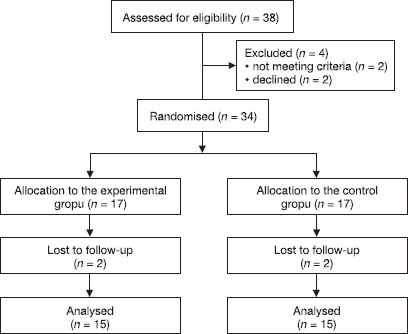
A total of 30 patients of both sexes were recruited for this study. Participants were recruited from the out-patient stroke rehabilitation clinics of Cairo University Hospital through physician referrals and advertisements placed in the hospital’s neurology department. All participants received a clear explanation of the study’s purpose, assessment procedures, and intervention protocols. Written informed consent was obtained from every participant prior to enrolment. Patients were randomly assigned to one of two equal groups: the experimental group, which received both sensory electrical stimulation and a task-specific training program, and the control group, which received the same task-specific training without electrical stimulation. Participants were randomly assigned in a 1:1 ratio to either the experimental or control group, using an alternating order based on outpatient clinic arrivals. A CONSORT flow diagram illustrates enrolment, allocation, and follow-up (Figure 1).
Blinding
Due to the nature of the intervention, blinding of participants and therapists was not feasible. However, outcome assessors and data analysts were blinded to group allocation to minimise bias.
Sample size calculation
The sample size was determined using G*Power software (version 3.1) based on data from a preliminary pilot study. Assuming an effect size of 0.8, a significance level ( ) of 0.05, and a statistical power (1– ) of 0.80, a minimum of 15 participants per group (total n = 30) was required to detect significant between-group differences.
Interventions
Participants in the experimental group received both peripheral sensory electrical stimulation and a task-specific training program. Sensory electrical stimulation was applied transcutaneously to the median, ulnar, and radial nerves of the affected upper limb. Self-adhesive surface electrodes (20 mm diameter) were positioned over the wrist, with the cathode placed proximally. Stimulation consisted of trains of five square-wave pulses (1 ms pulse width) delivered at 1 Hz, with an inter-pulse frequency of 10 Hz and a duty cycle of 50% (500 ms on/off). The stimulation intensity was adjusted to remain just below the motor threshold, avoiding visible muscle contractions. Sessions lasted two hours, three times per week, over a period of four weeks. The selected parameters (1 ms pulse width, 1 Hz trains, 10 Hz inter-pulse frequency, 50% duty cycle) were based on prior studies demonstrating their effectiveness in modulating corticospinal excitability while minimising discomfort [13]. The intensity was kept below motor threshold to ensure sensory-specific stimulation without inducing fatigue.
In addition, the experimental group participated in a task-specific training program based on the Action Research Arm Test (ARAT). Participants were seated with the ARAT testing kit placed at elbow height. Functional tasks targeting five categories, gross movement, grip, grip with rotation, pinch, and pinch with rotation, were practised in sequence. Each task category was performed for 10 min, with 2-minute breaks between categories, resulting in a total session time of approximately 2 hours, including rest. Tasks were progressive in difficulty, practised across multiple planes, and accompanied by verbal feedback. The level of difficulty of motor tasks was progressively adjusted to each patient’s ability. Tasks were graded in complexity (e.g., larger to smaller objects, slower to faster repetitions) to ensure continuous challenge and engagement.
The control group received the same task-specific training program without sensory electrical stimulation.
Outcomes and Interpretation
The primary outcome was hand function measured by the ARAT. Secondary outcomes included grip strength, pinch strength, and wrist range of motion.
Outcome measures were assessed before and after the intervention.
Grip strength: an indicator of global hand function and overall upper limb recovery. Grip strength was measured using a JAMAR hand dynamometer. The JAMAR grip dynamometer is highly reliable and can measure a cylindrical grip at five adjustable spacings. JAMAR measurements are accurate and reproducible, with almost no perceptible motion of the handles, regardless of grip strength. With its adjustable handle, JAMAR can accommodate hands of various sizes [14].
Participants were seated with the shoulder adducted, elbow flexed to 90°, forearm in neutral, and wrist positioned between 0–30° dorsiflexion and 0–15° ulnar deviation. The dynamometer was set to the second handle position. Three trials were recorded, and the average value (in pounds) was used for analysis [15].
Pinch strength: reflects fine motor control necessary for daily tasks such as writing, buttoning, or handling utensils. Pinch strength was evaluated using a baseline pinch dynamometer across three grip types: tip pinch (thumb and index fingertip), lateral pinch (thumb pad and lateral index finger), and palmar pinch (thumb pad and pads of index and middle fingers). For each type, three trials were performed, and the mean score was recorded [16].
Wrist range of motion (ROM): evaluates joint mobility essential for functional grasp and release. Wrist ROM for flexion and extension was measured using a digital goniometer. The device provided clear angle readings on an LCD screen and allowed the examiner to freeze measurements for reference [17, 18].
ARAT: a standardised measure of functional ability in object manipulation and daily activities. Hand function was evaluated using the ARAT, a 19-item stand-ardised test divided into four subtests: grasp, grip, pinch, and gross movement. Each item was scored on a 4-point ordinal scale (0–3), with a maximum score of 57. Patients achieving a score of 3 on the most difficult task in a subtest were given full credit for the remaining items in that subtest [19, 20]. In this study, patients performed each task with standardised equipment under assessor supervision. The highest achievable score in each subtest was credited to the remaining tasks, as per validated scoring guidelines.
Statistical analysis
All statistical analyses were performed using SPSS software (version 25.0; IBM Corp., Armonk, NY, USA).
Descriptive statistics were used to summarise participant demographics and clinical characteristics. Independent t-tests were conducted to compare mean values of age, weight, height, BMI, and stroke duration between the two groups. The chi-square test was used to compare categorical variables, including sex, hand dominance, and side of hemiparesis.
For ordinal outcome variables such as spasticity grade and Medical Research Council scores, within-group comparisons were analysed using the Wilcoxon signed-rank test, and between-group comparisons using the Mann–Whitney U test. Paired t-tests were used to assess pre- and post-treatment changes in grip strength, pinch strength, wrist range of motion, and ARAT scores within each group. A p-value < 0.05 was considered statistically significant for all tests.
Results
Descriptive results
The demographic and clinical characteristics of participants in both experimental and control groups are presented in Table 1. No significant differences were observed between the groups at baseline in terms of age, sex, body mass index (BMI), stroke duration, or other clinical variables.
No adverse events were reported. Patients generally tolerated the stimulation well, with only occasional mild tingling sensations at the electrode sites, which subsided immediately after treatment. All participants successfully completed the intervention sessions.
Table 1
Demographic and clinical characteristics of the experimental and control groups
Comparative results
Hand grip strength
Both groups demonstrated a significant improvement in hand grip strength following the intervention. However, the percentage of improvement was significantly greater in the experimental group compared to the control group (p = 0.0001). Post-treatment comparison between groups also revealed a statistically significant difference in favour of the experimental group (p = 0.03) (Table 2).
Pinch grip strength
Significant increases in tip, lateral, and tripod pinch grip strength were observed in both groups post-intervention. The magnitude of improvement was significantly greater in the experimental group than in the control group (p = 0.0001). Additionally, post-treatment comparisons between groups showed statistically significant differences favouring the experimental group in all three pinch types: tip pinch (p = 0.0001), lateral pinch (p = 0.004), and tripod pinch (p = 0.01) (Tables 3 and 4).
Table 3
Comparison of mean values of pinch grip strength within each group
Table 4
Comparison of mean values of pinch grip strength between both groups
Wrist ROM
Wrist flexion and extension range of motion significantly improved after treatment in both groups compared to baseline. The experimental group showed a significantly greater percentage of improvement than the control group (p = 0.0001). Furthermore, between-group comparisons at post-treatment revealed significantly higher gains in wrist flexion (p = 0.02) and wrist extension (p = 0.01) in the experimental group (Tables 5 and 6).
Table 5
Comparison of mean values of wrist ROM within each group
Table 6
Comparison of mean values of wrist ROM between both groups
ARAT
A significant increase in ARAT scores was observed post-treatment in both groups. The experimental group demonstrated a significantly greater percentage of improvement than the control group (p = 0.0001). Post-treatment comparison between groups confirmed a statistically significant difference in favour of the experimental group (p = 0.01) (Table 7).
Discussion
The findings of this study confirmed our hypothesis, demonstrating that sensory electrical stimulation combined with task-specific training yielded superior improvements in hand strength, wrist range of motion, and functional performance compared to training alone.
This study revealed significant improvements in grip strength, pinch strength, wrist joint range of motion (ROM), and upper limb functions in both groups post-treatment. However, the improvement was significantly greater in the experimental group compared to the control group. These findings are in line with McDonnell et al. [21], who found that combining appropriate afferent stimulation with task-specific training resulted in greater improvements than training alone in patients with impaired upper limb function following subacute stroke.
In contrast, De Kroon et al. [22] examined the efficacy of electrical stimulation of the affected upper extremity for improving motor control and functional abilities after stroke. Although they reported a positive effect on motor control, they found no significant improvement in functional ability, which they attributed to the inclusion of less severely affected patients. They suggested that more severely impaired patients may benefit more from electrical stimulation for muscle tone and ROM.
The significantly greater improvement in the experimental group may be attributed to cortical excitability modulation by peripheral stimulation, as demonstrated by Ridding et al. [23]. Similarly, Chipchase et al. [13] reported that peripheral electrical stimulation induces rapid plastic changes in the motor cortex, commonly used to facilitate movement and reduce pain, and can drive cortical plasticity in movement disorders.
The present study’s findings on grip strength improvement are consistent with Celnik et al. [24], who evaluated the effectiveness of whole-hand neural electrical stimulation in restoring fine hand movement in patients with chronic stroke. They observed improvements in ROM and fine motor control within a few days of initiating stimulation. Conversely, Ikuno et al. [10] found no change in grip and pinch strength following only one hour of peripheral sensory stimulation in sub- acute stroke patients. This discrepancy may be due to differences in stimulation duration.
Our study also demonstrated significant improvements in pinch strength, particularly tip pinch, in the experimental group. This may be due to the critical role of the index finger in grasping. Sivakumar et al. [25] emphasised the importance of thumb-index synergy in achieving functional grasp. Conforto et al. [26] similarly found that 2-hour median nerve stimulation increased pinch strength beyond the stimulation period, even in the absence of motor training. They concluded that somatosensory stimulation is a promising adjunct to stroke rehabilitation.
Additionally, Klaiput and Kitisomprayoonkul [27] reported significant increases in pinch strength following stimulation of the median and ulnar nerves in acute and subacute stroke patients. However, Bastos-Conforto et al. [28] found no significant improvement in pinch strength after both sub-sensory and supra-sensory stimulation. This discrepancy could be attributed to differences in protocol, as their study applied stimulation only to the median nerve prior to training, whereas ours applied stimulation to the median, ulnar, and radial nerves simultaneously with training.
Ikuno et al. [10] also examined the effect of peripheral sensory nerve stimulation combined with task-specific training but found no significant change in pinch strength. Their two-week intervention, with only one hour of stimulation in the first week, differs from our four-week protocol, which involves two hours of stimulation per session.
This study also found a significant post-treatment increase in ARAT scores in the experimental group. These results are supported by Tekeolu et al. [29], who indicated that TENS is an effective adjunct for improving motor function and activities of daily living in hemiplegic patients. Sullivan and Hedman [30] also showed that sensory-amplitude stimulation reduces impairment and enhances arm function post-stroke. Similarly, Ng and Hui-Chan [31] reported that TENS improves functional performance and reduces hyperreflexia in stroke patients. Laufer and Elboim-Gabyzon [8] further suggested that sensory stimulation via TENS enhances motor recovery, particularly when combined with active training.
Klaiput and Kitisomprayoonkul [27] found no significant change in ARAT scores following a single session of sensory stimulation without task-specific training. This may be due to a lack of cumulative stimulation effects or a ceiling effect in highly functional patients.
The broader improvements in upper limb function observed in the ARAT may be explained by dynamic cortical representation. According to Muellbacher et al. [32], limited activity in adjacent body parts can restrict cortical reorganisation in the affected limb after stroke. Their findings suggest that voluntary activity in one part of the limb can enhance cortical representation and functional recovery in another.
The control group also demonstrated post-treatment improvements in grip strength, pinch strength, wrist ROM, and ARAT scores. These effects are consistent with neuroplasticity induced by task-specific training. Classen et al. [33] demonstrated that simple, repetitive motor tasks reorganise the primary motor cortex and enhance motor-evoked potential in the involved muscles. However, Higgins et al. [34] reported no significant improvement in voluntary movement or manual dexterity in chronic stroke patients following task-specific training. This discrepancy may be explained by differences in patient selection, task complexity, body region targeted (hand vs. forearm or shoulder), and variability in muscle tone.
This study has several strengths, including its randomised controlled design, the use of standardised and reliable outcome measures, and a detailed intervention protocol that facilitates replication.
Limitation of the study
Despite its strengths, this study has some limitations. First, the relatively small sample size may limit the generalisability of the findings. Second, because the intervention period was short, and long-term follow-up was not performed, the durability of improvements remains unknown. Third, blinding of participants and therapists was not feasible, which may have introduced performance bias, although outcome assessors were blinded. Finally, the study included only patients with mild to moderate impairment, which may restrict applicability to more severely affected populations.
Recommendation
Future research should include larger and more diverse samples, extended follow-up, and exploration of optimal stimulation parameters. Studies should also compare sensory electrical stimulation with emerging rehabilitation technologies such as robotics and virtual reality to better define its role in stroke recovery. Clinically, incorporating sensory stimulation into rehabilitation programs may enhance patient adherence and maximise functional outcomes.
The implications for rehabilitation
The findings of this study have important implications for rehabilitation practice in chronic stroke patients. Sensory electrical stimulation has been shown to be an effective adjunctive modality for enhancing hand function. When applied in conjunction with task-specific training, it contributes to more pronounced improvements in motor recovery and overall functional outcomes. The results support integrating sensory stimulation into routine neurorehabilitation protocols, particularly for patients with persistent upper limb impairments. Moreover, individualised rehabilitation programs that incorporate sensory electrical stimulation are likely to improve patient engagement, increase treatment adherence, and ultimately maximise the therapeutic benefits for this population.
Conclusions
Based on the findings of this study, sensory electrical nerve stimulation appears to be an effective adjunctive intervention for improving upper extremity function in patients with chronic stroke. The integration of this modality into a structured physical therapy program, particularly one involving task-specific training, is recommended to enhance functional outcomes in this population.