Introduction
Small-sided soccer games (SSGs) are adapted game formats played on smaller fields, involve fewer participants, and have customised rules based on training objectives [1, 2]. SSGs have several benefits, including the ability to support adaptive learning and seamless game-related skills development in a realistic game situation [3–5]. Furthermore, they offer more frequent ball contacts and duels than traditional 11v11 games [6–8]. SSGs are essential for enabling targeted skill development while also improving decision-making and performance metrics, such as tactical understanding and endurance, which place unique demands on players [7, 8].
The literature indicates a growing interest in SSGs research that examines how players’ behaviour is affected by changing task constraints [9, 10]. These constraints can be manipulated in a variety of ways, such as by altering the number of ball touches allowed per possession, using goalkeepers (GKs), changing the type of marking or pitch size, providing coaching encouragement or feedback, and experimenting with different numerical relations [8, 11, 12]. A numerical relations constraint that is frequently used by coaches to modify their training sessions is the use of floaters (players who assist both teams in attacking phases of the game) [13, 14]. Floaters, who usually join the in-possession team, are crucial for establishing numerical superiority [7]. They can be positioned on the field or on the sidelines, with several performance metrics, including tactical, technical, physical, and physiological, adjusted to account for this position difference [14–16].
From a technical perspective, floaters have been found to reduce the number of dribbles on the pitch [17]. When considering tactical metrics, Padilha et al. [14] found that players used the playing space (width and length) in the opponent’s half more effectively during the offensive phase when sideline floaters were present. During the defensive phase, they compacted the defence in their own half (defensive unity) to limit the opponent’s space and create numerical inferiority. Praça et al. [18] reported that the 2-floater format inside the field substantially decreased team’s length, whereas both the 2-floater and 1-floater formats inside the field increased team’s width.
From a physical standpoint, Praça et al. [10] discovered that the physiological and physical responses of the two-floaters varied according to their position, with midfielders showing the strongest reactions because they provide the most support during the offensive phase. Moreover, Pizarro et al. [5] revealed significant variations in their physical metrics, with players covering greater total distances and running with higher intensity when goal-line floaters were present. Players also displayed lower heart rate values when there were lateral floaters on the touchline, whereas they demonstrated greater accelerations and decelerations when there were no floaters. Clemente [19] corroborated the finding that different floater placements yield different results and that central floaters cover the greatest distances as opposed to floaters placed outside the pitch.
Despite a substantial body of literature on the use of floaters in SSGs [4, 5, 7, 10], the extant research has been limited to men’s soccer. Consequently, little is known about the use of floaters in women’s SSGs or how coaches can best modify numerical constraints to accomplish training objectives. In particular, it is still unclear whether female players perform better with or without sideline floaters present. Hence, this study aims to analyse and compare the technical and physical responses of professional female soccer players with and without floaters in 3v3 SSGs.
Material and methods
Participants
Twelve professional female soccer players (age: 24.08 ± 4.25 years; body mass: 62.08 ± 9.29 kg; height: 1.62 ± 0.05 m) from a South African team playing in the Hollywoodbet Super League took part in the study. Players were training between 4 and 5 days a week with a match on a weekend.
Design and procedure
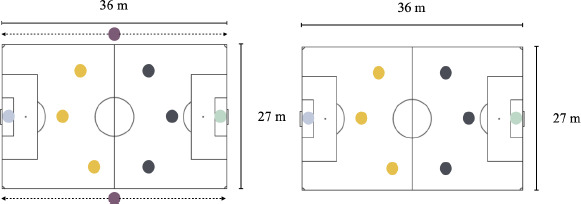
To become accustomed to wearing the foot-mounted inertial measurement units (IMUs; PlayerMaker™, Tel Aviv, Israel), the players undertook a familiarisation session one week before data collection began. Each session began with a uniform 20-minute warm-up at low intensity. Over a two-week period, each experimental SSG was then played on the same natural grass during the in-season phase. On each testing day, the session began at the same time of day (16:30) under the same average atmospheric temperature (19°C). All SSGs were conducted on a 36- by 27-metre field (see Figure 1).
As shown in Figure 1, two SSG forms were included in the experimental design: (1) 3v3 + 2GKs floaterSSG, where two floaters played for both teams (always assisting the team in possession during the attack phase); and (2) 3v3 + 2GKs SSG, where no floaters participated. The order of sessions was counterbalanced, with players taking part in SSGs with floaters during the first week and SSGs without floaters during the following week. Each session consisted of four 4-minute bouts, separated by 2 minutes of passive recovery, for both SSGs with and without floaters. Floaters were restricted to two-touch play and had to remain within the wide channels; they could move parallel to the sideline, but they were not allowed to score. During the SSGs, the outfield players were instructed not to enter in wide areas to mark the floaters. The same players acted as floaters throughout the SSGs. Participants received verbal encouragement from the researcher. To enable quick resumption of the game if the ball went out of bounds, extra balls were positioned close to the pitch boundary. Players were allowed to drink water during the rest periods in between bouts.
Data collection
Technical and physical metrics were collected using the IMUs (PlayerMaker™, Tel Aviv, Israel). Each IMU had incorporated a 2,000° • s–1 triaxial gyroscope and a 16-g triaxial accelerometer, integrated from the MPU-9150 multi-chip motion tracking module (Inven-Sense Inc., San Jose, CA, USA). Each player had two IMUs – one for each foot – which were fastened to the boots with manufacturer-provided silicone straps. The IMUs were positioned laterally at the malleoli. Acceptable validity and reliability of IMUs has earlier been confirmed by Marris et al. [20]. Prior to each training session, each IMU was activated and connected via Bluetooth to a tablet computer (iPad, Apple Inc., Sunnyvale, CA, USA). After each session, data was uploaded by the first author to the manufacturer’s cloud-based software (v.3.22.0.02). Before importing the data from the manufacturer’s cloud-based application into Microsoft Excel 2020, the start and end of each SSG were indicated. The technical metrics included the numbers (n) of touches, releases, successful passes, lost possessions, regains, and total time on the ball (s) [21, 22]. Physical variables included total distance covered (m), top speed (m/s), high-speed running (HSR) distance (m) (> 5.29 m/s), sprinting distance (m) (> 6.26 m/s), number of accelerations (> 2 m/s/s), and number of decelerations (> –2 m/s/s) [23–25].
Statistical analysis
Statistical analyses were conducted using the Statistical Package for the Social Sciences (SPSS), version 29 (SPSS Inc., Chicago, IL, USA) and Prism version 10 software (GraphPad, San Diego, CA, United States). Data is presented as means (M) and standard deviations (SD). Group mean differences are reported with 90% confidence intervals in raw data units. Data normality was checked using the Shapiro–Wilk test before the inferential statistics were performed. The variables (successful passes, lost possessions, regains, HSR and sprinting distance) that were not normally distributed (p < 0.05) were evaluated using the Wilcoxon signed-rank test, while the variables (touches, releases, total time on the ball, distance covered, top speed, accelerations and decelerations) that were normally distributed (p > 0.05) were examined using paired t-test for differences between floaters SSGs and non-floaters SSGs. Significance levels were set at 0.05 and 0.01. Additionally, Cohen’s d effect size (d) was calculated and interpreted as follows: 0.20 (small), 0.50 (moderate) and 0.80 (large) [26].
Results
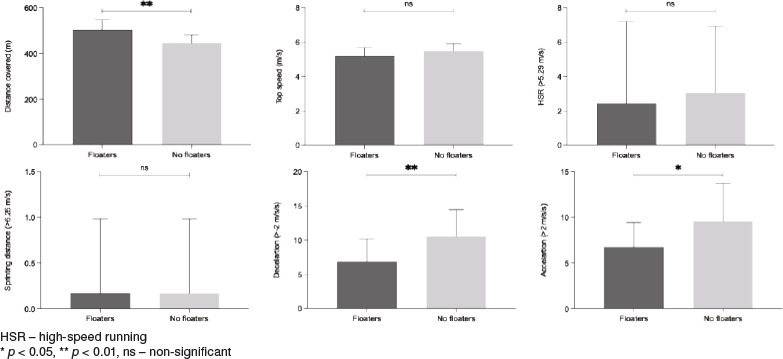
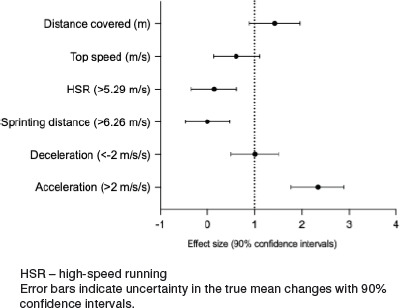
Figures 2 and 3 present the descriptive statistics and d of the physical metrics for the SSGs played with and without floaters. The results showed a significant difference in distance covered, with higher scores noted when floaters were present than when they were not (M = 502.38, SD = 44.12, t[23] = 5.14, d = 1.45, large effect, p < 0.001). However, players who played SSGs without floaters recorded significantly greater accelerations (M = 9.54, SD = 4.16, t[23] = –2.80, d = 0.80, large effect, p < 0.05) and decelerations (M = 10.50, SD = 3.94, t[23] = –4.17, d = 1.01, large effect, p < 0.001) than those who played SSGs with floaters. Furthermore, with a moderate d of 0.60, the players demonstrated a somewhat higher top speed in the SSGs played without floaters, although the difference was not significant (p > 0.05).
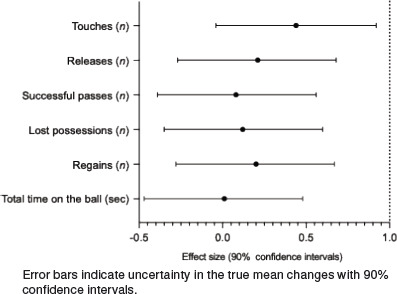
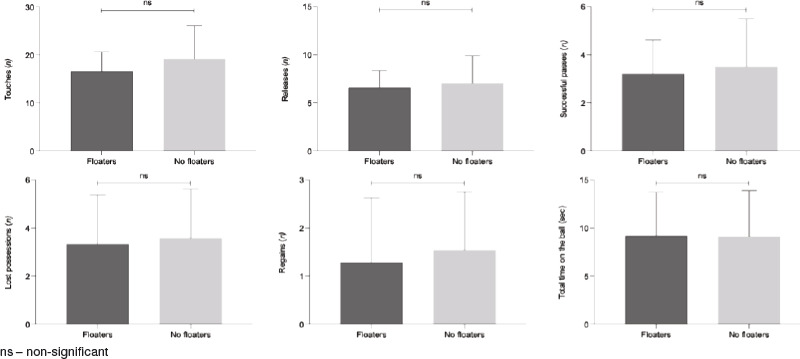
Figures 4 and 5 show the descriptive statistics and d of the technical variables for the SSGs played with and without floaters. No significant (p > 0.05) differences were found for any of the technical variables between the two SSG formats.
Discussion
This study investigated the technical and physical responses of female professional soccer players during 3v3 SSGs with and without floaters on the sidelines. The main findings were an increase in overall distance travelled in SSGs with floaters, and greater accelerations and decelerations in SSGs without floaters. The results also show that among professional female soccer players, the presence or absence of floaters during SSGs significantly alters their locomotor running activities, but not their technical demands. The present findings are consistent with previous research on youth male futsal players [5], which showed significant differences in internal and external physical load measures but no such variations in the technical factors examined.
An important finding was that the presence of floaters during SSGs was associated with greater overall distance covered. Contrary to the current data, earlier research by Sampaio et al. [27] demonstrated that when an extra player was permanently introduced, the teams with numerical advantage showed a reduction in the distance travelled. Furthermore, other studies [10, 28] showed that SSGs with numerical advantage in attack, that is, those that include floaters, resulted in a decline in total distance covered compared with SSGs with numerical equality. However, these studies did not take the position of the floater in the field into account. The floater’s placement on the goal line may have encouraged the attacking players to pass the ball to the floater in order to gain numerical advantage. As a result, the game may shift toward a more direct style of play, potentially leading to shorter ball possessions and more frequent passes to the floater; thereby allowing for greater distances covered per minute [5].
The current results also showed that the players in SSGs without floaters recorded noticeably higher acceleration and deceleration values than those in SSGs with floaters. This indicates that numerical equality in SSGs creates a highly competitive environment that may prompt more variable player movement, including a greater number of direction changes. In SSGs with equal numbers, every player typically has a direct opponent, which may result in numerous one-onone duels. Therefore, more feints and dribbles might be required, as well as changes of direction and adjustments in movement rhythm to allow possible increases in attacker-defender spatial-advantage on the field [5, 10, 29]. Furthermore, players in SSGs with numerical equality are likely required to run to find space or close it down, which could lead to continuous acceleration and deceleration.
The findings indicated that top speed was somewhat greater in SSGs played without floaters, with a moderate effect size. This may be attributed to the fact that when both teams have an equal number of players, there is no straightforward tactical mismatch to exploit other than utilising one’s physical prowess. This may demonstrate that players must rely on physical means to gain an edge in numerically equal situations, particularly while sprinting to get behind the defence, win loose balls and make quick presses or recovery runs. Consistent with a recent study [7], the results further showed that no significant differences were found in any of the technical metrics between SSGs with and without floaters. Given the lack of noteworthy outcomes and effect sizes, it appears that the floater’s placement on a sideline has less significance for technical measures than such a placement would have if there were no floaters.
Conclusions
The findings indicate that while the presence or absence of floaters during SSGs did not affect technical parameters, it significantly impacted the professional female soccer players’ physical demands. More specifically, the SSGs played with floaters allowed players to cover greater overall distances than the SSGs without floaters, while the latter required players to perform more accelerations and decelerations. The findings show that soccer coaches and scientists may want to include floaters during SSGs in order to modulate the physical demands of female soccer players.