Introduction
In modern football, transition phases are characterised by frequent high-intensity actions and represent some of the most physically demanding moments of the game [1, 2].
These phases are typically categorised as offensive (defence-to-attack) and defensive (attack-to-defence), each involving distinct tactical objectives and physical requirements [3].
In offensive transitions, players are required to perform high-intensity running actions to establish numerical superiority in the opponent’s half and create scoring opportunities. Conversely, defensive transitions involve rapid actions aimed at reorganising the defensive structure and limiting the opponent’s attacking opportunities [3].
Notably, counterattacks are recognised as one of the most important tactical situations during offensive transitions and among the most effective playing styles for scoring goals [4].
In light of this, small-sided games (SSGs) are widely used to simulate match scenarios by manipulating the tactical and physical demands on players [5, 6].
However, the limited space typically observed in SSGs may compromise sprint performance and reduce the likelihood of attaining the maximal running speeds required during transition actions [4].
Consequently, transition games (TG) may represent a valuable training strategy to adequately prepare players for the specific locomotor demands [7]. In support of this consideration, prior research has indicated that the TG may induce greater high-intensity running and mechanical demands than those detected during a 90-min match in youth players [8].
Given the widespread use of TG in football context, understanding how different numerical configurations, performed under constant pitch dimensions, influence external-load metrics remains crucial. Previous studies have investigated the effects of several task constraints, including playing format, pitch size, and bout duration, on physical responses [4, 7, 9]. However, to the best of our knowledge, sequential TG formats have received limited scientific attention despite being frequently employed in football training. This aspect may be particularly relevant since match play is inherently dynamic and characterised by successive transitions between different numerical configurations. Additionally, TG formats have not been examined in professional football players. Indeed, existing studies have predominantly focused on youth populations, and their findings cannot be directly extrapolated to the professional level due to substantial differences in performance characteristics [10].
Beyond population-specific characteristics, previous studies have predominantly quantified the mechanical load using fixed thresholds [4]. However, according to some authors, this approach may not adequately account for players’ individual mechanical capacities, potentially leading to an overestimation or underestimation of neuromuscular actions across players [11]. To address this limitation, a mechanical power-based approach incorporating the acceleration-speed profile in-situ (ASP) has been proposed [11]. In simple terms, ASP allows defining the interplay between running speed (from 0 to top speed) and the corresponding achievable acceleration for each individual [11, 12]. Based on this approach, Osgnach et al. [11] introduced bursts and brakes, which represent high-intensity acceleration and deceleration actions performed above an individualised threshold derived from the ASP. Interestingly, an earlier study has reported a significant correlation between bursts and the number of assists, suggesting that this variable may also influence technical-tactical performance and match-related outcomes [13].
Therefore, these individualised metrics may allow a more accurate assessment of TG in relation to players’ individual mechanical capacities. These aspects should be taken into account, as fixture congestion in modern football increasingly requires practitioners to adopt more individualised approaches to training load management. Finally, substantial inter-individual variability has been reported in the external load during football-specific tasks [14, 15]. This highlights the complexity of effectively interpreting physical output during training activities.
Therefore, the aim of the present study was to (i) compare external load metrics across two different TG formats; (ii) analyse the variability pattern elicited by different formats; and (iii) investigate the relationships between bursts and maximal theoretical acceleration (A0), as well as between peak velocity and maximal theoretical speed (S0), across both playing formats. We hypothesised that TG3vs2 may generate greater submaximal intensity exposure, whereas TG2vs1–3vs2 could be more specific for sprint performance and for reaching maximal running speeds. Furthermore, the latter playing format may be more appropriate for highlighting the acceleration qualities of professional football players.
Material and methods
Participants
Prior to the recruitment process, the G*Power analysis (Düsseldorf, Germany) was conducted to determine the required sample size. Assuming an effect size (d = 0.6), an alpha level of 0.05, and a statistical power of 0.80 for a paired-samples t-test, the analysis indicated that a minimum of 19 participants were required.
Given the absence of directly comparable studies in professional football players on TG tasks, a moderate effect size was assumed for the a priori power analysis, in accordance with Cohen’s conventional thresholds. Twenty professional football players (age: 24.3 ± 2.7 years; height: 181.8 ± 3.6 cm; weight: 81.9 ± 3.4 kg; professional playing experience: 4.6 ± 3.15 years) competing in the Italian third division participated in this study. The study included players from all playing positions to reflect real-world training contexts and to prevent bias. The inclusion criteria were as follows: (i) the absence of musculoskeletal injuries during the experimental sessions; (ii) an outfield playing position; and (iii) no alcohol consumption within 72 h preceding each experimental session. The players participated in six weekly training sessions (90–120 min duration) and one competitive match per week (Sunday). Although the data were collected as part of the team’s routine monitoring process, all players were informed of the aims, requirements, benefits, and potential risks of the study, and provided written and informed consent prior to participation.
Experimental design
A cross-sectional pilot study was adopted to evaluate the influence of different playing formats on physical responses in professional football players. Data were collected during the 2024–2025 competitive season (October), with each playing format performed on Match Day–4 (MD–4) according to the team’s weekly training schedule. Specifically, all players completed both formats, with TG3vs2 performed during the first week and TG2vs1–3vs2 in the following week. The methodological approach adopted by technical staff remained consistent throughout the experimental period, ensuring comparable training objectives over the course of the two weeks. In addition, fatigue, wellness status, and weekly training load were monitored to ensure similar training conditions during the experimental period. Both playing formats were conducted on a pitch measuring 50 × 40 m. The relative area during TG3vs2 was 286 m2 ∙ player–1, whereas TG2vs1–3vs2 was characterised by an initial relative area of 400 m2 ∙ player–1, which decreased to 286 m2 ∙ player–1 during the final phase of the task. The relative area was calculated as the total pitch area (in m2) divided by the number of players on the pitch (goalkeepers included) [16]. The protocol consisted of 2 × 9 min, separated by 2 min of passive recovery. The TG conditions were selected by two professional football coaches, as these situations frequently occurred during official matches involving the team included in the present study. In TG3vs2, three offensive players attempted to score against two defenders. Upon the conclusion of the action, regardless of whether a goal was scored or possession was lost, the defending players became the offensive team by adding one teammate and initiating the subsequent attack, whereas the previous offensive team assumed the defensive role to simulate this transition. In TG2vs1–3vs2, the exercise initially involved a 2 vs1 situation in which two attackers attempted to score against a single defender. Subsequently, the defending team became offensive with the addition of two teammates, thereby evolving the exercise into a 3 vs2 scenario. Figure 1 shows a graphical representation of the playing formats.
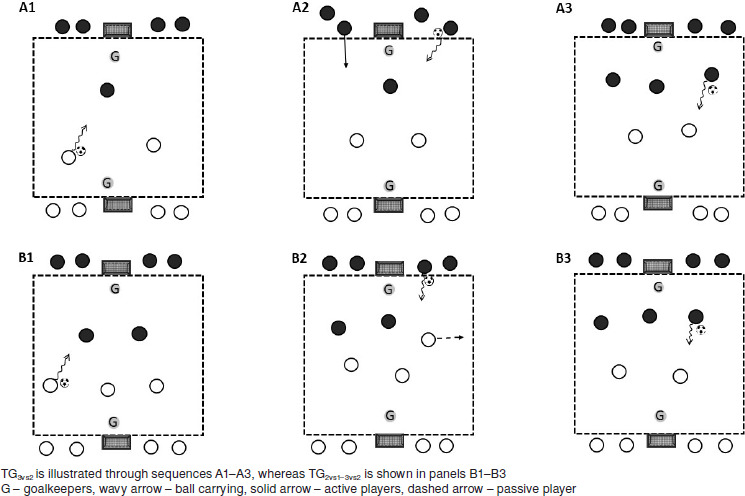
Two teams of 10 players were used for both experimental procedures. Each bout consisted of repeated actions lasting up to 20 s (time exposure per repetition: 10.3 ± 1.4 s), as previous authors have reported that professional teams commonly perform very high-tempo attacks (e.g., 20 s) [3]. All professional football players performed the same number of repetitions to ensure a comparable workload and avoid bias in the analysis of the results.
The players were grouped based on their technical and tactical levels, professional experience, and subjective evaluation by the coaching staff. For each repetition, defenders, midfielders, and strikers were included to ensure the representation of all outfield playing positions, as well as a balanced distribution of starters and non-starters throughout the experimental procedures. Players maintained their usual playing roles according to the coach’s tactical organisation during all training sessions.
During these playing formats, professional football players were verbally encouraged by coaches to maintain a high work rate. All players were familiar with the TG tasks, as they were regularly implemented in the weekly microcycle. Both playing formats were conducted on artificial turf under similar environmental conditions (17°C) at the same time of day (10:30–11:00). Each experimental session was preceded by a stan-dardised 20-min warm-up consisting of jogging, mobility exercises, dynamic stretching, flying sprints over 40 m, and passing drills.
Time-motion physical responses
External load data were collected using 18.18 Hz GPS units (GPEXE® SYSTEM, EXELIO srl, Udine, Italy), which were previously validated for team sport analysis [17]. GPS units were activated 15 min before the start of the training session to ensure optimal satellite signal acquisition. Distance covered (DC) [4], peak velocity (Vpeak) [18], percentage of peak velocity relative to players’ maximal speed (%Vpeak) [19], DC between 19.8 and 25.2 km ∙ h–1 (high-speed running, HSR) [20], DC above 25.2 km ∙ h–1 (sprint running, SR) [20], and number of sprints (NS) [15] were recorded. In addition, bursts and brakes were used to quantify the number of intense accelerations and decelerations based on individualised mechanical thresholds, respectively [11].
Acceleration-speed profile
GPS devices were also used to collect locomotor data during the same competitive mesocycle in which the TG conditions were performed. The players consistently wore the same GPS unit across all data collection sessions to ensure consistency and accuracy of the data. ASP parameters were automatically derived using an algorithm implemented in the GPExe software (Exelio, Italy), according to the procedure previously described by Morin et al. [21]. The ASP parameters were calculated from instantaneous acceleration and velocity data collected across several training sessions (n = 23) and matches (n = 5). Sessions involving players undergoing a return-to-play process or performing individualised training due to fatigue, injury-related restrictions, or modified workloads were excluded from the analysis. The speed and acceleration data were used to derive a linear regression, in which the x-axis represents S0 and the y-axis corresponds to A0. Previous research has demonstrated the validity and reliability of the ASP approach in professional football players and suggested a relationship between bursts and A0, as well as between Vpeak and S0 [21, 22]. Table 1 presents the descriptive statistics of the team’s ASP-derived parameters.
Statistical analysis
Data are presented as mean ± standard deviation (SD) for descriptive statistics. Data normality was assessed using the Shapiro–Wilk test. A paired-samples t-test was used to examine the differences in external load variables between playing formats. Effect sizes (ES) with 95% confidence intervals (95% CI) were calculated using Cohen’s d and interpreted as follows [23]: trivial: 0.00–0.19, small: 0.20–0.59, moderate: 0.60–1.19, large: 1.20–1.99, and very large: 2.00. The coefficient of variation (%CV) was calculated to examine the variability of the physical responses using the following equation: (SD/mean) × 100. Pearson’s product-moment correlation coefficients with 95% CI were calculated to assess the relationships between Vpeak and bursts with ASP parameters (S0 and A0, respectively). The magnitude of the correlations was interpreted as follows [24]: trivial (r < 0.1), small (0.1 < r < 0.3), moderate (0.3 < r < 0.5), large (0.5 < r < 0.7), very large (0.7 < r < 0.9), nearly perfect (r > 0.9), and perfect (r = 1). All statistical analyses were carried out using JASP software (version 0.19.2, Amsterdam, Netherlands), with statistical significance set at p < 0.05.
Results
Table 2 presents mean ± SD values of the external load variables recorded during the TG tasks.
Table 2
Comparison of the effect of different playing formats on external load
The results revealed that TG3vs2 significantly elicited greater values of DC, HSR, and burst compared with TG2vs1–3vs2 (p < 0.001 for all comparisons). Conversely, TG2vs1–3vs2 resulted in significantly greater values of Vpeak, %Vpeak, NS, and SR compared with TG3vs2 (p < 0.001 for all comparisons). Figure 2 illustrates the external load metrics elicited by both playing formats.
Table 3 displays the variability levels, expressed as %CV, for the proposed tasks.
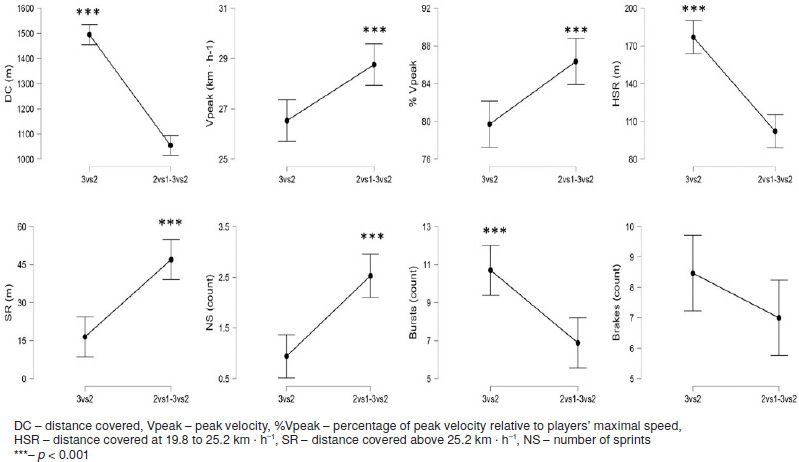
Table 3
Coefficient of variation computed in the TG tasks
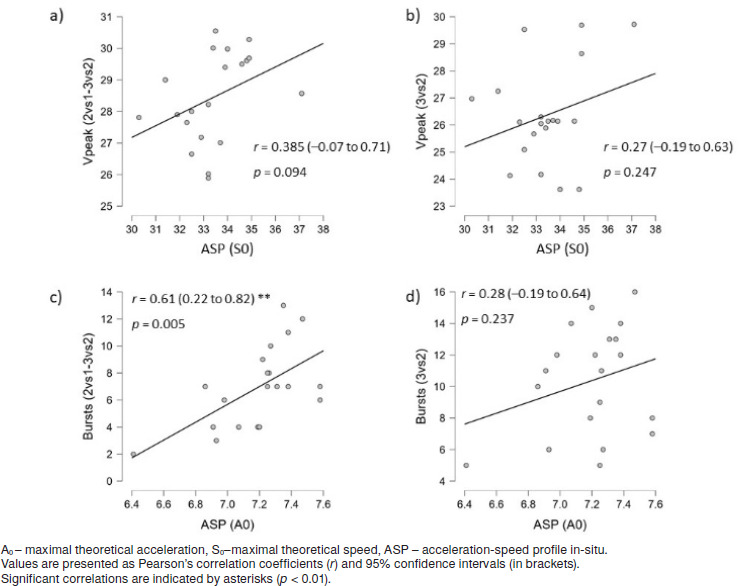
Figure 3 illustrates the correlation coefficients computed in two different playing formats between bursts and Vpeak with A0 and S0, respectively. Among the analysed associations, only the correlation between bursts and A0 during TG2vs1–3vs2 reached statistical significance (Figure 3c; r = 0.61, 95% CI: 0.222 to 0.826; p < 0.01).
Discussion
This study examined the effects of the TG formats on external load parameters in professional football players. To the best of our knowledge, this is the first study to investigate the physical demands elicited by TG in professional football players. The major findings confirmed our hypothesis, highlighting that TG3vs2 significantly elicited greater values of DC, HSR, and bursts than TG2vs1–3vs2. Conversely, TG2vs1–3vs2 resulted in significantly higher values of Vpeak, %Vpeak, NS, and SR.
The differences observed in the relative area between the two playing formats may represent one potential explanation for these findings. More precisely, TG3vs2 was performed in a smaller relative area due to the higher number of players, which may have contributed to greater submaximal running exposure and a higher number of high-intensity accelerations. Conversely, TG2vs1–3vs2 was characterised by a larger available space, which may have provided greater opportunities for reaching higher running speeds during the initial phase of the task (~400 m2 ∙ player–1).
These considerations highlight the key role of pitch size in shaping locomotor demands during football training [25]. To further support these findings, previous authors have suggested that minimal relative areas of 200 m2 ∙ player–1, 325 m2 ∙ player–1, and > 365 m2 ∙ player–1 are appropriate for replicating high-speed, very high-speed, and sprint running demands observed during competitive matches, respectively [26].
Nevertheless, despite the aforementioned considerations, contrasting findings have emerged when examining different TG formats. More specifically, Asian-Clemente et al. [4] reported that 3vs2 imposed higher physical demands than 2vs1 and 1vs1. This indicates that increasing the relative area does not automatically lead to higher load requirements. These discrepancies may be attributed to variations in the population, as the aforementioned study included elite youth players from a Spanish academy. In this regard, players’ experience and competitive level may influence the physical responses observed during the proposed tasks [27, 28].
Additionally, the differences observed between the formats may also be attributed to the specific tactical behaviours elicited by each task. Notably, TG2vs1–3vs2 may encourage offensive players to carry the ball over longer distances to exploit greater spatial availability. This behaviour may account for the greater exposure to sprint running and the increased likelihood of reaching higher running velocities. On the other hand, TG3vs2 may require more frequent passing and technical actions, as offensive players must coordinate their movements to overcome a more balanced defensive structure. Additionally, defenders are more likely to maintain positional organisation and apply controlled pressure, potentially resulting in a higher frequency of accelerations.
To further support this interpretation, prior research has demonstrated increased high-speed and sprint demands during TGs than in the large-sided games, which are traditionally the most commonly used sided-game to stimulate high-intensity performance [29]. Collectively, these findings emphasise that, beyond spatial constraints, the tactical characteristics associated with each task should also be carefully considered when monitoring training exercises.
Brakes represent the ability to perform high-intensity decelerations and are considered crucial motor skills in multidirectional sports [30]. No significant difference was found for brakes between the playing formats, although slightly higher values were observed during TG3vs2. This finding may suggest that both TG formats imposed comparable deceleration demands in professional football players. The existing literature reports contrasting findings regarding deceleration actions during TG tasks. Specifically, it was observed that 2vs1 and 3vs2 imposed more substantial braking actions than 1vs1 in elite youth football players. However, in another study, the same authors observed similar deceleration effort across different pitch configurations [7], a finding that appears to be in line with the present results. Therefore, the influence of TG on braking actions remains inconclusive and warrants further investigation.
When analysing external load metrics, the variability patterns should also be considered due to the heterogeneous stimuli typically observed in SSGs [14, 15]. In the present study, both playing formats induced low variability for DC (6.47–7.08%), Vpeak (4.48– 6.65%), and %Vpeak (4.57–7.35%); moderate variability for HSR (16.91–22.56%); and very large variability for SR (42–92.90%), NS (42.06–87.23%), bursts (33.04– 43.35%), and brakes (35.28–36.15%). The significant variability observed in the high-intensity parameters may be explained by the dynamic and unpredictable nature of these tasks, which require ongoing decision-making and adaptation to evolving game situations [14, 15]. Moreover, these variability levels may be attributed to the tactical roles of attacking and defending players, which impose distinct physical demands on them. Therefore, practitioners should consider inter-individual responses and %CV when evaluating training exercises rather than relying exclusively on average values.
These results align with earlier studies on SSGs and TG, which have shown greater variability when higher speed thresholds are reached [4, 14, 15]. Consequently, practitioners should be aware that TG formats may not provide a uniform sprint-related stimulus across players. Therefore, if more consistent exposure to sprint running is required, analytical tasks may be incorporated to facilitate a more homogeneous distribution of workloads among players.
Interestingly, HSR values obtained in the present study were lower than those reported during SSGs (45–146%) and TG (22–29%) [4, 14]. However, it is worth noting that the latter study adopted slightly different speed thresholds, which may partially explain these discrepancies.
The Pearson’s product-moment test revealed a significant relationship between bursts and A0 during
TG2vs1–3vs2, whereas no significant association was observed for TG3vs2. To the best of our knowledge, this is the first study to investigate the relationship between the external load imposed by TG formats and players’ ASP parameters.
Considering that A0 reflects individual accelerative capacity and is closely related to horizontal force production during sprint acceleration [21, 31], players with greater A0 may be predisposed to perform a greater number of explosive movements. Therefore, A0 could represent a potential parameter associated with bursts production during TG2vs1–3vs2. Future studies should further investigate this relationship across repeated TG sessions to establish its consistency.
Conversely, no significant relationship was found between S0 and Vpeak in either playing format. The absence of a significant relationship between S0 and Vpeak may indicate that the proposed TG formats did not consistently allow players to reach their maximal running speed.
However, TG3vs2 and TG2vs1–3vs2 induced mean %Vpeak values of 79.7% and 86.4% in professional football players, respectively. A possible explanation may be the verbal encouragement provided by the coaching staff throughout both TG formats, which may have facilitated the attainment of higher running speeds and contributed to the observed external load responses. These findings may offer additional insights into TG prescription using these formats.
Practical implications
From a practical perspective, the selection of TG formats should align with the specific physical and mechanical qualities targeted during the training session. Based on the present findings, practitioners may consider incorporating TG3vs2 when the aim is to increase neuromuscular load (e.g., MD–4), whereas TG2vs1–3vs2 may represent a practical option for sessions targeting sprint running exposure (e.g., MD–2 or MD–3). Moreover, the association between bursts and A0 in TG2vs1–3vs2 may indicate a potential relationship between individual acceleration capabilities and the execution of explosive actions imposed by this format. Collectively, practitioners may consider incorporating both absolute and ASP-related metrics when assessing TG tasks, as this approach may provide additional insight into inter-individual differences among professional football players.
Limitations and future directions
Several limitations should be acknowledged in the present study. Firstly, the relatively small sample size (n = 20) may have limited the statistical power of the analyses and the robustness of the findings.
Moreover, the very large ES observed in some comparisons should be interpreted with caution, as the limited sample size may have influenced these values. Therefore, future studies should include a larger number of participants to strengthen the evidence.
Additionally, considering that all participants were recruited from a single professional team, the results may not be directly transferable to other training environments or player populations, and remain specific to the context of the constraints and tasks adopted in this study.
Secondly, the non-randomised design and the playing formats conducted in consecutive weeks may have introduced potential confounding factors. Although training load and exercises were carefully monitored and remained comparable during the two experimental weeks, the influence of uncontrolled contextual variables cannot be entirely excluded.
Additionally, internal load and technical-tactical outcomes were not assessed. Therefore, future studies should incorporate physiological measures (e.g., heart rate and ratings of perceived exertion) alongside technical-tactical indicators to provide a more comprehensive evaluation of TG demands.
Furthermore, other playing formats (e.g., 4vs3, 5vs4) should be examined to better understand their impact on external load and further expand the existing body of research.
Finally, the inclusion of metabolic power may provide additional insight into TG demands, as these metrics have been proposed as a valid tool for quantifying energy expenditure in professional football players [32].
Conclusions
The present study compared the physical demands elicited by two different TG formats and investigated their relationships with players’ ASP parameters.
The findings suggest that TG3vs2 may elicit greater submaximal running activity and mechanical load, whereas TG2vs1–3vs2 could impose greater sprint demands and higher running speeds in this sample of professional players. Moreover, the latter playing format may provide additional insights into the relationship between players’ individual acceleration capabilities, as reflected by their ASP, and the execution of explosive actions. Overall, these findings offer preliminary information for the design and implementation of the proposed TG formats within professional football.